Best Rubber Pet Hair Brooms for Hard Floors
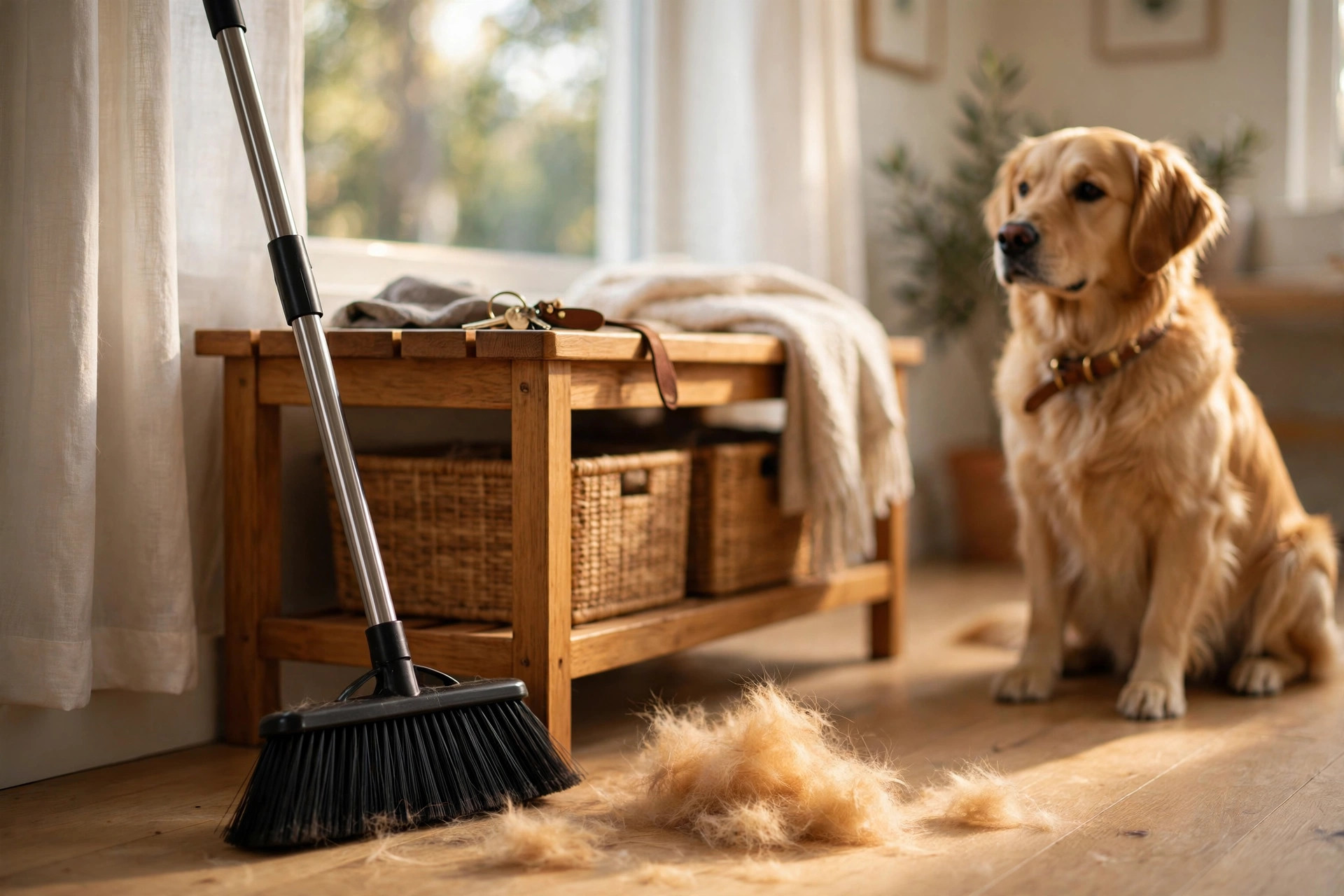
Every pet apartment has a moment like this: late-afternoon sun hits the hardwood and suddenly you see it — the drifts. Rolls of fur sliding along the baseboards, ten minutes after you finished vacuuming. Grab the regular broom and it gets worse: bristles flick hair into the air, push dust lines into corners, and static-charge the floor so the strands come back. A rubber broom is the tool built exactly for this job — and it costs less than a pizza.
- Rubber brooms use static attraction plus a squeegee pull, so hair clumps instead of scattering — the opposite of what bristles do on hard floors.
- Good ones cost $20–$50. Above $50 you are paying for branding, not better rubber.
- Look for a telescoping handle (roughly 36–60") and a head width that fits your layout: 12–14" for furniture-dense rooms, 16–18" for open plans.
- Most double as a wet squeegee for muddy paw puddles on tile and a carpet rake for low-pile rugs — three tools in one hook.
- Sweep in slow pulls toward you, 90 seconds, three times a week. That rhythm beats a weekend deep-clean.
Why rubber beats bristles on hard floors
A regular broom fails for a simple reason: bristles are stiff and round, so they flick hair rather than gather it. Light strokes send fine hair skidding across the laminate, and the friction generates static in the floor itself — pinning a film of hair and dust right where you “cleaned.”
A rubber broom flips the physics. As the rubber head drags across the floor it picks up its own static charge, pulling hair and lint toward the head instead of away from it. The flat squeegee blade then drags the clump along like a windshield wiper — hair rolls into a growing snake you can steer into a pile. And there are no bristles for hair to wrap around: rinse the head under the tap and it is clean.
There are two bonus jobs. Flip the head and the straight rubber edge works as a squeegee on wet mess — muddy paw prints on tile, the splash ring around a water bowl, a wet dog’s hallway trail. Run it over a low-pile rug and the toothed edge rakes embedded hair out of fibers like a comb. In 600 square feet, that is three tools collapsed into one hook on the back of a door.
Five rubber brooms that actually earn their hooks
Every model below is a real, currently sold rubber broom with a track record in pet homes. Prices move with marketplace sales, so treat the ranges as typical street prices rather than promises.
| Model | Best for | Typical price | Small-apartment note |
|---|---|---|---|
| FURemover Broom (Neater Pet Brands) | All-around pet-home pick | Usually $35–$50 | Telescoping 36–60" handle; hangs flat on a door hook. |
| Eyliden Rubber Broom (2-pack) | Tight budgets / two rooms | Usually $25–$35 | Two brooms means one at each end of the apartment. |
| Xifando Rubber Broom | Squeegee-first cleaning | Usually $25–$40 | Longer squeegee edge for wet paw prints and spills. |
| LANDOT Rubber Broom | Tall owners, deep reaches | Usually $25–$40 | Adjustable pole; slides far under sofas and beds. |
| Kelamayi Rubber Broom | Cheapest decent pick | Usually $20–$35 | Slim 50" handle; plenty for a single-pet studio. |
FURemover Broom — the original, and still the reference point
Neater Pet Brands’ FURemover Broom is the product that made “rubber broom” a pet-home category. The 18-inch head carries a rubber squeegee on one side and rake teeth for rugs on the other, with a handle telescoping from about 36 to 60 inches. On hardwood it pulls hair into long ribbons with very little pressure. Trade-offs: the highest price here, and a head that can feel wide weaving between chair legs in a cramped dining corner. For open-plan living rooms and hallways, it is the fastest of the five.
Eyliden Rubber Broom (2-pack) — the two-for-one that solves a real problem
Eyliden sells their rubber broom in a two-pack for roughly the price of one FURemover. In a small apartment, the friction is never the sweeping — it is fetching the broom. Park one in the entryway closet and one in the bedroom, and the 90-second routine below actually happens. Each head is narrower (about 12–13 inches) — genuinely better for tight spaces — with a handle extending to around 55 inches. Build quality is a step below the FURemover, but at this price a replacement is painless.
Xifando Rubber Broom — for homes where wet mess leads
If your dog tracks slush through the entryway or your cat’s water bowl is a splash zone, prioritize the squeegee edge — and the Xifando’s straight rubber edge is the longest of the bunch. It pulls thin water films and the hair stuck in them in one pass. The telescoping handle runs about 36 to 60 inches with a 14–15-inch head. It is a slightly worse carpet rake than the FURemover, so if your floors are half rug, lean the other way.
LANDOT Rubber Broom — the reach pick
LANDOT’s advantage is a sturdy four-section adjustable pole that locks without wobbling — fully extended it reaches well under beds and sofas. The 14-inch head uses a slightly softer rubber that grips fine dust well on LVP but wears faster on rough tile. For renters who cannot move heavy furniture, the extra reach is the feature that keeps getting used.
Kelamayi Rubber Broom — the honest budget pick
Kelamayi is the cheapest rubber broom here that still performs like one. The fixed 50-inch handle suits most people, the 13-inch head handles studios and one-bedrooms, and it includes a squeegee edge plus a dustpan clip. It is not as stiff or precisely molded as the FURemover — textured tile may need a second pass — but for the price of two takeout coffees it turns a daily hair problem into a two-minute habit. The best upgrade per dollar on this list.
What to skip
Dollar-store and ultra-cheap marketplace rubber brooms disappoint: flexible heads skip over hair, and two-piece handles bend at the joint within weeks. A $12 broom replaced twice a year costs more than a $40 one that lasts three. Also skip brooms marketed as “carpet only” for hard floors — dedicated carpet rakes have stiff teeth and no useful squeegee edge.
The three specs that actually matter
Only three measurements change your daily experience:
- Head width. 12–14 inches threads between furniture legs and down hallways; 16–18 inches clears open rooms twice as fast. If your living room is mostly open floor, go wide; if it is an obstacle course of dog crate, coffee table, and plant stands, go narrow.
- Handle length. Telescoping (roughly 36–60") wins in apartments because it collapses short enough to hang inside a hall closet or on a hook on the back of a door. Fixed long handles lean in corners and fall over whenever the cat sneezes nearby.
- Edge design. A straight squeegee edge handles wet mess and hard floors; toothed rake teeth handle rugs. Almost every decent model includes both — if one is missing, only buy it for the surface you mostly clean.
Things that do not matter: the rubber’s color, brand marketing language, and “anti-static technology” claims beyond the basic fact that rubber generates static by nature. Bonus: a rubber broom is nearly silent, so unlike your vacuum, you can sweep at 7 a.m. or 11 p.m. without worrying about the neighbors.
The 90-second sweep routine
Frequency beats intensity. Three quick sweeps a week keep hair from embedding into rug edges and baseboard corners. Here is the whole routine:
- Entryway and around the pet’s bed (30 seconds). This is where 80% of loose hair lives. Pull slowly toward yourself in long strokes — fast strokes flick hair loose again.
- Kitchen and feeding zone (30 seconds). Sweep under and around the bowls, where kibble dust and water-splash hair collect. Flip the head and squeegee the splash ring if there is one.
- Pull it all to one pile (30 seconds). Herd everything to the living room center, then gather the pile with a dustpan — or a damp paper towel for the wisps the pan misses.
That is it. Run this Monday, Wednesday, and Friday and a one-pet apartment stays ahead of the hair. The broom handles floors while a lint roller handles fabric — or slot the routine into the 10-minute cleaning caddy circuit for weeks when everything needs doing at once.
Care and lifespan
Maintenance is almost nothing. Rinse the head under warm water with a drop of dish soap monthly — dust and dander coat the rubber and weaken the static effect. Hang it by the handle; do not store it head-down on concrete, which deforms the edge. Keep it out of direct sunlight, since UV stiffens rubber. When the squeegee edge frays or curls — typically after 12 to 24 months — the broom is done: a ragged edge skips over hair. At $20–$50 every year or two, it is one of the cheapest recurring costs in pet ownership.
FAQ
Is a rubber broom safe for hardwood floors?
Yes — the rubber head is softer than standard broom bristles and most vacuum wheels. Use light pressure and slow strokes. One caution: gritty sand can scratch any finish, so sweep gritty entryways before pressing down.
Will a rubber broom replace my vacuum?
No — it replaces the between-vacuum cleanup: daily hair on hard floors, entryway passes, wet paw prints. Vacuums still win on rugs, upholstery, and anything embedded. The broom stretches your vacuum sessions from every day to twice a week.
Why does hair cling to the broom itself?
That is the static doing its job — dragging rubber across the floor charges it, pulling hair toward the head. Tap or rinse the head after each session. If hair stops clinging, wash the head: a dust-coated surface kills the static effect.
How is this different from just using a lint roller on the floor?
Reach and cost. A lint roller works on a three-foot square of floor before the sheet is spent; a rubber broom covers a room in a minute and never runs out of sheets. Keep the lint roller for fabric and furniture — let the broom do floors.