Best Cordless Handheld Vacuums for Pet Mess Spots
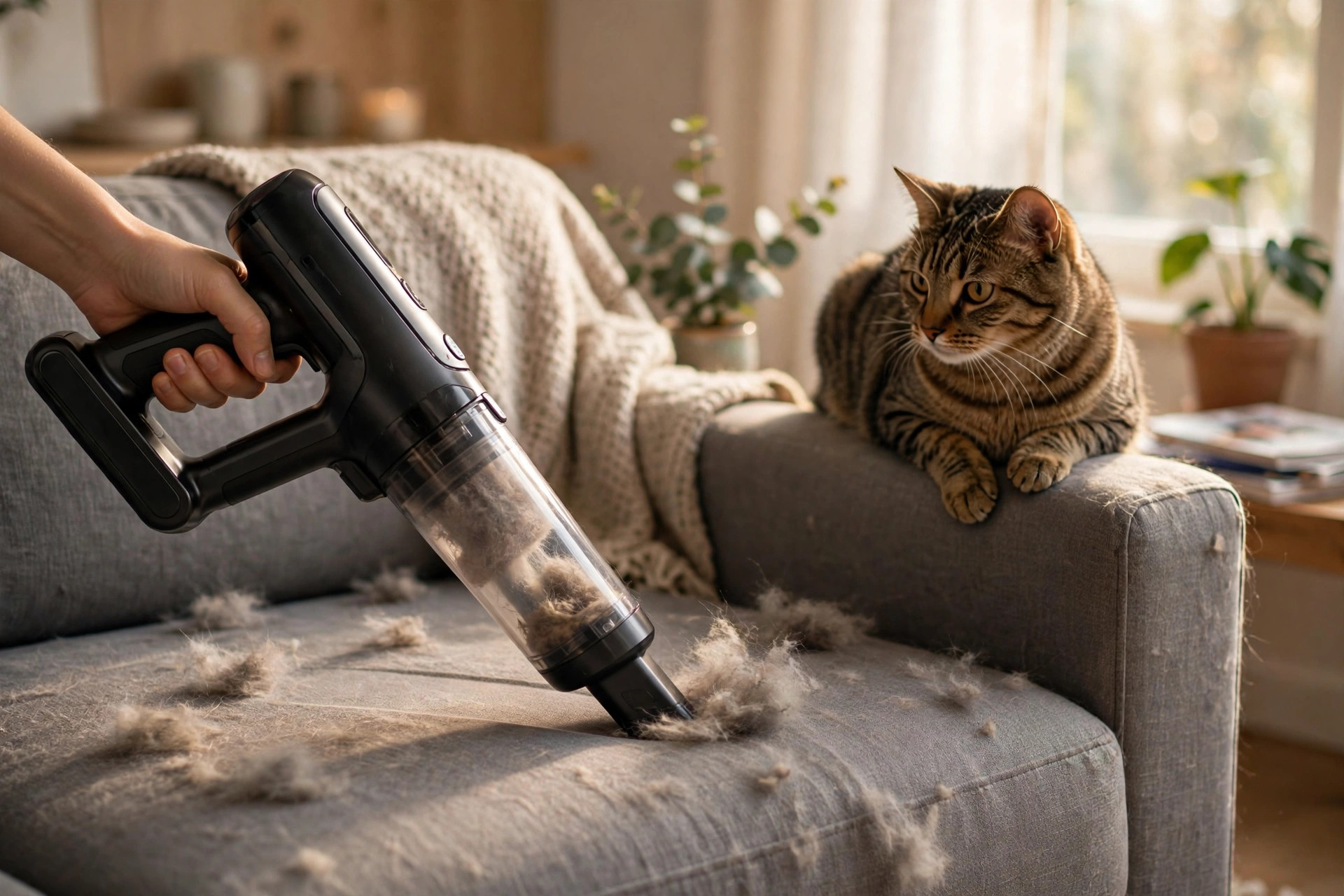
A full-size vacuum lives in the closet. Pet mess lives everywhere else: the windowsill where the cat flings litter, the stair landing the dog sheds on, the sofa crease where kibble hides. A cordless handheld turns “I’ll vacuum this weekend” into “done in sixty seconds.”
- Spot mess happens daily; full-size vacuum sessions happen weekly. A handheld bridges that gap.
- For pet mess, look for: at least 10 minutes of real runtime, a crevice tool plus an upholstery brush (or a motorized pet brush), and a bin you can empty one-handed.
- Budget roughly $70–$300. The sweet spot for most apartments sits around $100–$180.
- A handheld complements your main vacuum; it does not replace it.
- Park it on a countertop dock where you will see it — visibility is what turns it into a habit.
Why apartments need a spot-cleaner
The messes pets make in small homes are almost never floor-wide. They are localized, daily, and slightly embarrassing when guests drop by. A few examples from a typical week:
- Litter spray and scatter. Even with a good litter mat, fine litter lands on the windowsill, the bathmat, and the first two feet of hallway. A handheld with a bare-suction nozzle takes care of it in one pass.
- Kibble and treat crumbs. Dogs carry food across the room. Cats bat kibble off the counter like it owes them money. Crumbs under the table collect until they crunch.
- Sofa, bed, and car-seat touch-ups. Dander concentrates here. One pass over the dog’s cushion each week is the difference between “pet home” and “pet smell.”
- Stairs, ledges, and the entryway. Full-size vacuums hate stairs; a 2–3 lb handheld goes up and down them without complaint.
- Quick fixes before visitors. You do not need a 20-minute production when someone texts “I’m downstairs.” You need the couch and the rug to look sane in ninety seconds.
Visibility is the whole game: park it where you will grab it without thinking, not where vacuums “belong.”
What actually matters in a handheld for pet mess
Handhelds look similar on a shelf, but four or five details decide whether one handles pet mess or just relocates it:
- Brush type beats suction numbers. For hair, a motorized mini brush or self-cleaning brushroll outperforms bare suction. For litter and crumbs, bare suction with a crevice tool is plenty. Pet-focused models include the brush; generic ones usually do not.
- Usable runtime: 10–15 minutes is the bar. Headline figures are measured on the lowest mode; pet mess usually needs a higher mode, so mentally halve the advertised number. Anything under 10 minutes of real use means recharging mid-session.
- Dustbin: 0.4–0.7 L with one-hand emptying. Pet hair packs down and fills small bins fast. A bottom-release bin you can dump over the trash without touching the contents is worth more than an extra 100 mL of capacity.
- Attachments included, not sold separately. A crevice tool and a soft upholstery brush should be in the box. Motorized pet brushes sometimes ship as add-ons — price the package, not the base unit.
- Noise. Most handhelds run 65–78 dB. You will use this at 9 p.m. and on weekend mornings, so if you share walls, lean toward the quieter end of the range.
- Charging and battery. Expect 3–4 hours for a full charge. Removable batteries (common on the 12–20V tool-brand models) effectively double the machine’s life: when the battery fades in 2–3 years, you replace a $25–$40 battery instead of the whole vacuum.
Keep it in your cleaning caddy or on a hallway counter — the closet is where handhelds go to be forgotten.
Five handhelds that earn their drawer space
Real, widely available models with track records in pet homes. Prices are typical street ranges.
| Model | Best for | Typical price | Small-apartment note |
|---|---|---|---|
| Shark UltraCyclone Pet Pro+ | All-around pick | Usually $100–$130 | XL bin for a handheld; dual cyclones keep suction steady as it fills. |
| BLACK+DECKER dustbuster AdvancedClean+ Pet | Flexibility | Usually $70–$100 | Pivoting nose reaches awkward spots; pet power-brush head in the box. |
| Dyson Humdinger | Emptying + hygiene | Usually $200–$300 | Point-and-shoot bin keeps your hands off the hair; longest runtime here. |
| Bissell Pet Hair Eraser (cordless) | Heavy shedding | Usually $70–$100 | Rubber nozzle grabs hair off upholstery; straightforward and durable. |
| Eufy HomeVac H30 Mate | Light and quiet | Usually $90–$130 | Under 2 lbs and one of the quietest; best for nightly quick passes. |
Shark UltraCyclone Pet Pro+ — the all-around pick
The UltraCyclone Pet Pro+ is the handheld most pet owners default to, and it earns it. The oversized dust cup is noticeably bigger than competitors’ — you can finish a whole sofa and the stairs before emptying. The two-stage cyclonic airflow keeps suction from collapsing as the bin fills, which is where cheap handhelds die. It includes a pet power brush plus a crevice tool, and the brushroll has a self-cleaning feature that cuts down on hair wrapping. Runtime is the honest weak point: roughly 10 minutes on higher suction, so plan one zone per charge.
BLACK+DECKER dustbuster AdvancedClean+ Pet — the flexible pick
The dustbuster’s signature trick is the pivoting nose — the nozzle angle adjusts so you can get into couch corners and under low furniture without tilting the whole unit. The Pet version bundles a power brush with rubber bristles that pull hair off upholstery without scratching it, plus a flip-up brush and a crevice tool. Parts and replacement filters are easy to find, and the charging base sits neatly on a counter — a sensible first handheld.
Dyson Humdinger — the premium pick
The Humdinger is Dyson’s dedicated handheld — lighter and simpler than converting a stick vacuum. The hygienic point-and-shoot bin means you never touch a hairball. Runtime is class-leading — around 15–30 minutes depending on mode and attachment — so you can do the sofa, the stairs, and the car in one go. Roughly double the mid-range price for that runtime and the emptying mechanism: worth it for daily use, overkill for occasional crumb-cleaning.
Bissell Pet Hair Eraser (cordless handheld) — the heavy-shedder pick
Bissell’s handheld Pet Hair Eraser leans into its one job: the rubber nozzle creates static that pulls embedded hair off stairs and upholstery, and it handles litter and kibble without complaint. Simple machine — no app, no display, just a trigger and a large bin — but bulkier than the Eufy and louder on high. If your dog leaves tumbleweeds of fur and you want a handheld that punches above its weight class for under $100, this is it.
Eufy HomeVac H30 Mate — the light-and-quiet pick
At well under 2 lbs, the H30 Mate is the one you reach for at 10 p.m. when the cat has redistributed litter across the bedroom. It’s noticeably quieter than the Shark or Bissell, which matters in shared-wall living. The compact size means a smaller bin, so this is a one- or two-zone-per-session machine — fine for nightly touch-ups, less ideal as your only handheld.
What to skip
Sub-$40 no-name handhelds with a thousand five-star reviews: their suction is decent for a month, then the unsealed filters clog and stay clogged — most use proprietary filters you cannot buy separately. Skip corded handhelds too: the cord tangling around furniture defeats the entire point of a grab-and-go tool.
The 60-second spot-clean routine
Give each zone a fixed tool and a fixed order. Once it’s automatic, you stop thinking about it:
- Litter zone (20 seconds). Bare nozzle, one sweep around the litter box base and the nearest 2–3 feet of floor. Do this nightly.
- Sofa and pet bed (20 seconds). Upholstery or pet brush, one pass over the dog’s cushion and the armrests.
- Crumbs and corners (15 seconds). Crevice tool along baseboards and under the dining chairs.
- Dock it (5 seconds). Back on the charger immediately. A dead handheld is a paperweight, and the habit dies the first time you grab it and get nothing.
Total: one minute, once a day. Your main vacuum sessions then stay weekly instead of turning into emergency interventions. For sofa sessions where a vacuum feels like overkill, a lint roller covers the gap — the handheld handles everything a roller can’t.
Wash or tap out the pre-filter once a month. A clogged filter is the #1 reason a handheld “loses suction” within the first few months — the motor is fine, it just can’t breathe. Most filters rinse clean with water and need 24 hours to dry before going back in.
Keeping suction strong: battery and filter care
Handhelds die two ways: batteries that fade and filters that clog. Both are avoidable:
- Batteries: keep the vacuum at room temperature — not on a sunny windowsill or a freezing balcony. A spare pack lasts longer stored at half charge than at 100%.
- Filters: rinse monthly, air-dry fully (24 hours) before reinstalling. A damp filter mildews fast and the smell goes straight into the room. If your model uses a HEPA filter, never wash it unless the manual says washable — washing destroys the fiber mat.
- Brush rolls: cut wrapped hair off the pet brush monthly. Ignoring this turns into a brush that spins poorly and overheats.
- Replacement timeline: plan on a new battery every 2–3 years of regular use. That’s normal, not a defect — and it’s why removable-battery models are worth favoring.
FAQ
Can a handheld replace my main vacuum?
No. A handheld handles spots, fabric touch-ups, litter, and crumbs — it can’t deep-clean a rug or do a whole apartment efficiently. Think of it as the daily tool and your main vacuum as the weekly one. Together they cover everything a small pet home needs.
How long do handheld vacuum batteries last in practice?
A charge lasts roughly 10–30 minutes depending on model and suction mode; the battery itself typically lasts 2–3 years before holding noticeably less charge. Models with replaceable packs let you swap in a fresh $25–$40 battery instead of replacing the vacuum.
Is a motorized pet brush worth paying extra for?
If your pet sheds onto fabric — sofa, dog bed, stairs carpet — yes. A motorized brush lifts embedded hair that bare suction mostly skims over, which cuts the number of passes in half. If your mess is mostly litter and crumbs on hard floors, save the money and get a model with a good crevice tool instead.
Can I use a handheld for cat litter?
Yes — dry litter vacuums up fine with the bare nozzle. Don’t vacuum wet or damp litter (it cakes onto filters), and empty the bin over a trash can so you don’t breathe the dust.