Best Cooling Mats for Dogs in Hot Apartments
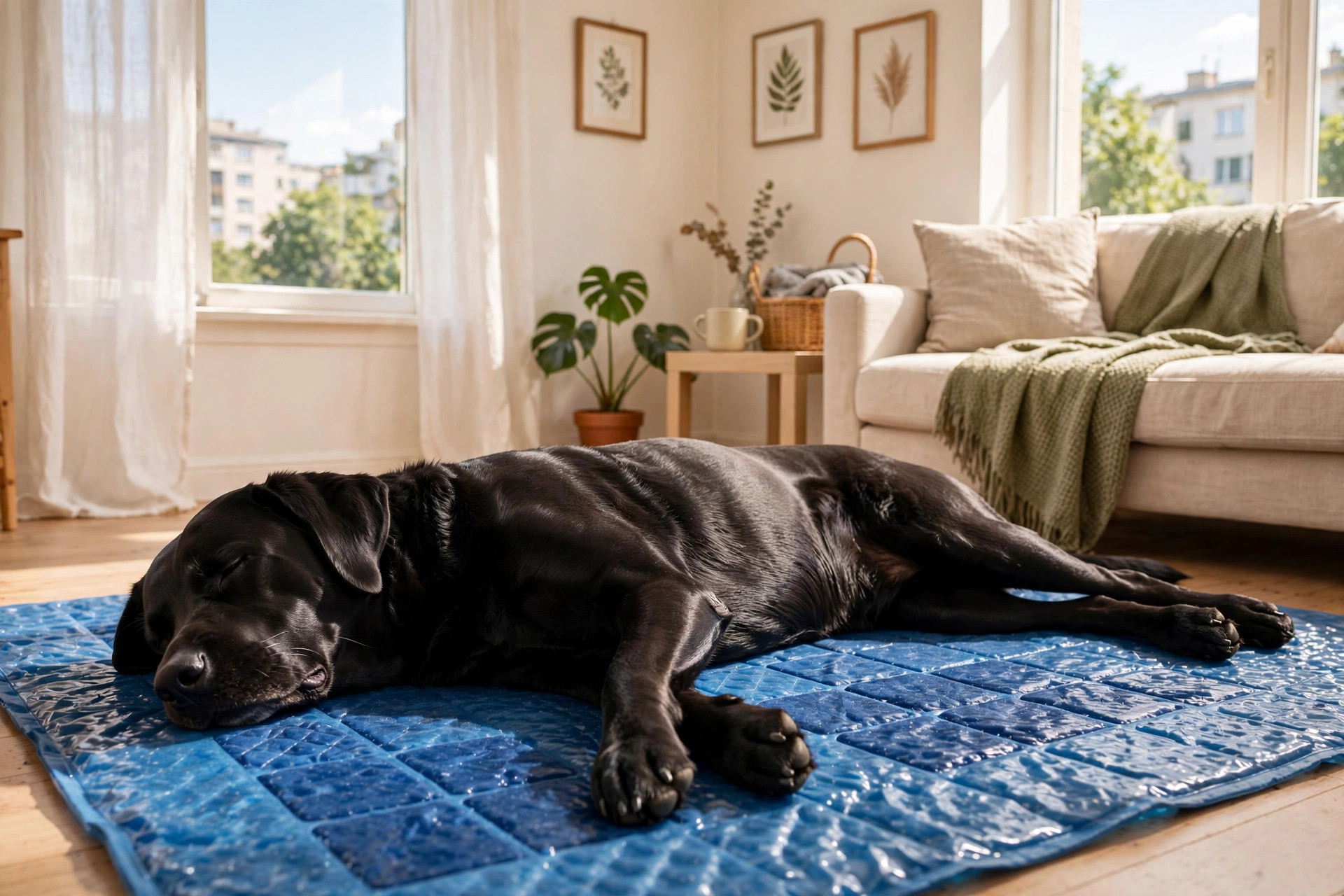
Dogs barely sweat. They cool themselves almost entirely by panting — which is miserable, inefficient work in a top-floor apartment that hits 85°F by 3 p.m. A cooling mat gives the dog a surface that is actively cooler than the air: lie down, and body heat flows into the mat instead of building up in the dog. No electricity, no water hookup, no noise. For apartments without central AC, it is the cheapest heat relief you can buy.
- Pressure-activated gel mats are the apartment standard: no water, no power, no freezer needed.
- Size it to the dog lying down, not standing up. An undersized mat the dog hangs off is barely better than the floor.
- Cooling lasts 2–4 hours of continuous use, then the mat needs 15–20 minutes of non-use to recharge.
- Chewers and heavy diggers can puncture gel mats. Supervise the first week; the gel is non-toxic but not a snack.
- A cooling mat is relief, not treatment. A dog showing heatstroke signs (glazed eyes, vomiting, collapse) needs a vet, not a mat.
Four mats worth lying on
Every mat below is a real, widely sold product — no novelty prints with mystery gel. Prices are typical street prices.
| Mat | Best for | Usually | Apartment note |
|---|---|---|---|
| The Green Pet Shop Cool Pet Pad | The proven standard | $45–$60 | Patented gel formula; recharges fastest; multiple sizes |
| Arf Pets Self-Cooling Mat | Value | $28–$40 | Solid gel performance for less; thinner profile stores flat |
| Coleman Comfort Cooling Gel Pad | Big dogs | $35–$48 | Generous XL sizing; wipe-clean cover handles muddy paws |
| K&H Cool Bed III | Maximum cooling | $55–$70 | Water-filled core cools longer; fill once, top up rarely |
Green Pet Shop Cool Pet Pad — the standard pick
The mat the category is measured against. The patented gel activates under the dog’s weight — no refrigeration, no water, no power — and stays cool for a few hours before needing a short recharge break. It recharges faster than the budget gels (around 15 minutes of non-use in normal room temperatures) and comes in sizes up to genuinely large-dog dimensions. The cover wipes clean, it folds for storage, and the gel is non-toxic. If you want the safe, well-reviewed default, this is it.
Arf Pets Self-Cooling Mat — the value pick
The honest cheaper gel mat. The cooling effect is real — noticeably cooler than ambient for a couple of hours — though it runs out somewhat sooner than the Green Pet Shop pad and recharges a bit slower. The thinner profile is actually an apartment advantage: it slides under a sofa or behind a door when not in use, and lighter dogs do not feel like they are climbing onto a raft. For a first cooling mat or a second one for the bedroom, the price is hard to argue with.
Coleman Cooling Gel Pad — the big-dog pick
Large dogs are underserved by a category that tops out at medium sizes; Coleman’s XL actually fits a sprawled lab or shepherd. The wipe-clean cover is the practical detail — big dogs bring the outdoors in on their paws, and a mat you can wipe down beats one you have to launder. Cooling performance is solid mid-pack: a few hours of relief per session. The Coleman name also means consistent manufacturing, which matters in a category with a lot of fly-by-night gel.
K&H Cool Bed III — the maximum-cooling pick
The different technology: instead of gel, a water-filled core that you fill once from the tap. Water has enormous thermal mass, so this bed stays cool far longer than any gel mat — through the whole afternoon heat peak, not just a couple of hours. The tradeoff is practicality: it is heavier, it does not fold, and a determined chewer can puncture it (though the vinyl is thick). For the top-floor apartment with western sun and no AC, where “a couple of hours” does not cover the problem, the water bed is the serious answer.
How they work — and what “recharge” really means
Gel mats contain a phase-change material that absorbs heat at roughly skin temperature. When the dog lies down, body heat flows into the gel and the surface feels cool — typically 5–10 degrees below ambient. The gel has a finite capacity: after 2–4 hours of continuous contact it reaches equilibrium with the dog and stops cooling. “Recharging” just means the dog gets off for 15–20 minutes so the gel can dump its stored heat back into the room air.
This is why two-mat rotation is the pro move in serious heat: one mat in use, one recharging in the coolest spot in the apartment (a tiled bathroom floor is ideal). It is also why placement matters — a mat in direct afternoon sun is fighting the room as well as the dog. Put it in shade, on a hard floor if possible, and away from heating vents that run year-round in some buildings.
- Small dogs (under 25 lbs): 20×16 in is plenty. Anything bigger becomes floor clutter.
- Medium dogs (25–60 lbs): 27×21 in covers a curled medium dog; size up if yours sprawls.
- Large dogs (60+ lbs): 35×27 in minimum. Measure your dog lying on its side, nose to tail base, and add 4 inches.
- Rule of thumb: the dog’s torso should fit entirely on the mat. Paws dangling off is fine; belly hanging off defeats the purpose.
Getting the dog to actually use it
Some dogs claim the mat within minutes. Others treat it with deep suspicion — it looks different, feels different, and smells like factory. The adoption protocol: put the mat in the dog’s existing favorite resting spot (not a new location), scatter a few treats on it, and let investigation happen on the dog’s schedule. Most holdouts come around within a few days once they discover it is cooler than the floor.
Do not force it — dragging a reluctant dog onto the mat creates a negative association that lasts longer than the heat wave. And keep the regular dog bed available alongside; dogs thermoregulate by moving between surfaces, and the choice between cool mat and cozy bed is itself the comfort.
The apartment heat strategy is a stack, not a single product: cooling mat for the dog’s body, air circulation for the room, walks shifted to early morning and late evening, and cold water always available. The mat is the highest-impact single item in that stack — but it works best as part of the system, especially for flat-faced breeds and seniors who handle heat worst.
FAQ
Is the gel inside cooling mats toxic?
The gels used by reputable brands are non-toxic, and all four picks above state this explicitly. “Non-toxic” does not mean “intended for consumption,” though — a dog that eats a significant amount of gel can still get an upset stomach or, worse, an intestinal blockage from the mat’s fabric. Supervise chewers, and retire any mat with a puncture rather than taping it.
Do I need to put the mat in the freezer?
No — and you should not. Pressure-activated gel mats work at room temperature; freezing can damage the gel structure and makes the surface uncomfortably cold at first contact. (A few older or off-brand designs do require chilling — avoid those; the freezer cycle is a hassle you will abandon by July.)
Can puppies use cooling mats?
Yes, but with the usual puppy caveats: supervise, because puppies chew everything, and make sure the puppy can get off the mat freely — very young puppies are less good at thermoregulating and should always have a non-cooled surface available too. Size down; a puppy lost on an XL mat will just sleep next to it.
How do I clean a cooling mat?
Wipe the surface with a damp cloth and mild soap — that is it. Never machine-wash a gel mat (the agitation can rupture internal baffles) and never use harsh cleaners that degrade the cover. For muddy-paw seasons, put a thin washable blanket over the mat; the cooling still works through one fabric layer.