Best Cat Carrier for Apartments and Vet Trips
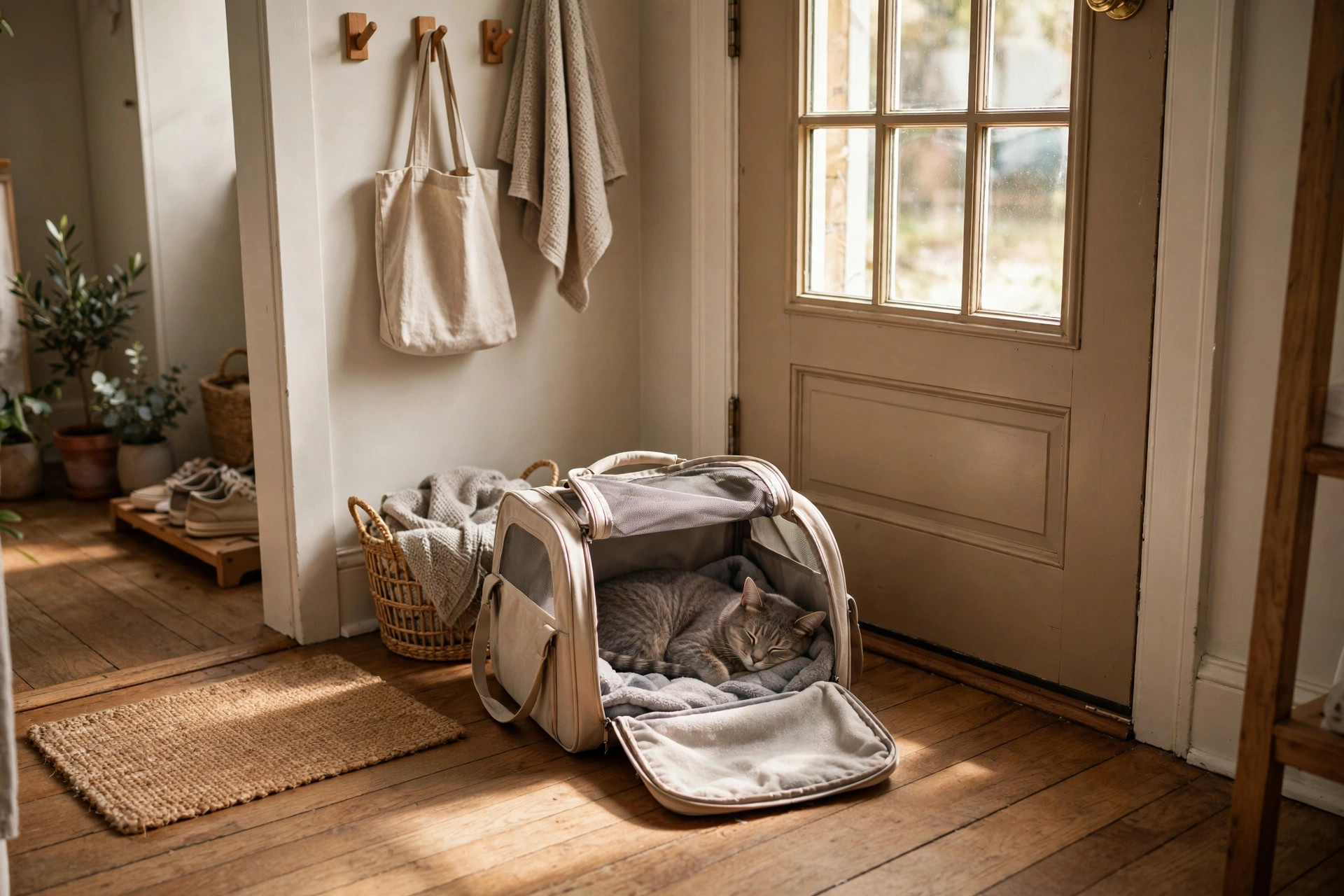
Most apartment cat owners buy a carrier once, shove it in a closet, and think about it exactly twice a year — usually in a panic, twenty minutes before a vet appointment. The right carrier earns its shelf space by solving three apartment-specific problems at once: it stores in almost no room, it loads a reluctant cat without a wrestling match, and it survives stairs, elevators, and subway rides without falling apart.
- Best all-rounder: Sherpa Original Deluxe — airline-approved sizing, top and side entry, typically $50–$70.
- Best if you fly a lot: Sleepypod Air — folds flat, crash-tested, typically $170–$200.
- Best budget pick: PetAmi soft carrier — light and cheap, typically $25–$35, fine for occasional vet trips.
- Best for nervous cats: a hard-sided top-loading kennel (Petmate-style) — typically $30–$50, easiest loading by far.
Why storage decides everything in an apartment
In a house, a carrier lives in the garage and nobody thinks about it. In a 500-square-foot apartment, a bulky hard kennel competes with your winter coats, and guess which one wins. The carriers that actually get used in small homes share one trait: they disappear when the trip is over. Soft-sided carriers compress onto a closet shelf or slide under a bed. The Sleepypod Air folds down to a few inches thick. Even a basic hard kennel stacks neatly if you pick a rectangular one rather than an igloo shape.
There is a second, less obvious reason storage matters: a carrier you can grab in thirty seconds gets used for practice runs. Behaviorists have said for years that the single best way to reduce carrier stress is to leave the carrier out with the door off and treats inside for a week or two before a trip. That only happens if retrieving the carrier is not itself a project. If yours is buried behind luggage in a storage cage downstairs, the cat meets the carrier for the first time on vet day — and you both pay for it.
4 carriers, compared for apartment life
Every carrier below is a real, widely sold product with years of owner reviews behind it. Prices move with sales, so treat the ranges as typical street prices rather than quotes.
| Carrier | Best for | Typical price | Small-space note |
|---|---|---|---|
| Sherpa Original Deluxe | Everyday + air travel | $50–$70 | Medium size fits most airline under-seat spaces; compresses onto a closet shelf |
| Sleepypod Air | Frequent flyers, car safety | $170–$200 | Folds flat to a few inches; doubles as a crash-tested car seat |
| PetAmi soft carrier | Budget, occasional vet trips | $25–$35 | Ultralight and collapsible; less structure for cats over ~14 lbs |
| Top-load hard kennel (Petmate-style) | Nervous or heavy cats | $30–$50 | Rectangular models stack in closets; top door = easiest loading |
The Sherpa Original Deluxe has been the default recommendation for over a decade for a reason: the medium size (roughly 17×11×11 inches) was literally designed around airline under-seat dimensions, it opens from the top and the side, and the mesh is sturdy enough that most cats cannot claw through it in one trip. For a cat under about 15 pounds that flies once or twice a year, it is hard to beat.
The Sleepypod Air is the splurge pick with a genuine justification: it is one of the few soft carriers independently crash-tested for car travel, and it folds genuinely flat, which matters if your “storage” is the six-inch gap between the wardrobe and the wall. The PetAmi, meanwhile, is the honest budget answer — it will not impress anyone, but for two vet visits a year it does the job, and at under $35 you will not grieve when a stressed cat has an accident in it.
Hard-sided vs. soft-sided for city trips
This is the fork in the road, and the right answer depends on your cat and your building. Soft-sided carriers win on weight and storage — a huge deal if you are carrying a cat plus groceries up four flights of walk-up stairs. They squeeze into overhead-adjacent spaces, under airplane seats, and between your feet in a rideshare.
Hard-sided carriers win on loading and cleaning. A top-loading hard kennel lets you lower a cat in from above instead of shoving it through a front door, which is the difference between a two-minute job and a twenty-minute chase behind the sofa. Hard plastic also wipes clean in seconds after the stress-induced accidents that soft fabric absorbs permanently.
The elevator test: picture your actual route to the vet — hallway, elevator or stairs, lobby, street, car or subway. If any leg involves carrying the cat one-handed while you juggle keys and a phone, get the lighter soft carrier. If your cat turns into liquid panic at the sight of a zipper, get the top-loading hard kennel and accept the extra pound or two.
For cats over about 14–15 pounds, lean hard-sided or toward a structured soft carrier like the Sherpa large. Cheap unstructured soft carriers sag in the middle under a heavy cat, which makes the cat feel unstable and makes you feel like you are carrying a duffel bag full of elbows.
The vet-day playbook for nervous cats
The carrier is only half the battle; the routine is the other half. This sequence is what low-stress vet clinics actually recommend:
- One to two weeks out: bring the carrier out, remove the door or tie it open, put a worn t-shirt inside. Feed treats near it, then in it.
- The night before: spray the bedding with a feline pheromone spray (Feliway is the common brand) about 15 minutes before the cat goes near it.
- Loading: with a top-loader, tip the carrier on its back end so the opening faces the ceiling, then lower the cat in hind-legs first. With a front-loader, back the cat in — cats resist less going backward.
- In transit: drape a light towel over the carrier. Covering three sides cuts visual stimulation dramatically, especially in a noisy subway car.
- At the clinic: keep the carrier on your lap or a chair, not the floor. Ask the vet to examine the cat inside the bottom half of a top-loading carrier if the cat is terrified — most cat-friendly clinics will.
Where to actually store it in a small home
Forget the “garage” advice. Real apartment storage spots that work: the top shelf of the entry closet (soft carriers), under the bed in a dust bag (fold-flat models), or behind the sofa if the gap is wide enough. One genuinely good trick is to make the carrier do double duty as furniture — a hard kennel with a cushion on top becomes a side table next to the couch, and the cat gets a permanent den that smells like home. When vet day comes, you lift off the cushion instead of excavating a closet.
Whatever you choose, keep the carrier within a one-minute retrieval. The best carrier in the world is useless if getting it out requires moving three other things.
FAQ
What size carrier fits under an airplane seat?
Most US airlines allow soft carriers around 17–18 inches long, 11 inches wide, and 10–11 inches tall, but the exact limit varies by aircraft — always check your specific flight before booking. The Sherpa Original Deluxe in medium was designed around these dimensions and is the most commonly accepted shape. Hard kennels rarely fit under seats.
Is top-loading really less stressful for cats?
For most nervous cats, yes. Being lowered into a carrier from above avoids the head-first shove through a small front door, which is where most vet-day injuries (to humans) and panic (to cats) happen. It is also why many cat-friendly vet clinics prefer top-loaders: the vet can examine the cat in the bottom half without a full extraction.
Should I leave the carrier out all the time?
Ideally, yes — with the door removed or tied open and comfortable bedding inside, so it reads as furniture rather than a trap. In a small apartment, try the side-table trick: cushion on top of a hard kennel next to the couch. If space truly does not allow it, bring the carrier out at least a week before any planned trip.
Hard or soft carrier for a 16-pound cat?
Go hard-sided, or pick a structured soft carrier rated for large cats. Budget soft carriers sag under heavy cats, which makes the ride feel unstable and can strain the zippers. A top-loading hard kennel in the 19-inch range gives a big cat room to turn around without becoming apartment furniture you resent.