Balcony Catio Safety Checklist for Apartment Cats
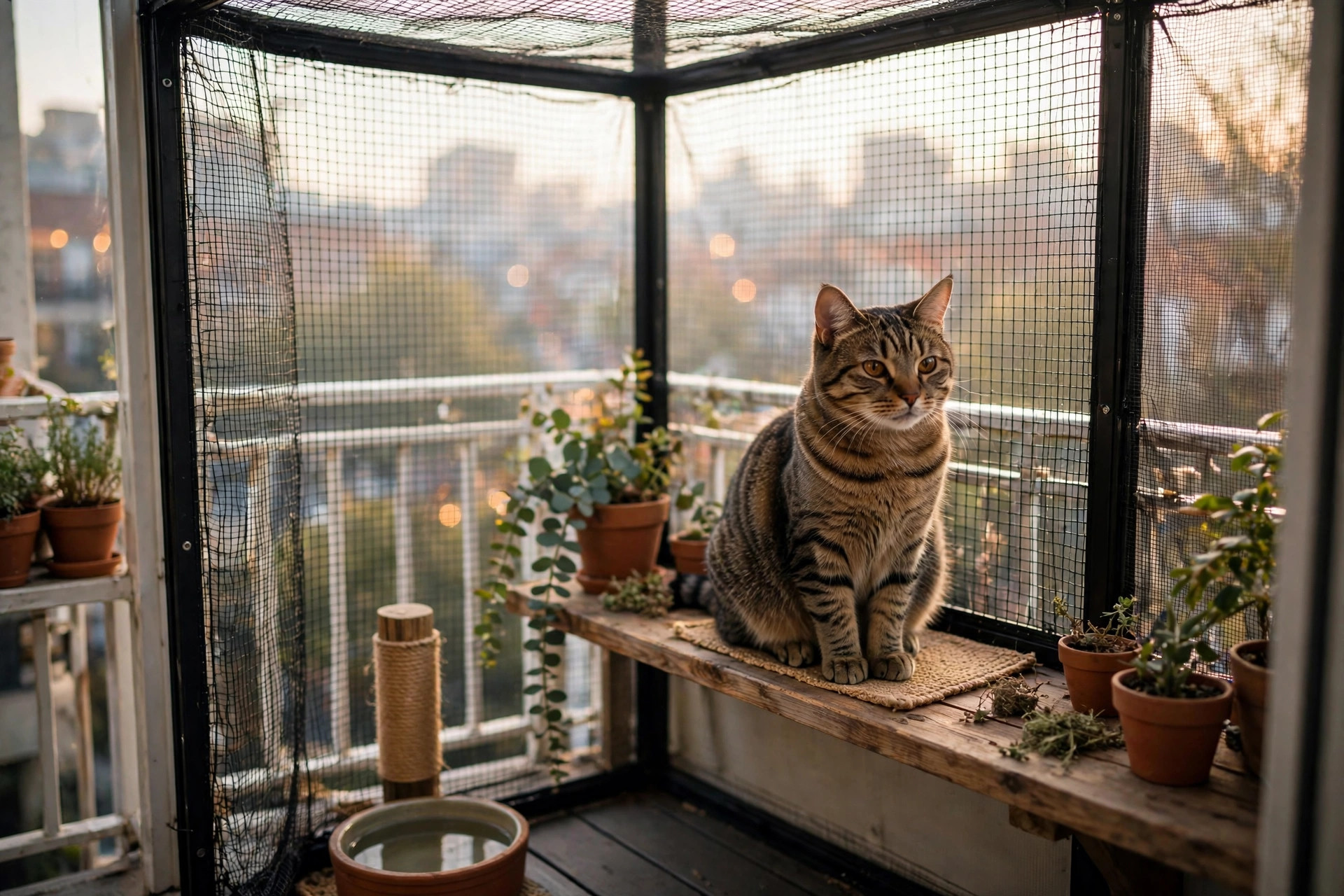
A balcony can be the single best square footage a city cat ever gets — fresh air, birds to watch, sunbeams that move across the floor. It is also the single most dangerous square footage in the apartment if you skip the proofing. Every item below comes from the two places balcony catios fail: the structure (gaps, weak netting, climbable railings) and the assumptions (it is “just for a minute,” “she never jumps”). Run the whole checklist once before the first paw goes out, then re-run the five-minute version every season.
- No cat goes on the balcony before the netting is up, tested by hand pressure, and the gaps are closed. “Supervised” is not a substitute for netting.
- Netting must be rated for cats: heavy-duty UV-stable polyethylene or wire mesh, fastened every 6 inches, with a bottom edge the cat cannot lift or crawl under.
- Remove everything climbable within two feet of the railing, clear toxic plants, and solve the door-latch problem — most balcony accidents start with a door that drifts shut.
- Heat, fireworks, and balcony-adjacent renovations each have their own cutoff: if the concrete is too hot for your palm, it is too hot for paws.
- Every renter-friendly fix in this guide comes off without damage: tension, zip ties, hooks, and freestanding frames.
Why balconies fail: the three accident patterns
Emergency vets know balcony injuries as “high-rise syndrome”: cats that fall from windows and balconies. The injuries cluster into three patterns, and each one tells you exactly what to proof:
- The slip-through. Cats squeeze under railings, between balcony divider panels, or through the gap between the railing and the wall. If a cat’s head fits, the body follows — a 4-inch gap is an open door. Divider gaps between neighboring balconies are the classic: they look sealed from your side and are wide open from the cat’s eye level.
- The over-the-top. Cats launch off chair backs, planter boxes, and AC units parked against the railing. Anything within jumping distance of the top rail converts the railing’s height to zero. The cat is not trying to escape; she is chasing a bird and overshoots.
- The locked-out or locked-in. A balcony door that blows shut strands the cat outside in heat, cold, or panic — and panicked cats climb. A door left ajar without a screen lets an unsupervised cat through at 3 a.m. when nobody is watching.
Notice what is missing: “the cat jumped on purpose.” Falls are almost never intentional. That matters because it means the fix is environmental, not behavioral. You do not need a cat that “knows” the balcony; you need a balcony a cat cannot fall from. If you are starting from zero on the whole balcony, our guide to pet-proofing a balcony for cats covers the general layout, and this checklist is the catio-specific tightening on top of it.
The 14-point catio checklist
Walk the balcony with this list and a tape measure. Every item is a yes/no: if it is not a yes, the cat does not go out yet.
- Netting or enclosure covers every open side, floor to ceiling. Not just the railing — the gap between railing top and the balcony above, and both side dividers. Pigeons and cats alike use the ceiling gap.
- Netting is cat-rated, not garden netting. Heavy-duty UV-stable polyethylene mesh (2–3 mm cord) or galvanized wire mesh. Lightweight bird netting tears under claws and degrades in sun within a season.
- Fastened every 6 inches with no sag. Cable/zip ties or hooks every 6 inches along rails, walls, and ceiling. Sagging netting is a hammock a cat can chew through.
- No gap bigger than 2 inches anywhere. Check under the railing, along the floor edge, between netting panels, and where pipes or AC lines enter the balcony. Stuff small gaps with foam backer rod or hardware cloth, not rags.
- Railing tops are unclimbable. Move chairs, planters, storage boxes, and the AC condenser unit at least 2 feet from the railing — or block the top with an angled netting panel so a launch meets mesh, not air.
- The floor is safe and not a chew source. Artificial turf is popular but some cats chew it; indoor-outdoor carpet or interlocking foam tiles (pet-safe, no crumbly EVA) are alternatives. Whatever you lay, confirm the cat cannot peel it back to the drainage gap underneath.
- Plants are on the pet-safe list. Sago palm, lilies, oleander, and many fertilizer spikes have no place on a catio. Cross-check every pot against our pet-safe indoor plants list before it goes out.
- Shade and water exist for the full sun window. A balcony that is pleasant at 9 a.m. can be an oven by 1 p.m. Provide a shaded hide and fresh water any time the cat is out; the palm test (too hot for your hand, too hot for paws) is the rule.
- The door cannot trap or be nudged. A door stop or a pet-door latch that holds the sliding door at a fixed 6-inch opening — wide enough for the cat, impossible to blow shut, and too narrow for a person to mistake as an invitation to close it.
- The divider to the neighbor’s balcony is sealed. Most rental balconies share a thin divider the cat can slip around or through. Net it, panel it, or block it — this is the gap owners discover after the cat is already next door.
- No dangling cords, hooks, or bird spikes in reach. String lights at cat height become chew toys; anti-pigeon spikes become paw traps. Route lights along the ceiling or skip them.
- The structure carries real weight. A freestanding catio frame plus shelves plus a 12-pound cat bouncing off them is a real load. Anchor frames to the railing or wall with tension hardware, and test shelves by pressing with your own hand harder than a cat ever could.
- Escape and emergency plan. Keep the carrier near the balcony door during catio time. If the fire alarm goes off — a common apartment event — you need the cat contained in under a minute; our guide to preparing pets for fire alarm tests covers the drill.
- Lease check done in writing. Some leases ban balcony enclosures or exterior modifications outright. A photo of your renter-friendly setup plus an email confirmation beats an argument after a neighbor complains.
| Enclosure option | Typical cost | Best for | Watch out for |
|---|---|---|---|
| Heavy-duty mesh netting kit | Usually $30–$80 | Most rental balconies; custom shapes | Must be cat-rated, not bird netting; re-tension yearly |
| Freestanding catio panels (e.g. KittyWalk-type) | Usually $150–$350 | Balconies where you cannot touch walls | Bulky to store; check panel latches |
| Wire mesh panels (hardware cloth) | Usually $40–$100 | Chewing cats; long-term setups | Heavier; cut edges must be filed smooth |
| Balcony screen door with pet panel | Usually $80–$200 | Controlling the door gap | Screen alone is not fall protection |
For the installation details behind these options, see the netting deep-dive in our renter-friendly balcony netting guide.
Renter-friendly installation that actually holds
Landlords object to holes; cats object to weak netting. The middle ground is hardware that grips without drilling:
- Tension rods and shower-rod frames span wall to wall for ceiling netting on balconies under about 6 feet wide. Use two rods, not one, and check tension monthly — buildings shift with temperature.
- Heavy-duty UV zip ties are the workhorse: loop them through mesh and around railing bars every 6 inches. Standard indoor zip ties go brittle in sun within a year; UV-rated black ties last several seasons.
- Removable adhesive hooks (rated 5+ lbs each) hold mesh against smooth walls and ceilings. They fail in heat and humidity, so treat them as helpers, not the main fastener, and never as the only thing holding the bottom edge.
- Freestanding frames made of PVC or light aluminum stand inside the balcony and carry the mesh, touching nothing. They cost more and eat floor space, but they are the answer when the lease says no modifications at all.
The test that matters: grab the installed netting with both hands and lean your body weight into it, the way a 12-pound cat hits it at a sprint. If anything flexes, creaks, or gives more than an inch, it is not done. Cats test enclosures at full speed, not politely.
Seasonal habits: the 5-minute re-check
A catio is not a build-it-and-forget-it project. Schedule the re-check with the seasons — spring and fall, the same weekend you flip the closet over:
- Netting tension and sun damage. Press every panel; UV and wind stretch mesh over time. Replace any section that has gone slack or brittle. A net that held a kitten may not hold the same cat at full adult weight.
- New gaps. Buildings settle, planters move, the AC unit gets serviced and put back two inches to the left. Re-measure the old gaps.
- Heat rules. Summer: catio time before 10 a.m. and after 5 p.m. only, water always out, and a shaded retreat the cat actually uses — watch where she chooses to lie on day one and put the hide there.
- Storm and fireworks rules. Thunder, high wind, and fireworks nights are indoor nights, no exceptions. A panicked cat can find a weakness in netting that a calm cat never noticed.
- Supervision policy. The honest industry answer: many owners do leave cats in well-built catios unsupervised, and many vets wince at it. The middle ground most behaviorists land on is unsupervised only in a fully enclosed, re-checked catio with water, shade, and a way back inside — and never on the first month of a new setup, never in extreme weather, and never for a cat that chews mesh.
Build for the cat you have at her worst moment — startled, sprinting, mid-zoomie — not the cat napping in the sun. Every catio failure story starts with “she had never done that before.”
FAQ
Can my cat be on the balcony unsupervised once the catio is built?
Only after a month of supervised use with zero incidents, a passed seasonal re-check, and only if the enclosure is fully sealed floor to ceiling with cat-rated netting. Even then, skip unsupervised time in heat, storms, fireworks, and for cats that chew mesh. When in doubt, supervised only — the whole point of a catio is safe enrichment, and an unsupervised escape undoes all of it.
Will my landlord allow a balcony catio?
It depends on the lease, not the law. Freestanding frames and tension-rod netting that touch nothing permanently are the easiest to get approved — send photos and ask in writing. If the lease bans all exterior modifications, a window catio box (an enclosed shelf that sits in the window frame) is the usual fallback that most leases do not cover.
Is regular window screen enough to keep a cat on a balcony?
No. Standard fiberglass window screen is designed to keep insects out, not cats in — claws go through it in seconds, and a cat leaning on a screen door can pop the whole panel out of its track. Screens control airflow; cat-rated mesh or wire panels control the cat.
My balcony is tiny — is a catio still worth it?
Yes, especially a small one. A 3-by-6-foot balcony with a perch, a scratcher, and safe netting gives a cat more sensory enrichment than most living rooms: moving air, birds, sun, smells. Use vertical space — a wall-mounted shelf and a hanging hammock turn a narrow balcony into a two-level catio.