What to Do If Your Cat Falls From a Window
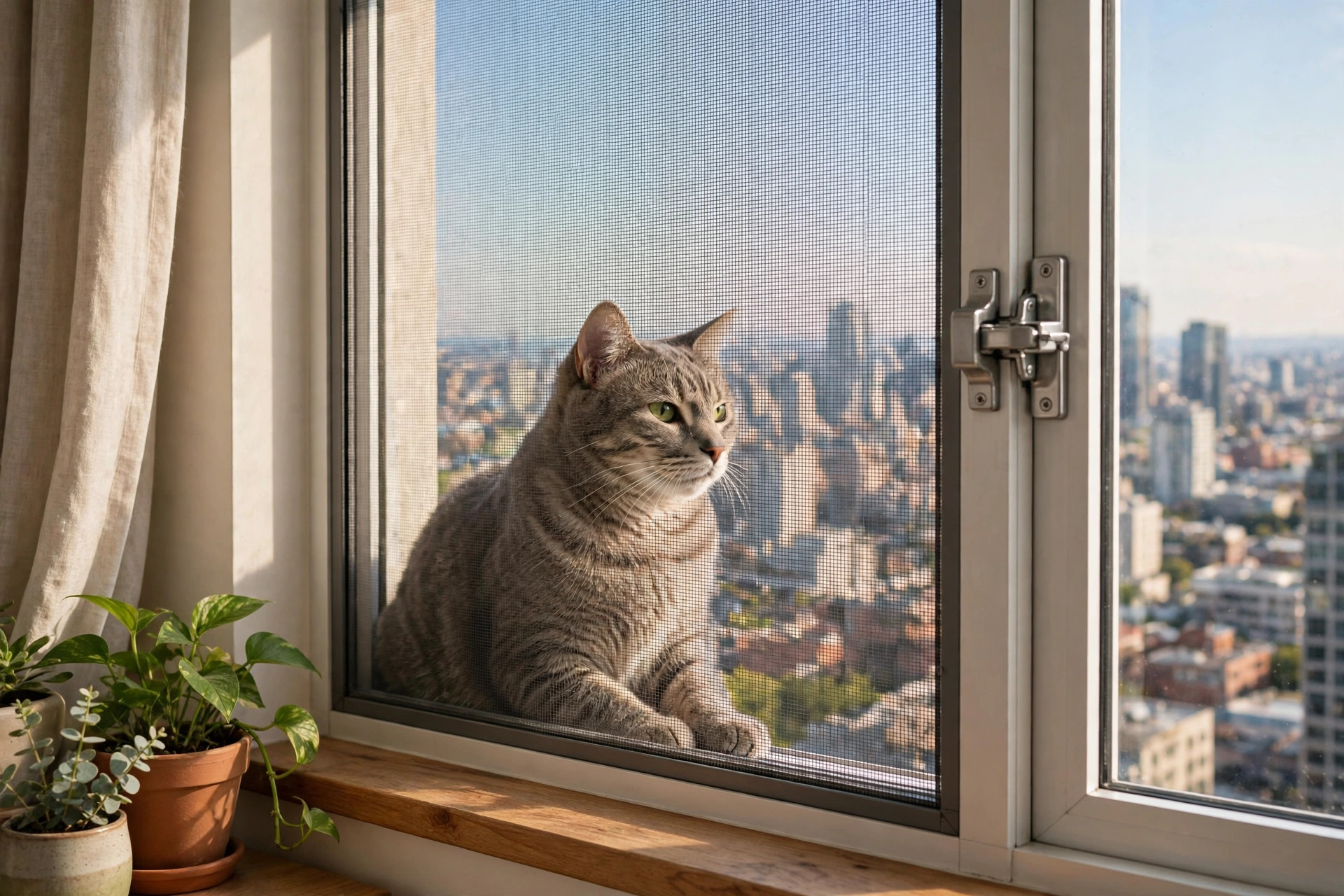
Cats fall from apartment windows and balconies often enough that vets have a name for the pattern — high-rise syndrome — and the cruelest part of it is how fine the cat can look afterward. Adrenaline carries many fallen cats home on their own feet with a broken jaw, a punctured lung, or internal bleeding that will not declare itself for hours. If your cat goes out a window, this guide is the sequence: what to do in the first ten minutes, what the vet is looking for that you cannot see, and how to make sure it never happens twice.
The first 10 minutes: find, contain, do not be reassured
Start downstairs immediately. Fallen cats typically do one of three things: freeze near the landing spot, crawl into the nearest cover (bushes, parked cars, stairwell corners, basement window wells), or — in a building with an interior courtyard — try to get back inside. Check the landing area first, then expand in a tight spiral, looking under cars and into every ground-level recess. A frightened injured cat often does not answer calling; search visually, flashlight on, even in daylight.
When you find her, approach low and slow and expect behavior you have never seen. A gentle cat in pain may bite hard enough to need stitches — wrap her in a towel or jacket to contain her, supporting the whole body rather than lifting by the scruff, and place her directly into a carrier or a box with a lid. Keep her warm and quiet. Do not offer food or water: if she needs surgery, an empty stomach matters, and internal injuries make eating risky.
Then the critical rule: a cat that walks away from a fall still goes to a vet — now, not tomorrow. The injuries that kill after high-rise falls are mostly invisible at home. Classic high-rise syndrome presentations include a split hard palate (the roof of the mouth), fractured forelimbs and jaw, chest injuries such as a punctured or bruised lung and air leaking into the chest cavity (pneumothorax), and a ruptured bladder. Several of these look like “she seems okay, just quiet” for 4–24 hours before they become emergencies. Quiet, after a fall, is a symptom, not a recovery.
At the vet: what they check and what it typically costs
Expect the vet team to work in this order, and expect them to be honest that the first exam can underestimate injuries:
- Breathing and chest first. Increased breathing rate or effort after a fall is treated as chest trauma until radiographs prove otherwise. Chest X-rays are the workhorse here; a pneumothorax that is stealing lung space may need air drained with a chest tap or tube before anything else is addressed.
- Mouth, jaw, and face. The split hard palate and jaw fractures are signature fall injuries — cats land partly face-first more often than the “always land on their feet” reputation suggests. Some palate splits heal with soft food and time; jaw fractures may need wiring.
- Limbs and spine. Forelimb fractures are common in higher falls. The vet will palpate each leg and the spine and may radiograph anything painful, swollen, or held oddly.
- Abdomen and bladder. A hands-on exam, sometimes an ultrasound, checks for internal bleeding and bladder rupture — abdominal pain, a distending belly, or no urine production afterward are the home warning signs if you are ever sent home to monitor.
Costs, honestly ranged (U.S., 2026): an emergency exam plus X-rays commonly runs $400–$900. A chest tube and a night of hospitalization can bring a case to $1,500–$3,000. Orthopedic surgery on a fractured leg or jaw wiring pushes totals toward $3,000–$6,000. Not every fall costs this: many cats are treated for a palate split and bruising for a few hundred dollars. But it is not rare for the bill to be written in the second column, and that financial reality is exactly why the prevention section at the end of this guide is short, cheap, and emphatic.
- The fall was more than one story, or from any height onto concrete
- Breathing is fast, shallow, or noisy at rest
- There is blood in the mouth, a crooked jaw, or the cat will not eat
- The cat is quiet, hiding, limping, or not urinating within 12–24 hours
The falling myths, corrected — because they cause the next fall
Three pieces of folklore do real damage in high-rise homes, usually by convincing owners that screens and supervision are optional.
Myth 1: “Cats always land on their feet, so they’re fine.” Cats do have a remarkable righting reflex and can spread their bodies to slow a fall — which is partly why survival rates even from significant heights are genuinely high when cats get prompt vet care. Landing oriented is not landing uninjured. The righting reflex positions the legs and face to absorb impact, which is precisely why forelimb, jaw, and chest injuries define the syndrome. “She landed on her feet” and “she is unhurt” are different sentences.
Myth 2: “Higher falls are safer than low ones.” This one circulates from old studies suggesting cats may relax and reach a terminal-velocity posture after several stories. More recent clinical data does not support using height as reassurance, and severity of injury rises with height in large case series. Treat every fall over one story as potentially serious regardless of what an internet summary claims a cat “should” survive.
Myth 3: “She’s been sitting at that window for years — she knows.” High-rise syndrome case histories are dominated by exactly this cat. It is almost never a cat seeking a view; it is a cat lunging at a bird, a moth, or a falling leaf through a screen that was never designed to hold 10 pounds of hunting cat. Screens keep insects out. They keep nothing else out. The relevant question is never “is my cat careful” but “what is between my cat and the outside that can bear her full weight in a lunge.” Our balcony pet-proofing guide is built around that distinction, and it applies to windows with equal force.
Prevention: the $50 fix that retires this entire scenario
Every case in the sections above ends at the same place — a barrier that can hold a lunging cat. The apartment-grade version of that barrier costs very little:
- Locking window screens and screen guards. Standard insect screens pop out under pressure. Replace or reinforce them with pet-resistant screen mesh (heavier-gauge vinyl-coated mesh, sold as “pet screen,” roughly $20–$40 per window in material) mounted in a frame that is screwed or firmly latched into the window track, and add window locks that limit how far double-hung windows open — under 4 inches. We compare lock and guard options in the window locks guide for high-rise cat owners.
- Never trust the sash gap. A window opened “just a crack” for air is an invitation scaled exactly to a cat’s curiosity. Install vent locks or wooden stops so the maximum opening is fixed and cat-proof, not mood-dependent.
- Balance the railing. If the escape route is a balcony rather than a window, the barrier is netting or panels tensioned to hold a full-body lunge; the renter-friendly balcony netting guide covers mesh sizes and no-drill mounting.
- Furniture discipline near windows. Cat trees and perches by the window are wonderful — behind glass. Move climbable furniture so its top is not level with an openable window or a screen-only barrier, and make the sunny spot a window bed behind a locked, screened, or barred opening instead.
Finally, cover the gap in every barrier plan: the human. Doors and windows get opened by guests, cleaners, and tired owners at 1 a.m. A short house rule — “windows open only on the latch, balcony door never propped” — plus a pet that is ID’d in case the worst still happens (chip and collar; see the microchip and ID guide in this series) closes the loop. High-rise syndrome is one of the most preventable emergencies in cat ownership. A $40 roll of pet screen and ten minutes of installation is the entire argument, and it is a strong one.
FAQ
My cat fell two stories and seems fine. Can I just watch her at home?
Watch her in the car on the way to a vet. Falls over one story, or any fall onto concrete, warrant a same-day emergency exam even when the cat walks away — chest injuries and internal bleeding routinely look like quiet tiredness for 4–24 hours before becoming critical. The exam and X-rays typically cost $400–$900; the injuries they catch early are the ones that stay survivable and affordable.
Cat fell from window and ran off — how do I find her?
Search immediately, visually, with a flashlight, starting at the landing spot and spiraling outward through ground cover, parked cars, window wells, and stairwell corners. Injured cats hide close and often will not answer calling. Expand the search with neighbors and building staff, post in local lost-pet groups, and keep returning to the landing area — cats commonly stay within a short distance of where they fell.
What injuries do vets see most after a cat falls from a window?
The high-rise syndrome pattern: a split hard palate (roof of the mouth), jaw and facial fractures, forelimb fractures, and chest injuries such as bruised lungs and pneumothorax (air leaking around the lungs), plus ruptured bladder in some cases. Breathing problems are the most immediately dangerous and are assessed first.
Does a higher fall really hurt less, like people say?
Do not rely on it. The claim comes from older studies and is not supported as a planning rule by more recent clinical data; injury severity generally rises with height. Cats do survive remarkable falls when they receive prompt care — survival is a reason to hurry to the vet, not a reason to skip the visit.
How do I stop this from happening again?
Replace or reinforce insect screens with pet-resistant mesh in a screwed or latched frame, add window locks limiting openings to under 4 inches, keep climbable furniture away from openable windows, and treat balcony barriers the same way with tensioned netting or panels. Standard screens are insect barriers only and will not hold a lunging cat.