Seasonal Shedding Survival Guide for Apartment Owners
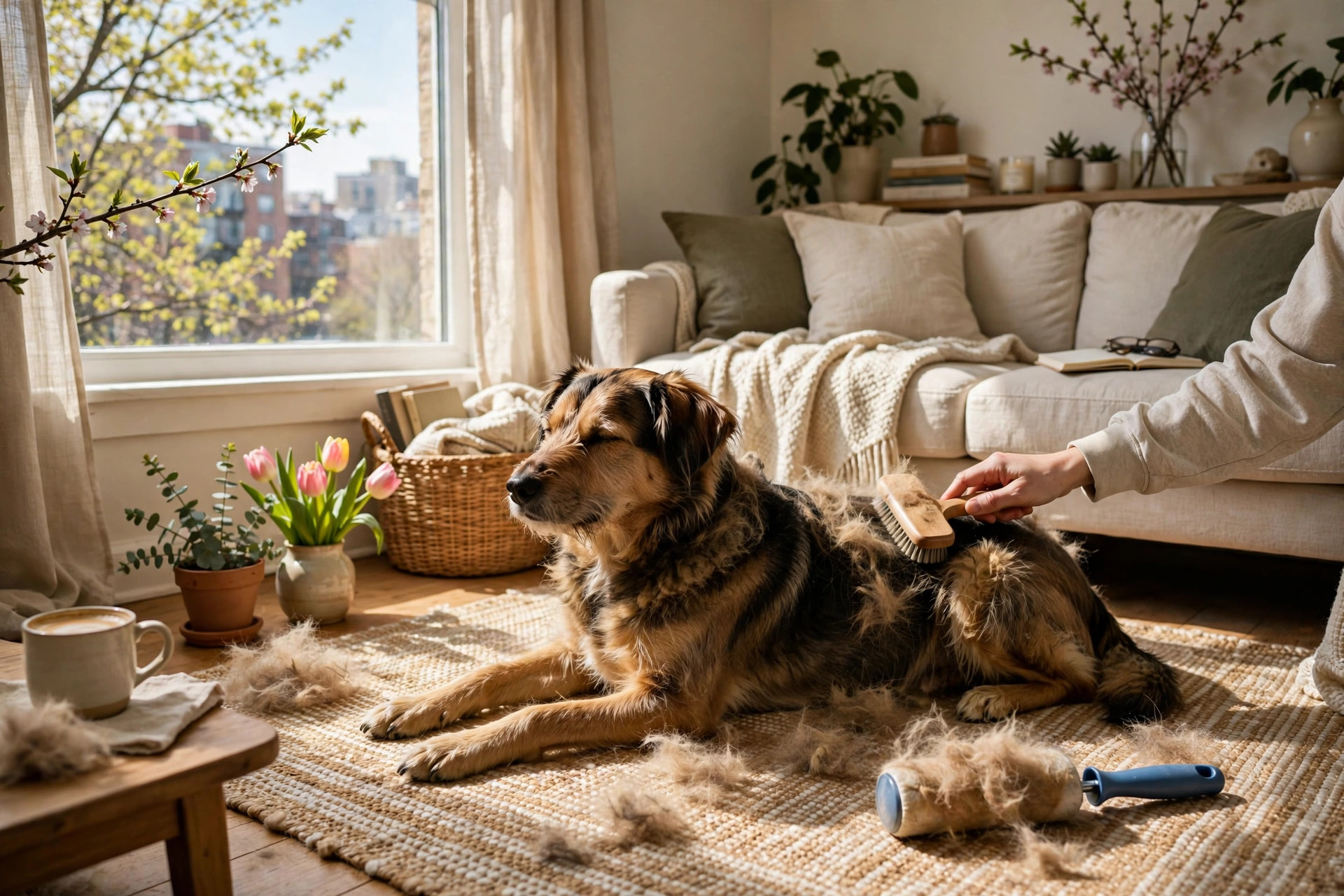
For six weeks every spring and fall, a double-coated dog in a 600-square-foot apartment produces more loose hair than the apartment has surfaces to hold it. Seasonal shedding is normal coat biology, not a grooming failure — but in a small home it fills the sofa, the vents, and your Friday plans unless you switch to a shedding-season system: more frequent brushing at the right depth, hair capture at the furnishing level, and laundry on a shorter loop. This guide maps the coat blow, the tools by coat type, and the daily rhythm that keeps a shedding season livable without a yard to shake the dog off in.
- The big seasonal blow lasts 3–6 weeks, twice a year, driven by daylight — indoor lighting softens but does not cancel it.
- Brush the undercoat, not just the surface: 10 minutes with the right tool beats 30 with the wrong one, every other day in peak weeks.
- Capture before cleaning: washable covers, entryway mats, and a laundry loop do more than any vacuum schedule alone.
- Bald patches, scabs, or itching are not seasonal shedding — that is a vet visit, not more brushing.
- Budget the season: tools $20–$45 once, covers about $35–$60, and your time in short daily windows.
What the seasonal blow actually is
Dogs with double coats — retrievers, Shiba Inu, corgis, huskies, northern and pastoral breeds — grow a dense undercoat for winter and shed it as daylight lengthens in spring, then do the reverse in fall on a smaller scale. Single-coat and continuously growing breeds (poodles, bichons, most terriers) shed lightly year-round instead. The spring blow is the dramatic one: owners describe clumps the size of hamsters and hair reappearing an hour after vacuuming. In a house, that hair disperses into spare rooms and a garage. In an apartment, every cubic foot is living space, so the same coat feels two to three times more intense.
Timing runs on photoperiod more than temperature, so a warm February does not move the blow up by much, and a cold April does not delay it. Indoor dogs under artificial light sometimes smear the blow across eight slower weeks instead of five intense ones, which is arguably kinder on the owner. Cats blow coat too — longhairs obviously, but even short-coated indoor cats shed a visible spring wave, and because cats self-groom, the seasonal signal in cats is hairballs increasing for a few weeks.
What seasonal shedding is not: complete bald spots, symmetrical hair loss on the trunk, red or scabbed skin, or a dog scratching through the night. Those patterns point to allergies, endocrine issues, or parasites. Shedding should look like volume, not absence — the coat underneath the loose hair stays covered and normal.
Tools by coat type (and the one tool to skip)
Shedding tools fail when they work the wrong layer. The guard-hair surface is not the problem in a blow; the releasing undercoat trapped beneath it is. Match tool to coat:
| Coat type | Best shedding tool | Typical price | Cadence in peak weeks |
|---|---|---|---|
| Double coat (retriever, Shiba, corgi) | Undercoat rake with rotating pins | $16–$28 | Every other day, 10–15 min |
| Short smooth coat (beagle, Frenchie) | Rubber curry brush / grooming mitt | $10–$18 | 2–3x weekly, 5 min |
| Long single coat (spaniel, setter) | Slicker brush + steel comb | $22–$38 set | 3x weekly, comb-check behind ears |
| Cat, short or long | Slicker or rubber brush by tolerance | $9–$20 | Every other day, 5 min |
The tool to skip for double coats is the blade-style deshedding tool used aggressively: dragged daily, it can cut guard hairs and irritate skin, thinning the coat cosmetically while the undercoat keeps blowing — owners brush more, the coat looks worse, the cycle feeds itself. Used weekly as directed it has a place; used as the daily driver it is the classic shedding-season mistake. Our undercoat rake guide covers technique for double coats in detail; for cats, our deshedding brush guide handles tolerance by coat length.
Technique matters more than brand. Brush in the direction of growth with the rake penetrating to skin on double coats, work in sections (one side, then the other, then chest and breeches), and empty the tool every few strokes — a full rake glides over packed hair collecting nothing. A slightly damp coat (misted with water) reduces flyaway hair indoors; our apartment grooming setup pairs this with a quiet dryer for the post-bath blow-out described below. End every session with the steel comb test: if the comb passes through the breeches and behind the ears without dragging, the session is done.
The bath and blow-out reset
One well-timed bath at the peak of the blow accelerates the whole season. Warm water and conditioner loosen the releasing undercoat, and drying with a pet dryer blows out hair that would otherwise distribute itself across three weeks of brushing. Schedule it when clumps start coming out in the brush with minimal strokes — usually week two of visible shedding. Apartments without tub space can use a self-wash station, typically $12–$20, which also keeps the hair clog out of your own drain, a non-trivial rental benefit.
Fit the bath into your existing bathing schedule rather than adding extras: most dogs are on a four-to-six-week rotation anyway, so simply aligning one bath with peak shed achieves the reset without over-bathing. Skip the 'shed-control' shampoos promising to stop shedding — nothing topical overrides photoperiod; at best they condition, at worst they add fragrance to a process that needs less chemistry, not more. Between baths, a wipe-down with a damp microfiber cloth after brushing catches the static-charged surface hair that otherwise lands on the sofa within the hour.
Capture the hair before you clean the hair
The contest is won at the furnishing layer, not the vacuum. Washable slipcovers or throws (usually $35–$60 for sofa-sized) on the dog's permitted furniture convert a hair-embroidered couch into a laundry item; shake outside the balcony door or over the tub, wash weekly during the blow. An entryway mat with real scrape-and-trap texture intercepts the walk-in coat shake that dogs perform five feet inside the door — that shake is a meaningful percentage of the floor hair in a small home. Bedding goes on the short loop described in our bedding-washing guide: the dog bed is the densest hair reservoir in the apartment, and washing its cover weekly during the season cuts the ambient float noticeably.
Laundry order matters in shedding season: pet textiles washed separately, shaken first, and never followed immediately by your black work clothes in the same load — residual drum hair transfers. Our laundry routine guide gives the full sequence, including the empty hot wash that resets the machine monthly. Air handling helps proportionally in small spaces: a purifier with a washable pre-filter near the dog's main resting zone captures the airborne fraction that otherwise settles on every horizontal surface; empty the pre-filter weekly in peak weeks or it becomes a hair sculpture that filters nothing.
Fabric choice is the long game for heavy shedders in small homes: tight-weave microfiber and leather release hair with a wipe, while open-weave linen and boucle hoard it past vacuuming. Nobody redecorates for shedding season, but when a throw or cushion cover next needs replacing, weave density is the apartment-relevant spec. Keep a rubber broom for hard floors (about $14–$22) — its static pull groups hair into lines a stick vacuum then picks up in one pass, instead of scattering it the way spinning brush rolls do on tile.
The seasonal daily rhythm
Peak weeks run on a light-touch daily pattern rather than weekend heroics:
- Daily (5–10 min): brush-out on grooming days (every other day for double coats), 60-second entryway and dog-zone floor pass with the rubber broom, lint-roll the sofa arm and your departure outfit.
- Every 2–3 days: shake throws and bed cover outside or over the tub; quick vacuum of the rug and sofa with the upholstery tool.
- Weekly: wash pet textiles, empty purifier pre-filter, full-apartment vacuum including baseboards where hair migrates, comb-test the coat to gauge whether the blow is tapering.
- Once per blow: the bath and blow-out reset at peak; a second only if the coat blows in two distinct waves.
Track the taper honestly: when the rake comes away light two sessions running, drop back to the normal weekly rhythm and congratulate the vacuum. Owners who keep peak-season intensity for two months burn out and then under-brush for the rest of the year — the off-season baseline of one good weekly brush is what keeps the next blow shorter, because packed undercoat entering the season is what makes it brutal.
You cannot brush a seasonal blow away in a weekend. You can only harvest it a little faster than the dog distributes it — and in an apartment, harvesting first is the entire game.
FAQ
How long does the spring coat blow last?
Three to six weeks for most double-coated dogs, with the heaviest release in the middle two weeks. Indoor lighting can stretch it to eight lighter weeks. If heavy shedding runs past eight weeks, or you see patches or itching, book a vet check.
Should I shave my double-coated dog for the summer?
No — the double coat insulates against heat as well as cold, and shaving disrupts regrowth patterns, sometimes permanently. Harvest the undercoat with a rake instead; that is the layer the dog is trying to lose.
Does diet change shedding volume?
A complete diet with adequate omega-3s supports skin health and coat quality, but it does not reduce seasonal volume — the blow is hormonal and daylight-driven. Sudden excessive shedding off-season is a vet conversation, not a food swap.
How do I keep hair out of the HVAC and vents?
Brush before the hair becomes airborne, vacuum vent covers in the weekly pass, and change or wash the purifier pre-filter weekly in peak weeks. Standard HVAC filters in rentals typically need a mid-season check during a heavy blow.
My cat is producing hairballs suddenly. Is that the season?
Often, yes — spring shedding raises hairball frequency for a few weeks. Daily brushing is the first fix. Vomiting food, retching without producing, or appetite loss is not hairballs and needs a vet promptly.