Litter Training for Senior Cats in Small Apartments
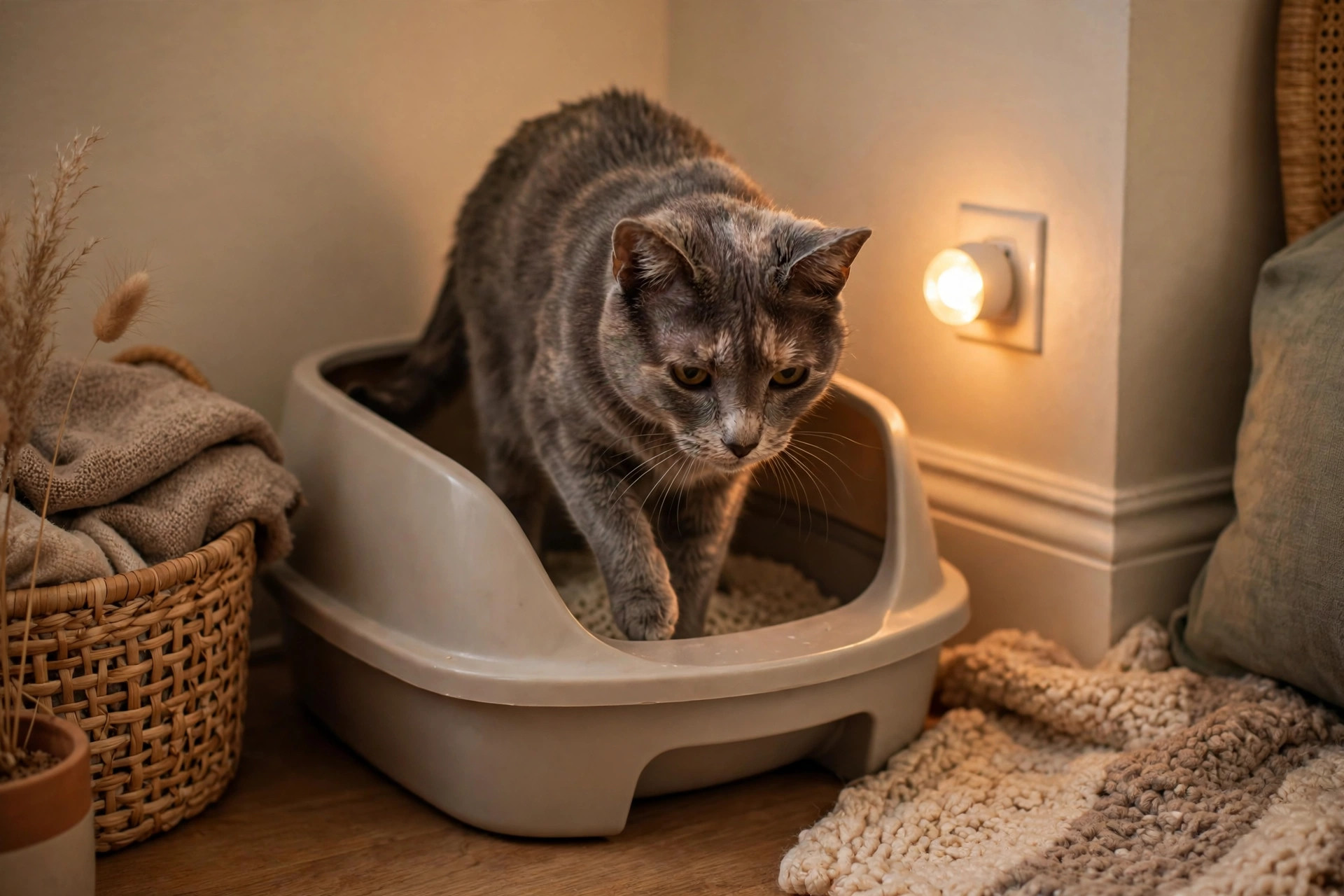
When a 14-year-old cat starts missing the litter box, it is almost never spite and almost never a training failure — it is a body that changed while the box stayed the same. Arthritis makes high walls painful to climb, kidney disease makes urgency unforgiving, and fading vision turns a dark hallway into an obstacle course. The fix is rarely “retraining” in the classic sense. It is redesigning the litter setup around the senior cat’s actual body, in the limited square footage of an apartment, and ruling out the medical causes that no amount of box tweaking will solve.
- Rule out medical causes first: new box avoidance in a senior cat is a vet visit, not a training project — arthritis, kidney disease, UTIs, and cognitive decline all present this way.
- Switch to low-entry boxes (3-inch entry or less) on every floor the cat uses. A box the cat cannot enter comfortably is a box the cat will not use.
- Add boxes rather than moving the one box: one per floor plus one extra, placed where the senior cat already spends time.
- Go softer and shallower on litter: fine-grain, low-dust, 1–2 inches deep. Arthritic paws feel every pebble.
- Scoop twice daily. Senior cats with reduced bladder control will not tolerate yesterday’s box.
The vet visit comes before the training plan
This ordering is non-negotiable. A senior cat that suddenly avoids the box, strains, cries in the box, goes more often in smaller amounts, or starts going on soft surfaces (beds, laundry, rugs) needs a veterinary workup before you change anything. The usual suspects: arthritis (present in the majority of cats over 12, often invisible until it hurts to climb into a high-sided box), chronic kidney disease (increased thirst and urination overwhelm the old routine), urinary tract infections and bladder inflammation (pain gets associated with the box itself), diabetes (same urgency mechanism as kidney disease), and cognitive dysfunction (the feline equivalent of dementia — the cat may genuinely forget where the box is).
What the vet visit buys you is not just diagnosis but calibration: pain management for arthritis transforms litter habits more than any box on the market, and treating a UTI can resolve “behavioral” avoidance in days. Bring notes: when the accidents started, where they happen, whether the cat still tries to use the box, and any changes in thirst, appetite, or mobility. If the vet clears the cat medically, then the redesign below is your project.
The senior box redesign: low, large, and numerous
Three box attributes matter for aging bodies, in this order:
1. Entry height under 3 inches. This is the single biggest factor. Standard boxes have 6–8 inch walls that a stiff cat must haul itself over — imagine climbing into a bathtub with sore knees, several times a day. Purpose-built senior boxes solve this: the KittyGoHere Senior Cat Litter Box (typically $40–$55) has a 3-inch entry with higher walls elsewhere to contain litter, and it is sized for a full turnaround. Budget alternative: a large plastic storage tote with a low doorway cut into one side (smooth the cut edge with sandpaper) — costs under $15 and works, though it looks like what it is. Avoid top-entry boxes entirely for seniors; they are the opposite of what an arthritic cat needs.
2. Footprint large enough to turn around. Senior cats are less flexible and less willing to balance on a narrow rim. Aim for a box at least 1.5 times the cat’s body length. Bigger boxes also let you keep litter shallower without the cat hitting the bottom, which matters for the next point.
3. More boxes, closer together. The old rule — one box per cat plus one — assumes a young cat willing to travel. A senior cat with urgency needs a box where it already is. In a small apartment that usually means: one box near the sleeping spot, one near the food/water area (not adjacent — a few feet of separation), and one on each additional level if you have a loft or split-level. Three boxes in 700 square feet sounds like a lot until you compare it to daily laundry.
| Box option | Entry height | Typical price | Senior-apartment note |
|---|---|---|---|
| KittyGoHere Senior | ~3 inches | $40–$55 | Purpose-built; high back walls contain litter |
| Nature’s Miracle High-Sided (cut down) | Cut to ~3 inches | $20–$30 + DIY | Cheap and roomy; sand the cut edge smooth |
| Under-bed storage tote (DIY doorway) | Cut to ~3 inches | $10–$15 | Huge footprint; best for large seniors |
| Standard high-sided box | 6–8 inches | $15–$25 | Avoid for arthritic cats |
| Top-entry box | Full climb-over | $25–$45 | Avoid entirely for seniors |
Softer litter, shallower fill
Paws change with age too. Arthritic cats often develop sensitivity to coarse or sharp litter textures — the cat that used the same chunky litter for a decade may start avoiding it because every step hurts. Switch to a fine-grain, low-dust clumping litter (Dr. Elsey’s Classic or similar, typically $18–$25 for 40 lbs) and fill only 1–2 inches deep rather than the usual 3–4. Shallow fill means less digging resistance for sore shoulders, and fine grain is gentler underfoot.
Transition gradually even though the cat is senior: mix the new litter into the old at 25/75, then 50/50, then 75/25 over about 10 days. Senior cats are more neophobic, not less — an abrupt full swap can cause the exact avoidance you are trying to fix. Unscented only: aging kidneys and older noses do not need added fragrance, and scented litters are a common avoidance trigger at any age. If dust is a concern in a small apartment (it should be — the box is never far from the bed), low-dust formulas earn their premium here.
Placement for aging bodies in small spaces
Where the box sits matters as much as what it is. Senior-specific placement rules:
- On the cat’s main level, near the sleeping spot. A senior cat should never have to cross the whole apartment — or worse, navigate stairs — on an urgent bladder. If the cat sleeps in the bedroom, a box belongs within a few steps of it.
- Warm, quiet, and lit. Cold tile floors stiffen arthritic joints; a box on a rug or mat in a warm corner gets used more. Add a night light near the box — fading vision plus a dark hallway is a genuine barrier for cats over 14.
- Escape routes, not corners. In multi-cat homes, a senior cat will avoid a box it can be ambushed in. Place boxes so the cat can see the approach and has two exit directions, not wedged behind furniture.
- Away from food and water, but not far. A few feet of separation satisfies the instinct; a different room defeats the urgency math.
For studio layouts where “near the bed” and “away from food” conflict, prioritize proximity to the sleeping spot — urgency beats etiquette — and manage odor with the cleaning cadence below plus a litter box furniture enclosure with the door removed for easy senior access.
The cleaning cadence that prevents avoidance
Senior cats are less tolerant of a dirty box, partly because reduced bladder control means they must go more often and partly because a cat that has had painful experiences becomes picky about conditions. Scoop twice daily — morning and evening — and do a full litter change and box wash every 2–3 weeks (weekly if the household has multiple cats). Wash with unscented soap and hot water; skip harsh disinfectants whose residue irritates paws and noses.
Watch the box like a health dashboard, because it is one: sudden increases in urine volume, straining, blood, or a strong ammonia change all warrant a vet call in a senior. Many owners catch kidney disease progression and UTIs early simply because the twice-daily scoop keeps them looking. The box is the cheapest diagnostic tool you own.
Reframe the problem: the cat is not “having accidents.” The cat is a senior citizen whose body outgrew its bathroom. Every fix in this guide — lower walls, softer litter, closer boxes, better light — is an accessibility renovation, not a discipline project. Build the bathroom the cat’s body needs and the “training problem” usually retires itself.
When it’s cognitive decline, not the box
Some senior avoidance resists every physical fix: the cat walks to the box, seems confused, and goes beside it — or forgets the box location it used for years. Feline cognitive dysfunction affects a large share of cats over 15, and disorientation is a hallmark. The adaptations: keep the box in exactly the same spot (do not “optimize” placement for a confused cat), keep the path clear and lit, use the same litter the cat has always known rather than introducing new textures, and add a box right next to the old one rather than replacing it. Mention suspected cognitive signs to the vet — there are diets and medications that can slow the progression, and ruling out concurrent pain or urinary disease matters even more here. Our senior cat night routine covers the broader evening adaptations that pair with this.
FAQ
How many boxes does a senior cat need in a studio?
Two minimum, three if you can manage it: one near the sleeping area, one near (not next to) the food and water. In a studio, “near” might mean ten feet apart — that is fine. The point is eliminating the long urgent trek, not achieving ideal feline feng shui.
My senior cat pees just outside the box. Is the box too small?
Often it is too tall, not too small — the cat tries, cannot comfortably climb in, and goes at the threshold. It can also signal that the box is dirty, the litter texture hurts, or a UTI makes the cat associate the box with pain. Check entry height first, then cleanliness, then call the vet if it is new.
Should I switch to pee pads instead of litter for a very old cat?
Pee pads can work as a supplement — placed beside the box for the cat that cannot quite make it in — but most cats strongly prefer to dig and bury, and pads alone often lead to the cat choosing other soft surfaces (your bed). Try the low-entry box redesign first; add pads as a backup layer, not the primary toilet.
Is it normal for a 16-year-old cat to forget litter habits entirely?
It can be part of cognitive dysfunction, but “normal for the age” should never be assumed without a vet check — treatable conditions (UTI, arthritis pain, kidney disease) cause identical signs and are far more common. Get the workup, then adapt the environment to whichever diagnosis comes back.