Senior Cat Night Routine for Small Apartments
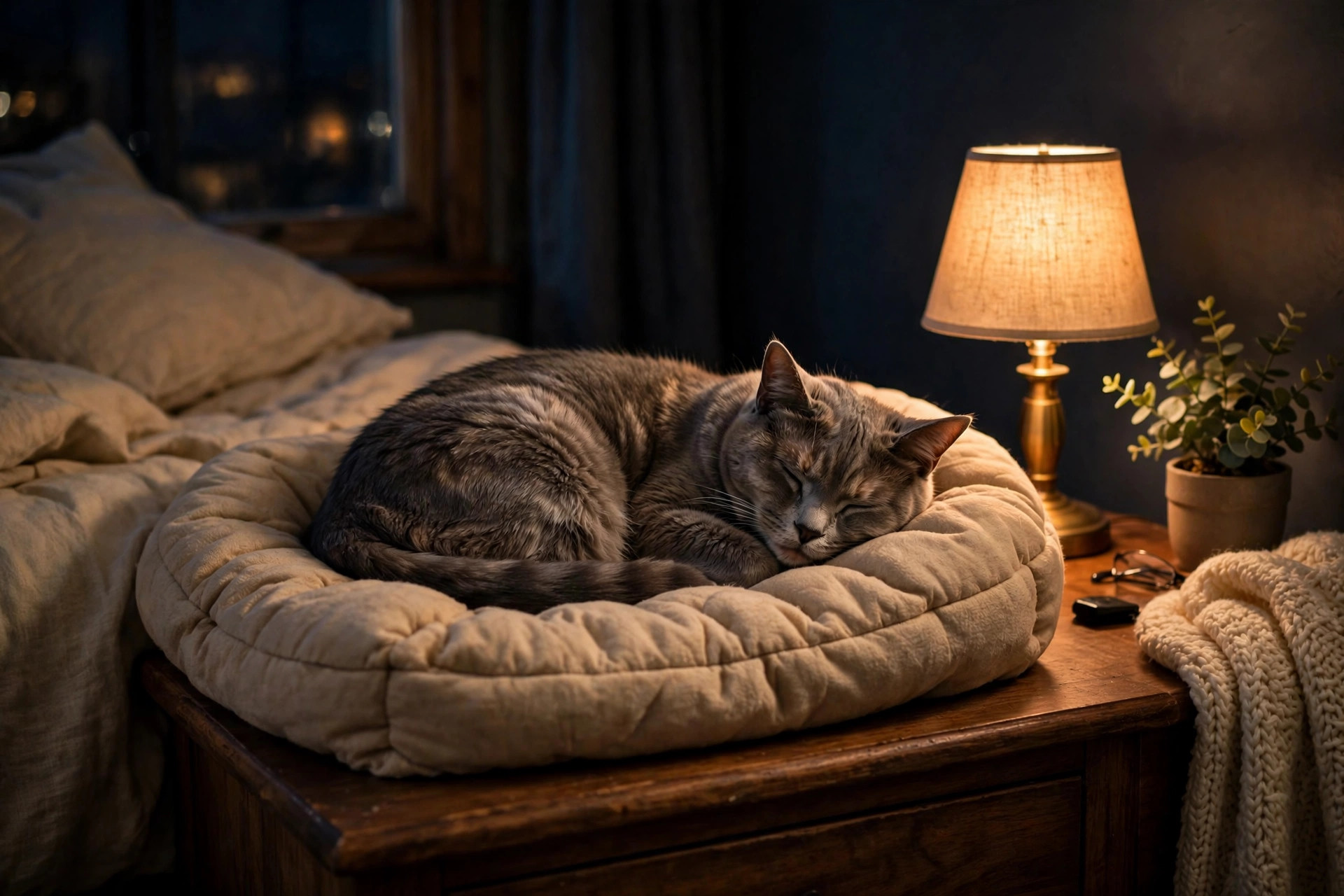
A senior cat does not need more discipline at night; she needs a better evening. Somewhere around age 11 or 12, the cat who once slept through anything starts pacing at 2 a.m., yowling in the hallway, or missing the litter box she has used for a decade. In a small apartment you hear all of it, and the fix is not training — it is a routine built around aging joints, fading senses, and a bladder that no longer waits. This is that routine, step by step.
What actually changes after age 11
Night problems in senior cats are rarely “behavior” in the training sense. They are usually one of four age-related shifts expressing itself after dark, when the apartment goes quiet and there is nothing to distract from discomfort:
- Arthritis. Stiff joints make the jump to the bed painful, the litter box entry a negotiation, and long stillness uncomfortable — so the cat gets up, lies down, gets up again. Night restlessness in a senior cat is arthritis until proven otherwise.
- Fading senses. Vision and hearing decline gradually. A cat that cannot see well in the dark gets disoriented in a dark apartment and vocalizes to locate herself — the classic 3 a.m. hallway yowl.
- Cognitive decline. Feline cognitive dysfunction shows up as night waking, vocalizing, staring, and forgetting where the litter box is. It progresses slowly and responds to routine and environmental support.
- Medical drivers. Hyperthyroidism, high blood pressure, and kidney disease all cause increased thirst, restlessness, and night vocalizing. New or suddenly worse night behavior in a senior cat earns a vet visit and bloodwork before any routine change.
The routine below assumes the vet has ruled out or is treating the medical layer. If night restlessness is new, sudden, or paired with weight loss, extra drinking, or litter box changes, the appointment comes first — no routine fixes a thyroid.
The evening sequence: 8 p.m. to lights-out
Senior cats thrive on predictability. Run the same sequence nightly; the cat will learn it within a week and start anticipating each step, which is itself calming.
- 8 p.m. — gentle play or grooming. Forget the 15-minute hunt session of her youth. Five minutes of slow wand-toy movement, a brushing session, or simply interactive petting — whatever she still enjoys. The goal is mild engagement, not exhaustion; an overtired arthritic cat sleeps worse, not better.
- 8:30 p.m. — the last real meal. Serve dinner now, not at your bedtime. Senior cats do better with the day’s calories split into 3–4 small meals; the evening portion should be the largest, served early enough that she eats, grooms, and settles. Warm the food slightly — seniors with reduced smell eat better when food is aromatic.
- 9 p.m. — litter box check and refresh. Scoop now, not in the morning. A senior cat with a full bladder and a dirty box at midnight will either hold it uncomfortably (and pace) or go on the rug. Fresh box, every night.
- 9:30 p.m. — comfort setup. Heated bed on (low setting), night lights on along her path, water bowl topped up near — not across the room from — where she sleeps. Place her in or near the bed with a treat the first few nights until the spot becomes the habit.
- 10 p.m. — lights down, apartment quiet. Dim to the night-light level you will keep all night. Sudden full darkness after bright light is what disorients a cat with fading vision; a gradual dimming gives her eyes time to adjust.
If she still wakes and yowls despite the routine, our guide on stopping night waking in a studio covers the ignore protocol — but apply it gently with seniors: first confirm the yowl is not pain, hunger, or a full bladder, because ignoring a medical signal is the one mistake you cannot take back.
The senior-proof bedroom setup
In a small apartment, the bedroom is usually the whole nighttime territory. Four changes make it navigable for an aging cat:
| Change | What to buy or do | Typical cost | Why it matters at night |
|---|---|---|---|
| Low-entry litter box nearby | Senior or shallow box, entry under 3 inches | $15–$30 | Arthritic cats avoid high-sided boxes; accidents happen at night |
| Night lights on her path | Warm plug-in LEDs along floor level | $10–$20 for a pack | Fading vision + dark apartment = disorientation yowling |
| Heated bed on low | Self-warming mat or low-wattage heated pad | $25–$60 | Old joints stiffen in cool rooms; warmth keeps her settled |
| Bed ramp or step | Pet stairs or a sturdy ottoman | $30–$70 | Removes the painful jump that keeps her pacing instead of sleeping |
Placement matters as much as the items: in a studio or one-bedroom, keep the litter box, water, and bed within a short, well-lit triangle. A senior cat should never have to cross the whole dark apartment for any nighttime need. For the full lighting approach, our night-light setup for senior pets maps out plug placement room by room.
When she still wakes: the calm response protocol
Even with a good routine, senior cats wake. The difference between a 30-second resettle and a 45-minute concert is your response:
- Check the basics first, silently. Water bowl, litter box, room temperature. Half of senior night waking resolves at the water bowl — kidney-compromised cats drink more and get thirsty at night.
- Guide, don’t carry (unless she asks). If she is yowling in the hallway, walk her back to the lit path and the warm bed with a calm voice and a treat. You are re-orienting, not scolding.
- Keep your response boring and brief. A two-minute calm resettle is fine; a 20-minute cuddle session at 3 a.m. teaches that yowling produces premium attention, even in a 15-year-old. Warm, short, done.
- Track the pattern. A notebook by the bed: time, what she did, what helped. “Yowled at 2 a.m. three nights running, drank a lot” is the sentence that gets a vet to run bloodwork instead of shrugging.
A senior cat’s night is only as good as her evening. Comfort, warmth, light, and a fresh litter box do more for 2 a.m. pacing than any amount of nighttime discipline ever will.
FAQ
Why does my senior cat yowl at night all of a sudden?
Sudden night vocalizing in a cat over 11 is a vet visit, not a behavior project, until proven otherwise — hyperthyroidism, hypertension, pain, and cognitive decline all present this way. If bloodwork is clear, the usual drivers are disorientation in the dark (fix with night lights), arthritis pain (fix with warmth and low-entry everything), or a learned attention loop.
Should I let my senior cat sleep on the bed with me?
If she can get up and down without pain — with stairs or a ramp — yes; the warmth and company genuinely help seniors settle. If she struggles, cries when jumping, or has started avoiding the bed, give her a heated bed at floor level instead. Forcing the jump nightly is how arthritis turns into night pacing.
How many litter boxes does a senior cat need in a small apartment?
At least one per floor of her territory plus easy access — in a studio or one-bedroom that usually means two: one near where she sleeps, one in the usual spot, both low-entry and scooped nightly. Senior bladders do not wait, and distance is the enemy. Our litter box number guide covers the general math.
Do calming supplements help senior cats sleep?
They can take the edge off anxiety-driven restlessness, but they do not fix pain, thirst, or disorientation — and some interact with common senior medications. Run any supplement past the vet who manages her other drugs first, and treat supplements as a complement to the routine, not a replacement for it.