Litter Box Training for Kittens in Small Apartments
Kittens arrive with the instinct to dig and bury already installed. Litter training in a small apartment is therefore mostly an access problem: a box with sides a nine-week-old can climb, in the room the kitten actually lives in, visited after every meal, nap, and play session. Get those logistics right and most kittens are reliable within two weeks — no scolding, no spray bottles, and no mystery corners.
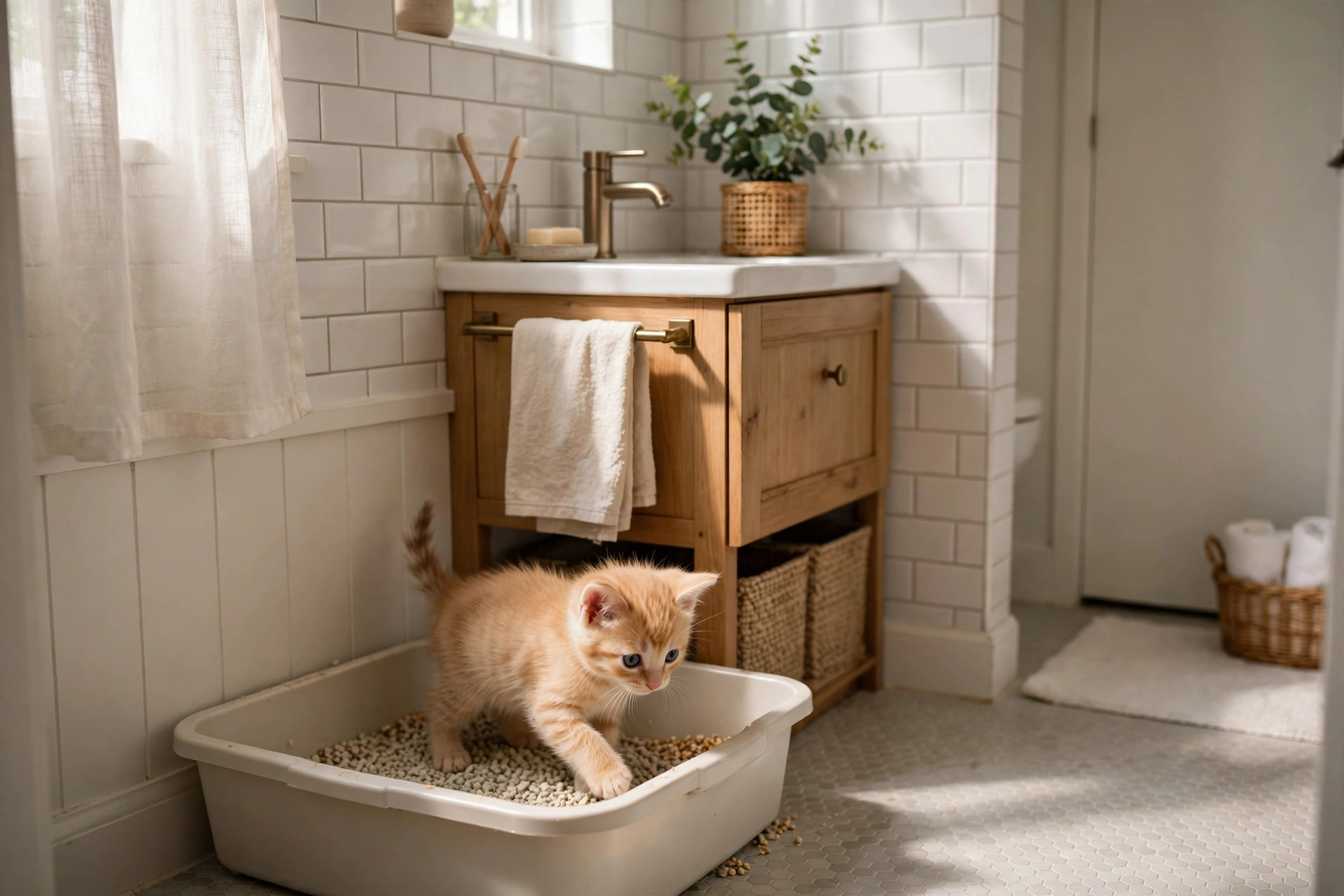
- Most kittens arrive pre-programmed by their mother; your job is access, not teaching — a box the kitten can always reach and climb into.
- Sides under 3 inches for kittens under 12 weeks; a full-size box with one cut-down entry beats a tiny kitten box they outgrow in a month.
- The golden moments: after meals, after naps, after play. Carry the kitten to the box at those times for the first two weeks.
- Unscented, fine-grain litter, 1–2 inches deep for kittens — deep litter swallows small legs and discourages digging.
- Punishment never works. A miss means the box was too far, too dirty, too tall, or the kitten is unwell — in that order of likelihood.
Access first: box size, height, and count for small homes
Kitten litter training fails in apartments for physical reasons far more often than behavioral ones. A nine-week-old kitten has a bladder the size of a walnut, legs four inches long, and a strong instinct to dig and cover — provided it can reach a suitable spot within about thirty seconds of the urge. In a 600-square-foot apartment that means the box must be in the room the kitten actually lives in, not down a hall behind a closed door. For the first two weeks, confine the kitten's world to one room with the box in a quiet corner of it; expand territory one room at a time as the record stays clean.
Buy the adult box now and modify it. A standard open box around 18 by 14 inches with one side cut down to a 2–2.5-inch entry (or a low-entry model like the IRIS USA open litter box, usually $15–$25) serves from kittenhood to adulthood. Tiny novelty kitten boxes are outgrown by week 14 and every box change is a small re-training event you do not need. Skip hoods and top-entry designs until at least six months — lids trap odor at kitten nose height and top entries require jumping strength kittens do not yet have. Our litter-zone setup guide covers where the box can live once the kitten has the run of the apartment.
The after-meal, after-nap, after-play routine
For the first two weeks, you are the kitten's transport system. Place the kitten in the box at four predictable moments: within five minutes of finishing a meal, immediately after waking, after a play session, and whenever you see the pre-elimination signals — sniffing the floor in circles, scratching at carpet or bedding, or suddenly sprinting to a corner. Gently scratch the litter with your fingertip once; most kittens copy the digging motion within a day or two. Then step back. Hovering at face level makes some kittens leave, and leaving mid-lesson is the habit you are trying not to build.
Praise quietly when the kitten uses the box, wipe any miss with an enzymatic cleaner (Nature's Miracle or Rocco & Roxie, usually $12–$18 a bottle), and never — at any age — rub the kitten's face in a miss or scold it near the box. Cats form place associations fast; a box associated with being grabbed and shouted at becomes a place to avoid, and you will have traded a two-week training task for a two-month one. Most kittens are reliable in their home room within 7–14 days. Reliability across a whole apartment takes until roughly four months, which is a maturity fact, not a training failure.
- Meal ends → carry to box, wait two unhurried minutes, then play.
- Nap ends → box before the first stretch is finished, if you can manage it.
- Play ends → box, then water; excitement loosens small bladders.
- Bedtime → final box trip as part of the lights-down sequence, every night.
Litter choice and depth for kitten paws
Kittens explore the world mouth-first, which drives the one safety rule of kitten litter: avoid clumping clay litter until about four months, because kittens who nibble litter can swallow clumps that expand. Use a non-clumping or natural litter in the early weeks — paper-based Yesterday's News-style pellets (usually $12–$18 a bag) or a fine walnut or corn litter (usually $15–$25) — then transition to the adult litter your apartment life actually needs. Our comparison of clumping versus crystal litter and the tofu-litter guide cover the odor-versus-tracking trade-offs for small spaces once the kitten is old enough for the full menu.
Depth matters more than brand at this age. Fill 1–2 inches: enough to dig and cover, not so much that a three-pound kitten sinks to its belly and concludes the box is a swamp. Keep the texture constant during training; changing litter, box, and room in the same week is the classic setup for a sudden strike. Scoop twice daily. A kitten deciding whether the box is acceptable is making a cleanliness judgment with a nose far better than yours, and in a small apartment you will want that twice-a-day habit anyway.
One apartment-specific warning: keep kittens away from automatic self-cleaning boxes until they weigh enough to trigger the sensor reliably and are old enough not to be frightened by the rake — most manufacturers set the floor around six months and 5 pounds. A kitten startled mid-use by a moving rake can develop a durable box aversion in a single afternoon.
Misses: the four-cause checklist
When a kitten misses, work this checklist in order before assuming attitude. First, distance: was the box in the same room, with the door open? Kittens do not plan ahead. Second, access: could the kitten climb in easily, and was a resident cat, a dog, or a laundry basket blocking the corner? Third, cleanliness: a box used twice by two animals is, to a kitten, a full box. Fourth, health: kittens who strain, cry, visit the box repeatedly with little result, or have diarrhea need a veterinarian the same day — urinary and parasite problems are common in recently rehomed kittens and both present as 'bad litter habits.'
Location misses are information, not defiance. If the kitten repeatedly chooses the bath mat, it prefers soft texture — try a finer litter and move the mat for two weeks. If it chooses a corner of the bedroom, it is asking for a second box there; in multi-room homes the adult rule of one box per cat plus one extra applies, and kittens may need a temporary second box that you retire at five months. In a studio, one well-placed box plus fast cleanup beats two boxes competing for the same corner.
Every miss is a field report: too far, too tall, too dirty, or not feeling well. Read the report, fix the cause, and the training fixes itself.
Graduating to the whole apartment
Expand territory when the kitten has been accident-free in its home room for five consecutive days. Open one new room, keep the original box exactly where it is, and supervise the first evenings. If the kitten plays in the new room for an hour and then travels back to the box, the map is learned. Move the box to its permanent home last, and move it slowly — a few feet a day — or simply place the permanent box and retire the training box only after the kitten uses the new one reliably for a week. The permanent-spot rules for tiny homes are in our guide to where to put the litter box in a studio.
By five to six months most kittens handle a one-bedroom apartment on a single box, scooped twice daily, with the litter transitioned to your adult choice. Keep the enzymatic cleaner under the sink for the occasional surprise during thunderstorms, guests, or schedule chaos — even well-trained young cats have a short list of things that reset them, and a fast, unemotional cleanup keeps a one-off from becoming a habit.
FAQ
At what age do kittens use a litter box reliably?
Most kittens use a box in their home room within 1–2 weeks of arrival (usually by 9–11 weeks old) and manage a whole apartment by about four months. The instinct is built in; reliability is mostly bladder maturity and easy access.
How many litter boxes does a kitten need in a studio?
One, placed in the kitten's main living area and scooped twice a day. Add a temporary second box only if misses cluster in a specific far corner — that is the kitten requesting one.
Why does my kitten use the box, then miss an hour later?
Usually access or distraction: the kitten was playing hard in another area and left it too late. Increase supervised box trips after play, and check that no resident pet is ambushing the box corner.
Can I use clumping litter for a 10-week-old kitten?
It is safer to wait until about four months. Kittens mouth litter, and swallowed clumping litter can expand in the stomach. Use paper, walnut, or other non-clumping options first, then transition gradually.
Should I keep the litter box in the bathroom?
Only if the door stays open at all times and the kitten lives mostly nearby during training. Bathrooms are easy to clean but easy to be shut out of; during the first weeks, the box belongs in the kitten's main room.