How to Stop a Cat From Knocking Things Off Shelves
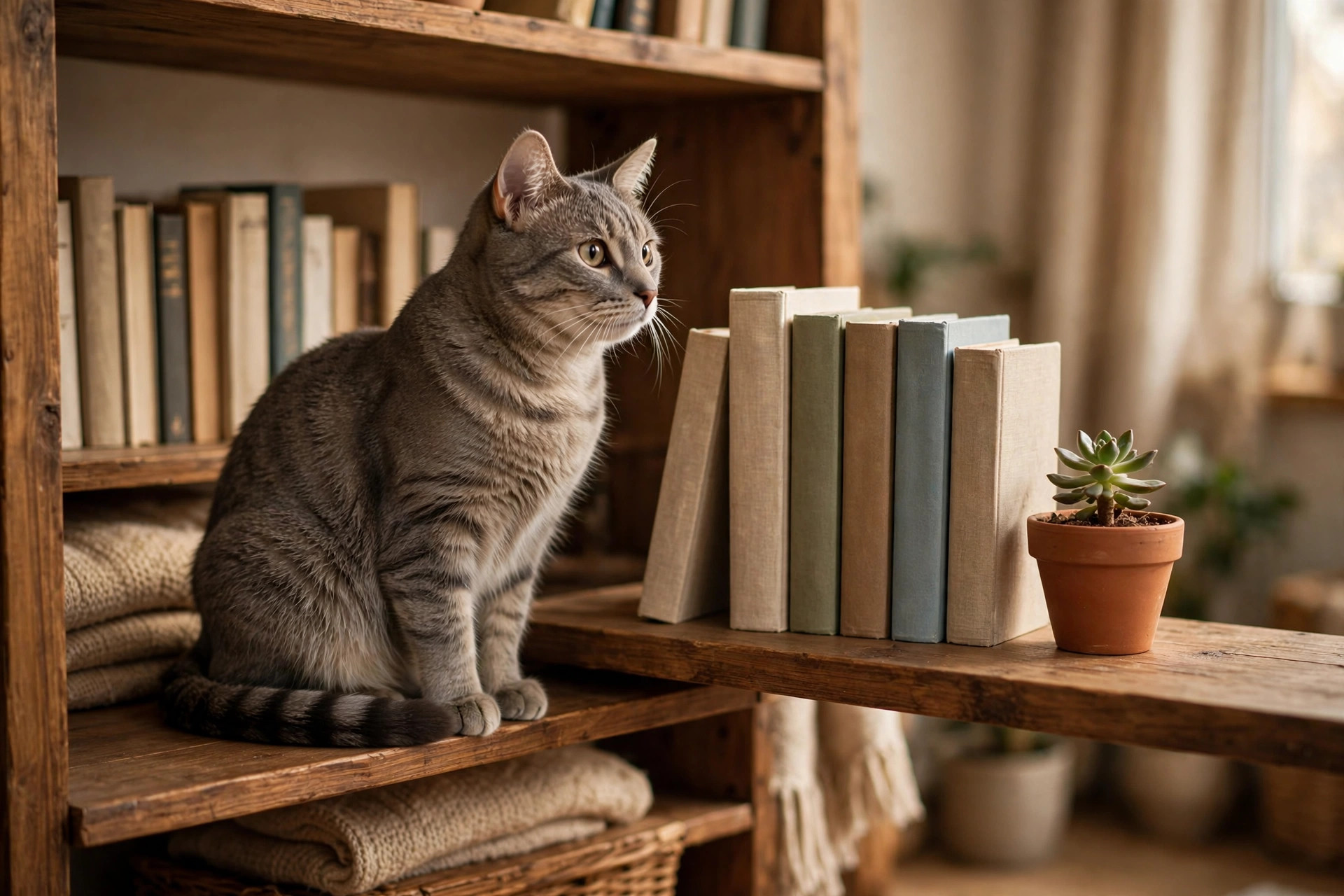
It is 3 a.m. You hear the deliberate scrape of a paw against ceramic, a pause — the cat is looking at you — and then the crash. Cats do not knock things off shelves to annoy you, though it certainly feels personal. They do it because moving objects trigger the prey-testing instinct, because the crash summons the human (which is interesting at 3 a.m. when nothing else is), and because the shelf is in their territory and your vase is in their way. You cannot train the instinct out, but you can make the habit unrewarding and the shelves uninteresting. That combination ends it.
- Cats knock things off for three reasons: prey-testing instinct (does it move?), attention (the crash summons you), and clearing their path along the shelf.
- Secure what matters: museum putty ($8–$12) or earthquake gel under valuables, heavier bases on lamps, and nothing breakable on open shelves the cat walks.
- Rearrange shelves so the cat’s highway is clear — a dedicated empty stretch of shelf for the cat, with objects pushed back from the edge on the rest.
- Stop rewarding the 3 a.m. crash test: no getting up, no shouting, no dramatic reaction. Attention is the paycheck; remove it.
- Bored cats audit your shelves nightly. Ten minutes of evening wand-toy play plus a food puzzle cuts most shelf crime within a week.
Why they do it: the three motives
Motive 1: the prey test. A cat’s paw tap is a diagnostic tool — in the wild, it tests whether something is alive, edible, or dangerous. Your pen, your keys, the remote: each gets the tap, and anything that moves, rolls, or makes an interesting sound passes the test and gets pushed further. This is why small, light, rollable objects are the primary victims. The cat is not being bad; it is running quality control on its environment.
Motive 2: the summoning. A crash brings the human running, every time, often with shouting and chasing — which, to a bored cat at 3 a.m., is the most exciting thing that has happened all night. If you leap out of bed when the vase wobbles, you have just paid the cat for the behavior with the highest-value currency there is: your full attention. Cats that knock things off at night are almost always running this economy.
Motive 3: the highway. Shelves, mantels, and bookcases are cat highways — elevated routes through the territory. Your decorative objects are traffic cones in the middle of the road. The cat does not hate your succulent; the succulent is simply in the way of the patrol route, and paws clear obstacles. This motive is the easiest to fix, because it is an interior-design problem, not a behavior problem.
Secure the displays: museum putty and shelf engineering
Start with the physics. Museum putty (QuakeHold and similar, $8–$12 a pack) is a reusable adhesive that anchors vases, frames, and figurines to the shelf — a pea-size dab under each object resists a paw swipe but peels off cleanly when you redecorate. It is the single highest-value purchase for this problem. For heavier items like lamps, swap to wider, heavier bases or add adhesive furniture pads that raise friction. Anything genuinely irreplaceable — heirlooms, expensive ceramics — moves behind glass: a display cabinet with doors ($60–$150 secondhand) ends the risk entirely.
Then engineer the shelf itself. Push objects back from the edge at least 4–6 inches — most paw swipes only reach the front two inches, so depth is free protection. Leave one shelf, or one stretch of shelf, deliberately clear as the cat’s highway: a folded blanket or a small cat bed ($15–$25) on that stretch tells the cat “this part is yours.” Cats with a sanctioned perch on the shelf stop clearing the rest of it. And check the shelf’s stability itself — a cat launching onto a wobbly floating shelf brings everything down at once, which is also why our furniture-anchoring guide matters for climbers.
Remove the paycheck: the boring response protocol
For the attention motive, the fix is gloriously simple and annoyingly hard: when the cat knocks something off, do nothing dramatic. No shouting, no leaping up, no chase — calmly pick it up later, or in the morning. The first three nights are the worst, because the cat escalates to test whether the old payoff still works (the extinction burst — expect louder crashes on night two). By night four or five, the behavior starts fading, because the human stopped being interesting.
Two things make this work instead of merely suffering. First, secure the breakables first (see above) so the extinction burst does not cost you the good vase. Second, replace the nighttime excitement with a scheduled evening play session: ten minutes of wand-toy hunting ($8–$12 for a good one) ending with a small meal, right before your bedtime. A cat that has hunted, eaten, and groomed is a cat that sleeps — the 3 a.m. audit happens because the cat woke up bored. Our indoor cat enrichment schedule builds this into a full daily rhythm.
You cannot punish the instinct out, but you can bankrupt it. Secure the objects, bore the audience, tire the hunter — the shelf crime wave ends when none of it pays anymore.
The enrichment fix: give the paws a better job
A cat that spends its nights auditing shelves is a cat with unspent hunting energy. The long-term fix is not shelf management — it is a life interesting enough that the shelves are boring by comparison. The core prescription: two 10-minute interactive play sessions daily (morning and evening), a food puzzle for at least one meal ($10–$20 for a starter puzzle feeder — see our puzzle feeder guide), and a window perch or bird feeder view for daytime entertainment. Rotate the toys weekly; a feather wand that reappears after a week off is new again.
For the dedicated shelf-walker, add vertical territory that is better than the bookshelf: a tall cat tree ($60–$120) near a window, or renter-friendly wall shelves ($40–$80 for a set) mounted on studs. Cats choose the highest, most interesting route — make the legal highway better than the bookshelf and the traffic reroutes itself. Most owners report the shelf crime dropping 80–90% within two weeks of the full program: secured objects, boring responses, and a genuinely tired cat.
FAQ
Will a spray bottle stop my cat knocking things off?
It stops the cat while you are watching and teaches it to do it when you are asleep — which is when most of it happens anyway. Punishment also damages trust without addressing any of the three motives. Management plus enrichment works; the spray bottle just moves the crime to 3 a.m.
Is museum putty safe if my cat chews it?
Museum putty is non-toxic, but it is not food — use a small amount fully hidden under the object, not blobs at the edges where a cat can pick at them. For dedicated chewers, earthquake gel (clear, less interesting to chew) or behind-glass display is the safer choice.
My cat only knocks things off at night. Why?
Cats are crepuscular — most active at dawn and dusk — and a cat that sleeps all day wakes up at 3 a.m. with a full hunting budget and an empty apartment. The evening play-hunt-eat-sleep sequence targets exactly this: a tired cat at midnight is not auditing shelves at 3 a.m.
Should I just clear all my shelves?
You do not need to live in an empty apartment — secure the valuables with putty, push the rest back from the edge, and give the cat its own sanctioned shelf stretch. Most owners keep 90% of their decor exactly where it is and lose 90% of the crashes.