How to Anchor Furniture and TVs Against Climbing Cats
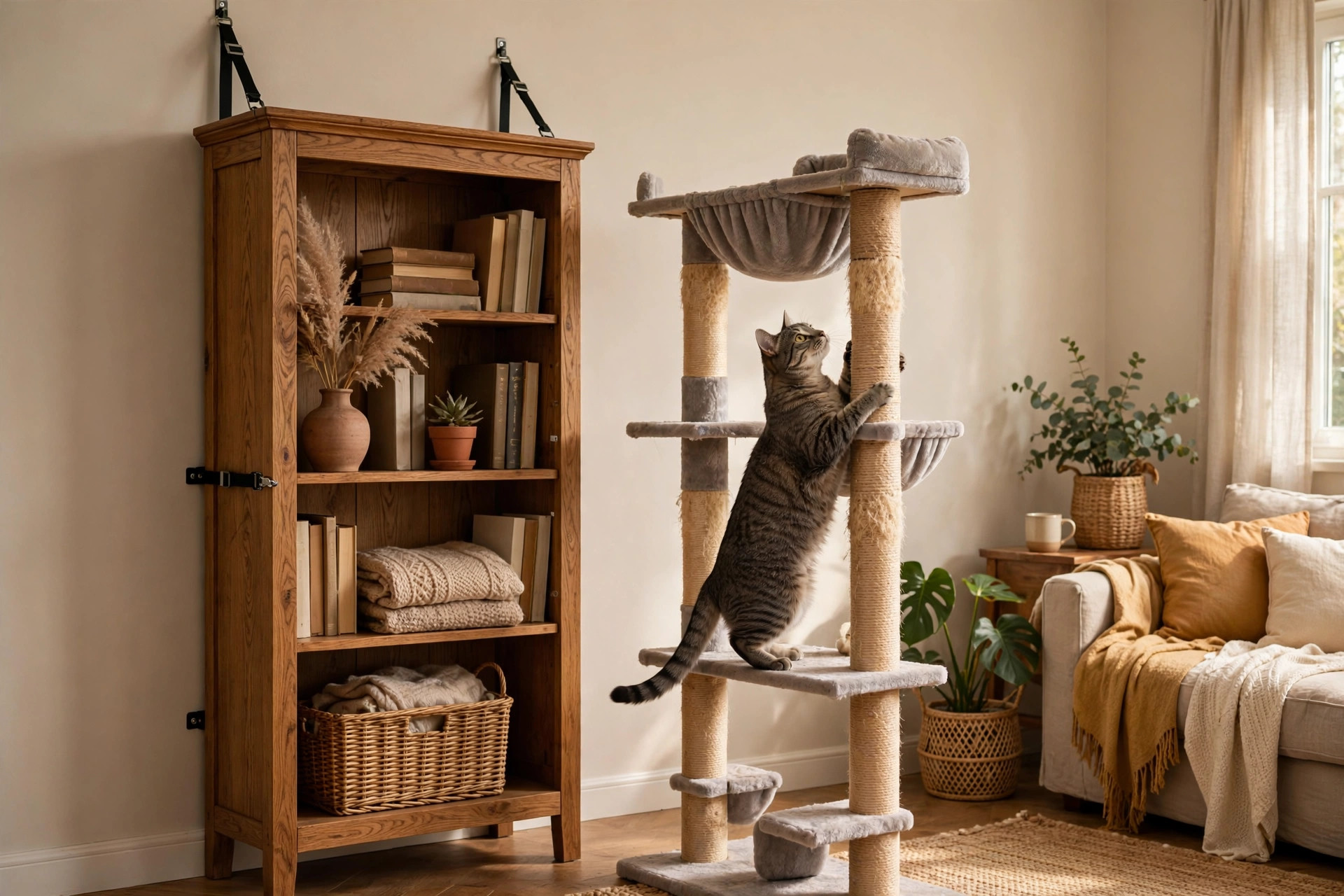
A 12 lb cat hitting the top of a bookcase at full sprint generates startling force — and bookcases, dressers, and flat-screen TVs are designed to sit still, not to absorb a lateral impact from a furry projectile. Tip-over injuries kill children every year and crush cats with grim regularity: the animal climbs, the furniture goes, and a 60 lb bookcase lands on a 10 lb animal. Anchoring is a $15, one-hour project per room. There is no reason any cat owner’s furniture should be unanchored.
- Anchor every bookcase, dresser, and shelving unit taller than 27 inches. If a cat can climb it, a cat can tip it.
- Strap kits ($5–$20) beat L-brackets for renters: strong, removable, and they do not care what the furniture is made of.
- TVs get wall-mounted or strapped to the stand — a TV on feet is a guillotine with a cat launching behind it.
- Anchors must hit a stud or a proper drywall anchor. A screw in bare drywall holds nothing; the whole point fails at the wall.
- Budget about $15 per furniture piece and $30–$60 for the TV. One hardware-store trip covers the apartment.
The physics of a cat vs. a bookcase
A typical apartment bookcase — 6 feet tall, 30 inches wide, loaded with books on the upper shelves — is already top-heavy by design. Its center of gravity sits high, and its footprint is narrow. A cat launching onto the top shelf adds a sudden lateral load at the worst possible point: the very top, where leverage is greatest. It does not take much — a 10 lb cat landing hard is enough to start a tall, narrow, top-loaded case moving, and once it passes the tipping point, gravity finishes the job.
Dressers are the sleeper hazard. They look stable, but a cat climbing the open drawers — using them as stairs, which every cat owner has watched — pulls the weight forward drawer by drawer. An extended drawer full of clothes plus a cat on the front edge is a tip-over recipe. This is the same mechanism behind child dresser tip-overs, and the fix is identical: anchor the back to the wall.
Three anchoring kits that actually hold
| Kit | How it works | Typical price | Best for |
|---|---|---|---|
| QuakeHOLD! Furniture Strap | Nylon strap, furniture bracket + wall bracket | Usually $12–$18 for 2 | The standard; strong, adjustable, removable. |
| Skyla Homes Anti-Tip Kit | Steel cable + brackets | Usually $15–$25 for 2 | Heavy pieces; the highest load rating of the three. |
| IKEA PATRULL | Fabric strap + wall fitting | Usually $4–$6 | Budget and IKEA furniture; does the job for light cases. |
QuakeHOLD! — the default recommendation
QuakeHOLD! straps are the earthquake-country standard, which tells you everything about their strength: they are designed to hold furniture through shaking, so a cat is well within their margin. The kit includes a bracket that screws to the furniture’s back or top, a wall bracket, and an adjustable nylon strap connecting them. Installation is two screws and a tug-test. The strap has enough give to let you pull the furniture out for cleaning without detaching it — a detail that determines whether the anchor stays installed or gets removed in annoyance. Two straps per tall piece (one per top corner) is the correct dosage. $12–$18 for a 2-pack.
Skyla Homes — for the heavy stuff
When the furniture is a solid-wood armoire or a loaded 6-foot bookcase, steel cable beats nylon strap. Skyla’s kit uses braided steel cable with metal brackets and carries the highest load rating of common consumer kits. The trade-off is less forgiveness: steel does not stretch, so measure the furniture-to-wall distance carefully and position the piece where it will live before installing. $15–$25 for two. Overkill for a small nightstand; exactly right for the big bookcase the cat treats as a personal tower.
IKEA PATRULL — the budget strap
IKEA includes wall-anchoring hardware with most of its tall furniture, and the PATRULL strap ($4–$6) is the standalone version. It is a simple fabric strap with a wall fitting — less adjustable than QuakeHOLD!, but perfectly adequate for light-to-medium bookcases and shelving. If your apartment is mostly IKEA furniture, buying a handful of these with your next order is the cheapest path to a fully anchored home. Pair with proper wall anchors (below) — the strap is only as strong as what it screws into.
An anchor screwed into bare drywall is a decoration. The wall side of every strap must hit a wood stud or a rated drywall anchor — toggle bolts or self-drilling anchors rated for the load. Test every installation with a firm pull at the furniture’s top edge; if it moves, the anchor failed, not the strap.
The wall side: studs, anchors, and renter repairs
The furniture side is easy; the wall side is where installations fail. Here is the decision tree:
- Wood stud: the gold standard. Find it with a $15–$25 stud finder (or the knock-and-listen method), drive a 2-inch wood screw through the wall bracket into the stud. Holds hundreds of pounds.
- Drywall, no stud: use toggle bolts or self-drilling threaded anchors rated for at least 50 lbs each. Cheap plastic expansion plugs are not enough — they pull out under sustained lateral load. Two rated anchors per bracket.
- Plaster/lath (old buildings): drill carefully with a masonry bit at low speed to avoid cracking the plaster, then use toggle bolts. Old plaster is strong once you are through it.
- Concrete: masonry screws or concrete anchors with a hammer drill. If you do not own one, this is the one case where asking the super for help is reasonable — or use a freestanding alternative (below).
Renters: a 1/4-inch screw hole is a dab of spackle and a touch of paint at move-out — the most routine repair in existence, and no landlord has ever reasonably objected to furniture anchoring. (Many leases explicitly require it for tall furniture.) If your lease truly forbids wall holes, freestanding anti-tip options exist: heavy-duty furniture anchors that wedge between the piece and the ceiling, or simply replacing tall narrow bookcases with short wide ones that cannot tip. But check the lease first — “no holes” almost always means “no unrepaired holes,” and spackle exists.
TVs: the special case
A modern flat-screen on its factory feet is a tall, thin, top-heavy object on a narrow stand — the single most tippable item in the living room, and cats love the warm slot behind it. Two fixes, in order of preference:
- Wall-mount it. A tilting wall mount ($25–$50) rated for your TV’s size and VESA pattern eliminates the tip-over risk entirely and frees the stand surface. Mount into studs — a TV’s weight plus a cat’s launch force needs real structure. This is the best answer and the one worth doing.
- Strap it to the stand. If wall-mounting is impossible, use TV anti-tip straps ($10–$18 for a pair): one end screws to the TV’s VESA holes, the other to the back of the stand, and the stand itself gets anchored to the wall. Strap the TV and anchor the stand — strapping the TV to an unanchored stand just ensures they tip over together.
Also manage the warm gap behind the TV: cats wedge into it for the heat, then panic when the TV wobbles. A wall-mounted TV with 2–3 inches of clearance removes the wedge spot; a strapped TV should have its cables bundled (see our cord protector guide — written for puppies, equally applicable to cats) so there is nothing to chew back there.
The 30-minute room sweep
Do one room at a time, top to bottom:
- List everything taller than 27 inches the cat can reach: bookcases, dressers, shelving units, the TV stand, floor lamps (yes, really — a cat launching off a bookshelf onto a floor lamp topples it).
- Push-test each piece. Push firmly at the top front edge. Anything that rocks, slides, or feels eager to move gets anchored today.
- Install straps high. Anchors work by leverage: a strap at the top of the furniture resists tipping far better than one at mid-height. Top third of the piece, both top corners for anything over 4 feet tall.
- Tug-test everything. Pull the top of each anchored piece toward you with real force. It should feel like pulling the wall. Re-do any that give.
- Re-check yearly. Straps loosen, cats get heavier and bolder, furniture gets rearranged. Annual tug-test day — tie it to the smoke-detector battery change.
While you are at it, this is the natural moment to do the companion project: our loft bed and high furniture safety guide covers the fall side of the vertical-apartment problem, and the two projects share tools and an afternoon.
FAQ
Will anchoring damage my rental walls?
A screw hole is filled with a dab of spackle ($5) and touched up with paint at move-out — the most routine repair there is. Most leases explicitly permit or require furniture anchoring. The damage from an unanchored bookcase falling — to the wall, the floor, and the cat — is vastly worse.
My cat is only 8 lbs. Can it really tip furniture?
Yes. Tip-over is about leverage, not just weight: a small cat landing on the top edge of a tall, narrow, top-heavy bookcase applies force at the maximum leverage point. Add the dynamic load of a sprinting launch, and 8 lbs is plenty to start a tippy piece moving.
How many anchors does a bookcase need?
Two — one per top corner — for anything over 4 feet tall. One centered strap resists straight-back tipping but allows the case to twist and walk sideways under repeated cat launches. Two corners lock it in both axes.
Can I just put heavy things on the bottom shelf instead?
Bottom-weighting helps stability but does not replace anchoring — it raises the force needed to tip, but a determined cat launch on a tall case can still overcome it, and it does nothing about the case walking forward incrementally with repeated impacts. Do both: heavy items low and straps at the top.
What about freestanding TV stands — are they safer than wall mounts?
No — a TV on a stand is tippable unless both the TV is strapped to the stand and the stand is anchored to the wall. A wall mount eliminates the problem in one step and is the stronger, simpler solution whenever the wall allows it.