How to Pet-Proof a Home Gym in a Small Apartment
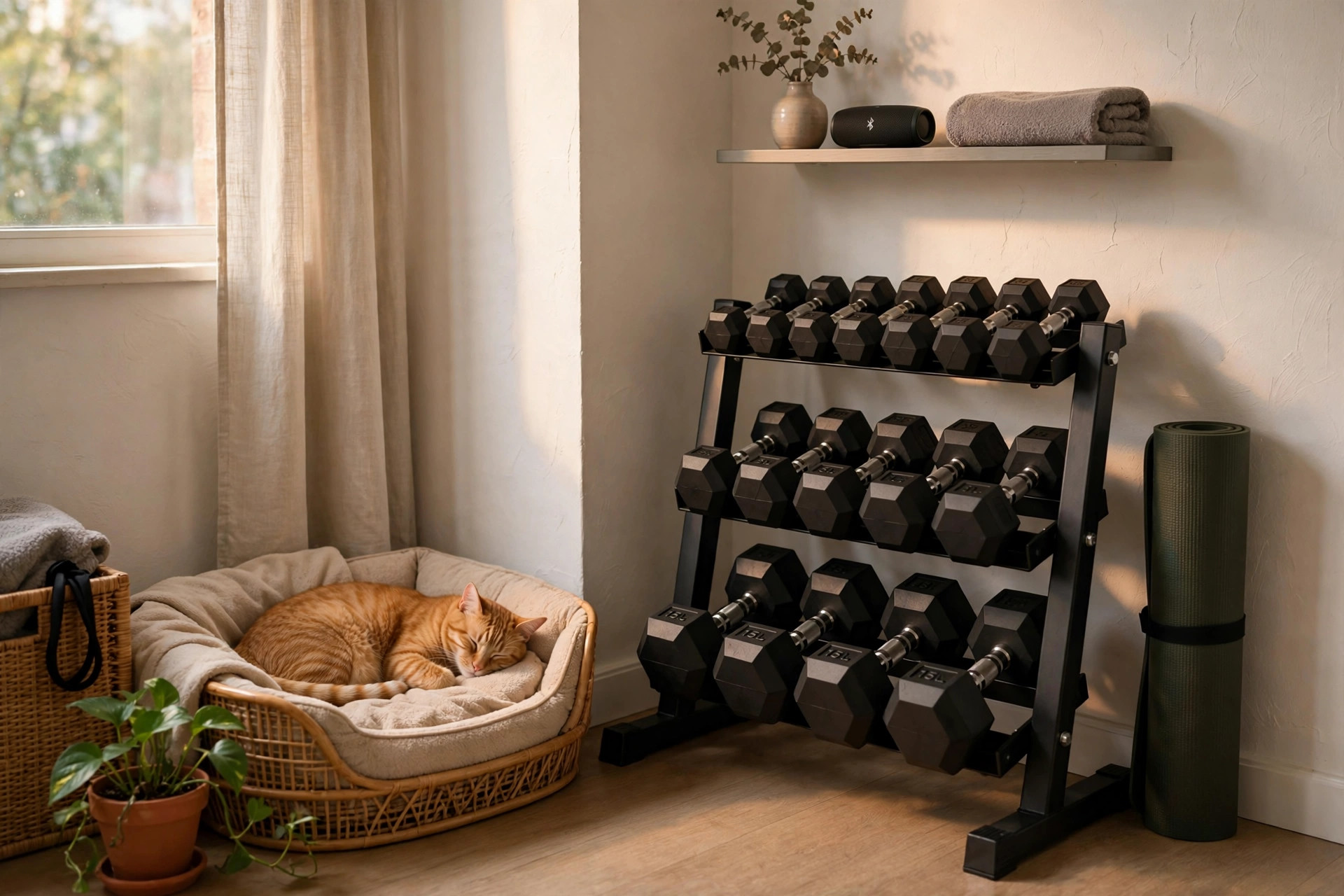
A home gym in a small apartment is a room your pet already considers theirs — the warm spot under the bench, the interesting-smelling mat, the resistance band that is clearly a toy. The hazards are real: a 25 lb dumbbell rolling off a rack onto a paw, a snapped resistance band, a cat chewing a cable, a dog walking under a loaded bar. Pet-proofing a gym corner takes one focused afternoon and about $50 in supplies, and it ends the low-grade anxiety of working out while scanning the room for your animal.
- Store every weight off the floor in a rack or locked cabinet. A dumbbell on the floor is a rolling hazard; on a rack it is furniture.
- Resistance bands live in a closed container, not draped over equipment. A snapped band under tension can injure eyes — yours and the pet’s.
- Give the pet a defined spot in the gym area — a bed or mat with a “place” cue — so “out of the way” is a trained behavior, not a hope.
- Unplug and cover anything with a motor or a cable. Cats chew cords; dogs trip on them.
- Budget roughly $40–$60: a weight rack or storage, a lidded bin for small gear, cord covers, and a mat for the pet’s spot.
Map the hazards by equipment
Walk your gym corner at pet height — literally crouch down — and inventory what an animal encounters:
- Dumbbells and kettlebells. The number-one gym injury risk for pets is a weight rolling or falling onto a paw or tail. Round dumbbells roll; hex dumbbells migrate when bumped. Anything above 10 lbs can break small bones. Kettlebells are worse — top-heavy and eager to tip.
- Weight plates and barbells. Plates leaning against a wall slide and pinch. A loaded barbell on a low rack is at head height for a large dog walking underneath.
- Resistance bands and tubes. Chewing hazard plus snap-back hazard. A band anchored to a door that slips free under tension whips back at face height — for a dog sitting nearby, that is an eye injury.
- Benches and racks. Pinch points where adjustable parts meet, and collapse risk if a large dog jumps against an unfolded bench. Cats love the underside of benches — check before adjusting anything.
- Cardio machines. Treadmill belts are the classic: a curious cat or small dog stepping onto a moving belt gets thrown, and paws caught at the rear roller get serious friction injuries. Bikes and rowers have exposed chains, flywheels, and cables.
- Small gear. Jump ropes (entanglement and chewing), foam rollers (chewed into chunks that get swallowed), wrist wraps and lifting straps left on the floor (linear foreign bodies if swallowed — a surgical emergency in cats especially).
- Supplements and cleaning wipes. Pre-workout powders, protein powder with xylitol/birch sugar, and disinfectant wipes are all toxic or irritating. Gym bags on the floor are buffets.
The storage overhaul (one afternoon)
The core principle: nothing the pet can move, chew, or knock over stays at pet level. Work through the gym corner in this order:
- Rack the weights. A 3-tier dumbbell rack ($60–$120) holds a full set off the floor; for small spaces, a compact 2-tier or a vertical dumbbell stand ($40–$70) fits in about 2 square feet. Kettlebells go on the bottom tier or in a dedicated kettlebell tray — never balanced on top of anything. Plates go on a plate tree or a vertical plate holder, never leaning against the wall.
- Bin the small gear. One lidded storage bin ($12–$18, the kind with a snap lid) for bands, jump ropes, wraps, straps, and foam rollers. The lid matters — open bins are just organized temptation. Bands get coiled, not knotted; knotted bands develop weak spots that snap under load.
- Cover the machines. A treadmill gets unplugged after every session (pull the safety key and pocket it — a hanging safety key is a cat toy that starts the belt) and covered with a fitted equipment cover ($20–$30) that blocks paw access to the belt gap. Bikes and rowers get their cables routed and covered.
- Manage the cords. Run every cable through a cord cover channel ($10–$15 for a multi-pack) along the wall, and bitter-apple spray on the cover for dedicated chewers. Power strips go inside a cord box, not on the floor.
- Lock the consumables away. Supplements, wipes, and the gym bag move to a closed cabinet or a high shelf. Protein powder with xylitol (often labeled “birch sugar”) is the one to fear — it is severely toxic to dogs even in small amounts.
The test of a pet-proofed gym is simple: could you leave the room for five minutes mid-workout without worry? If the answer is no, something is still at pet level that should not be.
Train the “place”: give the pet a job during workouts
Banning the pet from the gym room works in a house with doors. In a studio or one-bedroom, the gym corner is the living room, so the realistic goal is a trained spot:
- Set up a bed or mat 6–8 feet from the equipment — far enough that a dropped plate cannot reach, close enough that the pet does not feel exiled. A raised cot-style bed ($25–$40) reads as “the spot” more clearly than a flat mat.
- Teach “place” separately from workouts. Ten 5-minute sessions over two weeks: lure onto the bed, reward for staying, release with a cue. Build duration before adding your movement nearby, then add equipment sounds (clanking a plate gently at distance, rewarding calm).
- Make the spot pay. A stuffed Kong or a long-lasting chew appears on the bed only during workouts. The pet should think gym time is the best part of the day.
- Cats get vertical, not horizontal. A cat will not stay on a floor bed during your workout. Give it a perch or a shelf at the room’s edge with a view of you — supervision satisfies most cats’ need to monitor the weird human activity.
For the first month, use a freestanding pet gate during heavy sessions (deadlifts, overhead work) while the “place” behavior is still proofing. Gates are training wheels, not the solution — but training wheels prevent accidents.
During the workout: the live rules
- Check under and around equipment before each session. Cats nap in the warm hollow under benches and inside plate trees. Make the pre-workout scan a ritual: clap once, look under the bench, check the treadmill belt.
- No pets under a loaded bar. Ever. A dog wandering under during a squat set is the nightmare scenario — the spotter’s job includes watching the floor, not just the bar.
- Collar off during workouts. Tags and collars snag on equipment. A naked pet in the gym room is a safer pet.
- Water bowl placement. Keep the pet’s water 8+ feet from the equipment — a kicked bowl under a bench creates a slip hazard for you mid-lift.
- End-of-session reset. Re-rack everything, bin the small gear, unplug the treadmill, close the supplement cabinet. The five-minute reset is what keeps the system working; a gym that decays back to floor-weights within a week was never pet-proofed, just tidied once.
Renter-specific notes
Apartment gyms have two extra constraints: floors and neighbors. Dropped weights transmit through most buildings — a 6×4-foot area of 3/4-inch rubber horse-stall mats ($40–$60 per 4×6 mat) under the lifting zone protects the subfloor and meaningfully dampens impact noise. Interlocking foam tiles are cheaper but compress under heavy loads; rubber is the right material where iron lands. For neighbors below, keep heavy compound lifts to daytime hours and consider bumper plates over iron if you are buying — they are quieter on the drop and kinder to floors. And check the lease: some buildings cap home-gym equipment weight or prohibit it above the ground floor. Finding out from the lease beats finding out from the super.
FAQ
Can my dog stay in the room while I lift?
Yes, with a trained “place” spot 6–8 feet from the equipment, everything racked, and no loaded bars overhead. Use a gate during heavy sessions until the place behavior is rock solid. Never let any pet under a loaded bar.
What’s the most dangerous common home-gym item for pets?
Unracked dumbbells and kettlebells on the floor — rolling and tipping weights cause the most pet injuries, mostly broken toes and paw fractures. Second is the treadmill belt for cats and small dogs. Both are solved by storage habits, not purchases.
My cat chews resistance bands. How do I stop it?
Remove access first: bands live in a closed bin, always. For the chewing drive itself, provide appropriate chew outlets and check whether the behavior is boredom or pica — persistent non-food chewing in cats warrants a vet conversation. Never leave bands out “to train” the cat to ignore them; a swallowed band fragment is a surgical emergency.
Are rubber gym mats safe if my dog chews them?
Rubber stall mats are too dense for most dogs to damage, but foam interlocking tiles are very chewable and the chunks are a choking and obstruction risk. If your dog chews flooring, use dense rubber mats and supervise — or gate the gym corner when unsupervised.
How do I keep protein powder away from my dog?
Store it in a closed cabinet, never on a low shelf or in an open gym bag. The specific danger is xylitol (birch sugar) sweetener, which is severely toxic to dogs — check your powder’s label. Scoops left in the tub get licked; rinse the scoop or keep it inside the sealed container.