How to Manage Barking at Deliveries in Apartments
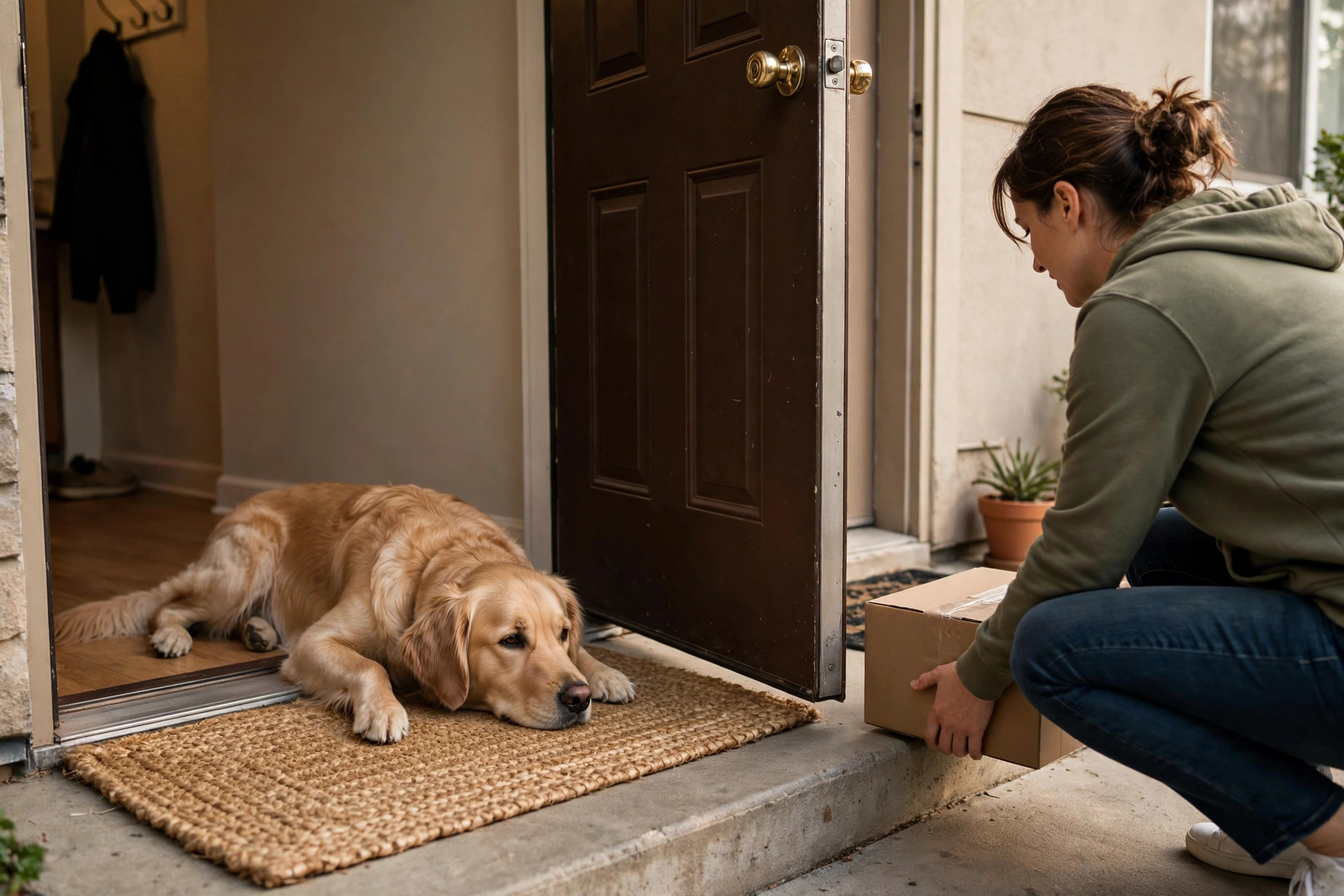
The modern apartment dog faces a threat its ancestors never knew: a stranger arrives at the door, makes a loud noise, and vanishes — three to five times a week. Food delivery, packages, groceries: every knock is a full alarm event with no resolution, because the “intruder” is already gone by the time the dog reaches the door. The dog never learns the ending of the story, so the arousal never discharges — it just stacks, delivery after delivery. This guide breaks the cycle at four points: preventing the trigger, training a replacement behavior, desensitizing the sound, and muffling what gets through.
- Use delivery notes on every order: “please don’t knock, text on arrival.” Eliminating the trigger beats training against it.
- Train the delivery drill: knock → dog goes to mat → treats rain → you collect the package. A rehearsed ritual replaces the panic sprint.
- Desensitize knock and doorbell sounds separately with recorded sounds at low volume, paired with high-value treats.
- White noise near the door plus window film on door-adjacent windows cuts the hallway stimuli that prime the dog before the knock.
- Barking that continues long after the trigger, or generalizes to all hallway noise, needs the deeper protocol in our hallway-noise guide.
Why deliveries are the perfect barking machine
Understand the loop and the fixes become obvious. A delivery event has four phases, and each one feeds the next: (1) Approach sounds — footsteps in the hallway, the elevator ding, a bag rustling. The dog’s arousal starts climbing before anything visible happens. (2) The trigger — knock, doorbell, or the door opening. Full alarm. (3) The charge — the dog sprints to the door, barking, with no one there to resolve the confrontation. (4) The aftermath — elevated arousal with nowhere to go, so the dog patrols, barks at the next hallway sound, and stays primed for hours.
In a house, phase 3 sometimes resolves — the dog sees the driver leave, the story ends. In an apartment, the driver is gone before the door opens, so the dog’s brain files the event as “threat neutralized by barking” — the barking gets credit for the departure. Every delivery is therefore a training session in the wrong direction, several times a week, on a variable schedule — the most powerful reinforcement pattern there is. Interrupting this loop requires acting on multiple phases at once, which is exactly what the four-part plan below does.
Phase 1 fix: the delivery notes that prevent knocks
The cheapest intervention is removing the trigger, and delivery apps make it easy — if you actually fill in the fields. Set these once and they persist:
- DoorDash / Uber Eats / food apps: delivery instructions — “Please do NOT knock or ring. Text when you arrive; I’ll meet you at the door.” Also select “leave at door” with the same note, so the default is silent.
- Amazon / packages: delivery instructions in your account — “Please leave packages at the door without knocking. Dog in training — silent delivery appreciated!” Drivers respond well to the training framing; it gives them a reason beyond preference.
- Building concierge or front desk: if your building holds packages, ask them to text rather than buzz, at least during your training month.
- A physical door sign: a small sign at eye level — “Please don’t knock — text instead. Dog in training, thank you!” ($5–$10 for a printed plaque, or handwritten) — catches the drivers who skip the app notes.
This single change eliminates the majority of trigger events for most households. It will not catch everything — some drivers knock out of habit — which is why the training below still matters. But going from five alarm events a week to one changes the math completely: the dog’s baseline arousal drops, and the remaining events become trainable instead of overwhelming.
Phase 2 fix: the mat-settle delivery drill
For the knocks you cannot prevent, install a ritual. The delivery drill gives the dog a script that is incompatible with the panic sprint:
- Knock happens. You calmly say the mat cue (“place” / “mat”) — said once, in a normal tone, not shouted over barking.
- Dog goes to mat (positioned 6–10 feet from the door, trained separately at calm times — see how to teach a dog to settle on a mat).
- Treats rain on the mat — a scatter of 5–8 small treats tossed onto the mat buys you 30–60 seconds of sniffing and chewing, which is physiologically calming.
- You collect the package while the dog works the scatter. Return, treat the continued settle once more, release.
Rehearse this as a drill without real deliveries first: have a helper knock, run the sequence, repeat 5 times. The first real delivery will still be messy — that is fine. By the fifth real delivery, most dogs start moving toward the mat at the knock sound itself, because the knock has started predicting the treat scatter instead of predicting a confrontation. That prediction flip is the entire goal.
| Intervention | Which phase it fixes | Cost | Time to effect |
|---|---|---|---|
| Delivery notes + door sign | Trigger (knock) | $0–$10 | Immediate |
| Mat-settle delivery drill | Charge (the sprint) | $0 (uses existing mat) | 1–3 weeks |
| Knock desensitization | Trigger response | $0 | 2–4 weeks |
| White noise at door | Approach sounds | $30–$55 | Immediate |
| Window film | Visual priming | $8–$15 | Immediate |
Phase 3 fix: desensitize the knock itself
Separate from the drill, run a dedicated desensitization protocol for the sounds — knock, doorbell, and the building buzzer if yours is loud. The method: play recorded sounds from your phone at a volume below the dog’s reaction threshold (ears perk, but no barking), and pair each sound with a high-value treat. Ten reps, twice a day, 3 minutes per session. Over 2–3 weeks, gradually raise the volume toward real-life levels, always staying under threshold — if the dog barks, the volume was too high; drop back down.
Then generalize: have a helper knock softly on the real door while you treat, building to normal knocks across sessions. The milestone you are watching for: the dog hears a knock and looks at you expectantly instead of charging the door. That orienting response — checking in with the human — means the emotional association has flipped from “threat!” to “payday?” Our quiet command guide layers on top of this for the barks that still slip through during training.
Phase 4 fix: muffle the approach
Many delivery eruptions are primed before the knock — the dog has been listening to hallway footsteps for thirty seconds, arousal climbing, so the knock lands on an already-loaded spring. Dampening the approach sounds lowers the starting point:
- White noise near the door. A white noise machine ($30–$55; the Yogasleep Dohm and LectroFan are the reliable picks) placed in the entryway masks the low-level hallway sounds — footsteps, distant voices, elevator dings — that wind the dog up. Run it during peak delivery hours at minimum; many owners run it all day.
- Window film on door-adjacent windows. If your dog can see the hallway or the building entrance through a window or a glass door panel, visual triggers stack on the audio ones. Static-cling privacy film ($8–$15 per roll) blurs the view while keeping the light — renter-friendly, peels off clean.
- Rug at the door. A thick doormat or runner in the entryway does double duty: it muffles the dog’s own charge footsteps (less self-reinforcing thunder) and gives the mat-settle station a defined texture.
The delivery driver is not the enemy and the dog is not being bad — the dog is running an alarm program that the building keeps triggering with no resolution. Every fix here either removes a trigger, gives the alarm a job, or lowers the starting arousal. Stack all four and the 6 p.m. DoorDash stops being the worst part of the dog’s day.
When it’s bigger than deliveries
The delivery protocol handles trigger-specific barking. Escalate to the deeper work if you see these signs: the dog barks at every hallway sound, not just knocks — footsteps, doors, voices; barking continues for many minutes after the trigger is gone; the dog cannot settle between events and seems generally on edge; or the barking pairs with lunging, snapping, or barrier frustration at the door. That pattern is generalized territorial arousal, and it responds to the full program in how to stop barking at hallway noise — which this delivery plan slots into as one module. And if the dog’s distress looks panicky rather than territorial — drooling, destructive, vocalizing when you leave rather than when strangers arrive — read the separation anxiety plan instead, because that is a different problem wearing a barking costume.
FAQ
Do “do not knock” notes actually work with drivers?
Mostly, yes. The majority of delivery drivers follow written instructions — knocking is habit, not policy, and a clear note breaks the habit. The physical door sign catches the rest. You will still get the occasional knock, which is why the training protocol runs in parallel rather than replacing the notes.
My dog barks at the text notification sound now. What happened?
The dog has learned the association chain: text ding predicts knock predicts excitement. This is actually useful information — it proves the dog learns associations fast. Change your text tone to something neutral, and fold the new sound into the desensitization protocol at low volume with treats.
Should I just crate the dog during expected deliveries?
Crating during a known delivery window is fine management, but a dog that barks in the crate has the same arousal with less outlet — and neighbors still hear it. Use the crate as a calm station (with a stuffed Kong) as part of the drill, not as a barking box. The mat settle usually works better because the dog practices the calm behavior rather than just being contained.
How long until deliveries stop triggering barking?
With the notes in place (fewer triggers) plus the drill and desensitization: most dogs show clear improvement in 2–3 weeks, with reliable mat-settle responses by week 4–6. Dogs with a long history of rehearsed delivery panic take longer — the protocol still works, it just has more history to overwrite.