First-Time Dog Park Safety Guide for City Owners
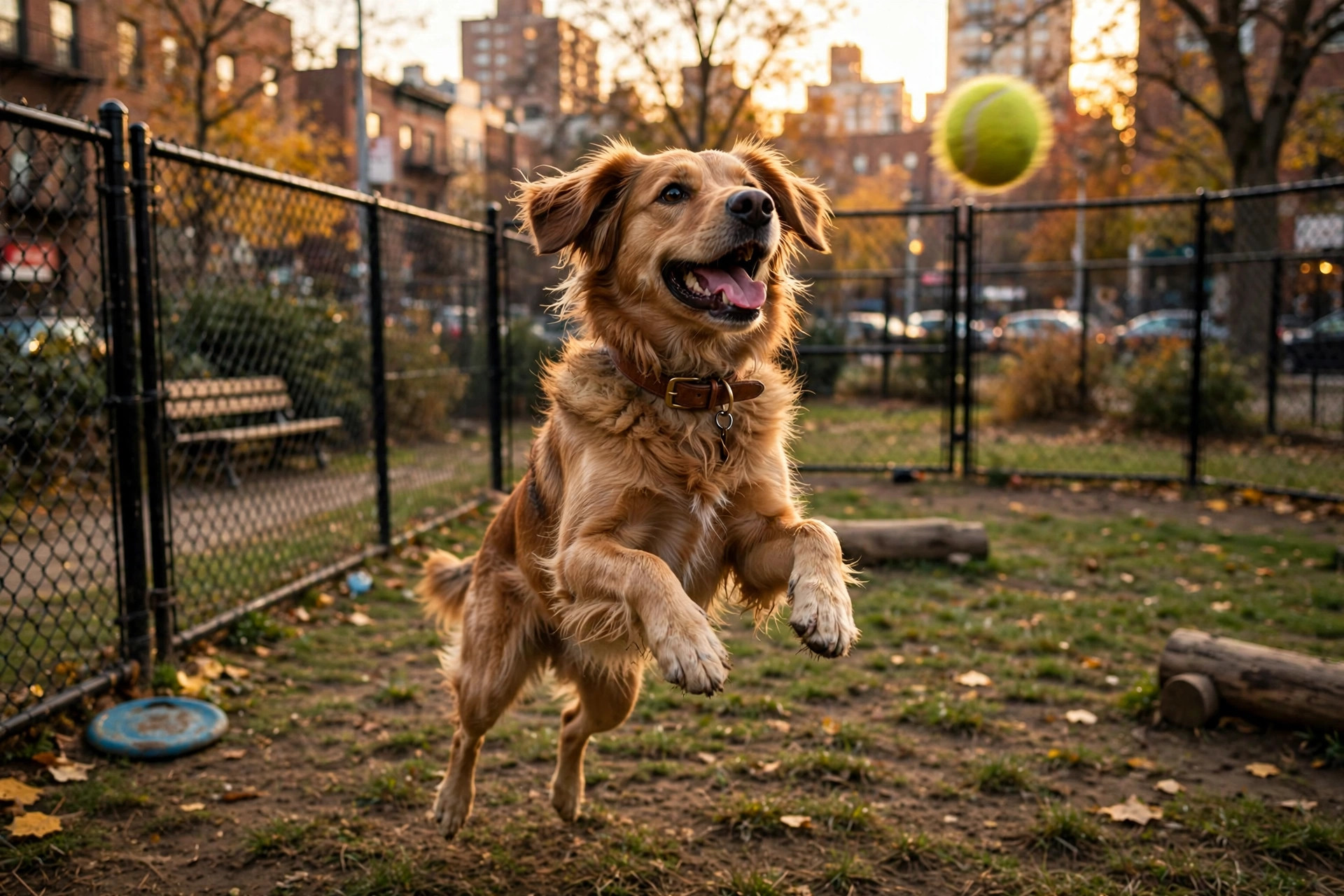
A city dog park is the one place your apartment dog can truly sprint — and the one place twenty strange dogs, a broken latch, and a hot asphalt path converge on your first visit. Most bad first trips are not caused by bad dogs. They are caused by owners who arrived unprepared: a puppy too young for shared water bowls, a park nobody scouted, and an entry made straight through a crowd of gate-rushing dogs. This guide front-loads the preparation so your dog’s first park memory is freedom, not a fright.
- Wait until vaccinations are complete — generally 16 weeks or older — before the first visit, and confirm bordetella, rabies, and canine influenza coverage with your vet.
- Scout the park without your dog first. A double-gated entry, separate small-dog area, and a posted rules sign are the three markers of a well-run urban park.
- Go at off-peak hours for the first three visits: weekday mid-morning or mid-afternoon, when crowds are thin and the resident regulars are calmer.
- One skill matters more than any gear: a recall that works at home, on a 30-foot line, in a busy hallway. Practice before you go.
- Plan your exit before you enter — know where the nearest gate is and leave while things are going well, not after they go wrong.
The pre-park checklist: age, vaccines, and the one skill that matters
Most vets give the same answer when asked about a dog park debut: finish the puppy vaccine series first, which lands around 16 weeks for most puppies. The shared water bowls, communal toys, and concentrated dog traffic make parks the highest-exposure environment a city dog will ever visit. Beyond the core series, ask your vet specifically about bordetella (kennel cough) and canine influenza — both spread fast in dense urban parks and both have vaccines that many city vets recommend as routine. Rabies documentation is worth carrying on your phone too; several city parks require proof on request.
Health is only half the ticket. The other half is recall — your dog coming when called at home, in the hallway, and on a 30-foot long line ($12–$20 at most pet stores) at a busy sidewalk. You will not need perfect obedience at the park, but you need a dog you can collect if play turns rough or a gate gets left open. Two weeks of recall practice in progressively harder locations buys more safety than any harness. If your dog cannot yet disengage from another dog on cue, spend the practice time on leash-walk manners first — our guide to leash training for crowded sidewalks covers the city-specific drills.
Finally, pack like a short outing, not a expedition: water and a collapsible bowl ($8–$15), a handful of high-value treats in a pocket (not a noisy treat bag — the crinkle sound gathers a crowd of other people’s dogs), poop bags, and your phone with the vet’s number saved. Leave the favorite toys at home on day one; communal toys are the number one cause of resource-guarding fights in parks, and you want zero contested objects on a first visit.
How to vet a city dog park before your dog ever enters it
Walk the park without your dog on a quiet weekday. Fifteen minutes of scouting reveals everything that matters, and a park that fails this screen is a park you skip — no loyalty required.
| What to check | Green flag | Red flag |
|---|---|---|
| Entry design | Double-gated airlock, gates self-closing, latches working | Single gate, broken latch, or a gate that stays propped open |
| Size separation | Separate small-dog and large-dog areas with posted weight limits | One mixed pen where a 90-lb dog and a 6-lb dog share space |
| Fence integrity | Full-height fence with no gaps at the bottom or bent sections | Digging under the fence line, gaps wide enough for a small dog to slip |
| Surface and shade | Grass or mulch, water station, shade structure or trees | Bare dirt or gravel only, no water, full sun with no shelter |
| Culture | Posted rules, owners watching their dogs, dogs circulating calmly | Owners on phones at the far fence, dogs mobbing every new arrival |
Two city-specific items deserve emphasis. First, many urban parks sit beside busy streets or bike paths — check that the fence line nearest the road has no gaps a dog could bolt through in a panic. Second, check the water station: standing water in shared bowls is a giardia vector, which is why your own bowl and fresh water matter. If the park’s posted rules include a vaccination requirement and a leash-on-until-inside rule, that is a sign the regulars maintain standards — parks without rules enforcement tend to run on whoever is loudest.
The first-visit playbook: 30 minutes that set the tone
Arrive off-peak and leashed. Weekday mid-morning or early afternoon gives you a thin, calm crowd — the dog-park rush hours are evenings after work and weekend mornings, and your first visit should not be either. Enter the double-gated airlock, close the first gate behind you, unclip the leash in the airlock (never in the main area — leashed dogs greet unleashed dogs badly), then open the inner gate.
Give the greeting five minutes. Expect a crowd of curious noses at the gate. Stay calm, keep moving slowly into the pen rather than standing still in the doorway — a stationary new dog becomes the center of a mob. Most greets resolve into play or indifference within five minutes. If your dog freezes, tucks the tail hard, or tries to climb you, shorten the visit: calm, reward the brave moments, and leave before the stress compounds. There is no quota to fill on day one.
Cap it at 20–30 minutes. Shorter is better for a first trip. End with something your dog loves — a treat, a sniff walk along the fence line — and leash up in the airlock while things are still going well. A first visit that ends on a good note makes the second visit easy. A first visit that runs until the dog is overtired makes the second visit a negotiation. Many owners find that a sniff-focused walk home, like the routes covered in our apartment dog exercise guide, finishes the outing perfectly.
Leash off in the airlock, not the pen. A leashed dog meeting a pack of loose dogs feels cornered, and cornered dogs bite — the airlock exists to make every entry a fair one.
Reading play before it turns rough
You do not need a trainer’s eye — you need four reads. Loose, bouncy bodies with play bows and frequent role reversals mean the fun is mutual. Stiff bodies, one dog always on top, or one dog repeatedly trying to leave while the other follows: that is not mutual anymore, and a calm recall or a short leash break resets it. Watch the quiet dog in any pair — the one who never gets to be the chaser, never gets a breather, or starts yawning and lip-licking is telling you the game stopped being fun a minute ago.
Two situations call for immediate, boring intervention. A dog mobbing the gate to rush every newcomer needs the owners to call their dogs off — if nobody does, collect your dog and leave rather than entering a pile-up. Mounting that goes on past a correction or two tends to escalate, and it is the park’s most common fight trigger; step in early and cheerfully, not when it is already a brawl. If a real fight breaks out between other dogs, grab your dog by the hind legs’ area and the collar from behind is for last resort — the safest move is a loud distraction (a thrown treat scatter, a sharp clap) and a fast exit through the nearest gate, because dogs arriving at a fight join it.
City-specific hazards most suburban guides miss
Hot surfaces on the walk there and back. City parks are surrounded by concrete and asphalt, and on an 85°F day pavement can top 130°F. Press your palm to the sidewalk for seven seconds — if it is uncomfortable for you, it is burning for paw pads. Route the walk through shade and grass verges, and keep park visits to morning or evening in summer. Our hot-pavement guide covers the full pad-protection routine.
Gate-adjacent chaos. The 15 feet inside the gate is the park’s danger zone: arriving dogs, departing dogs, and regulars who cluster at the entrance. On early visits, walk past the gate zone and settle near the far fence or the water station. If your dog is small, the size-separated area is not optional — one accidental collision from a 70-lb runner can injure a 10-lb dog.
Scavenged food and trash. Urban parks accumulate takeout containers, chicken bones, and worse along fence lines. A fast “leave it” earns its keep here; if your dog hoovers everything off the ground, keep visits short and stay in the middle of the pen. Knowing what to do if your dog eats something on a walk is worth reading before it happens, not after.
The lost-dog arithmetic. A gate left open at a park near a six-lane road is a nightmare scenario. Microchip plus a collar with a current phone number tag ($8–$12) is the baseline — see our microchipping guide for the full ID setup. If your dog is a known bolter, skip off-leash parks entirely until recall is solid; there is no shame in a long line at a quiet park instead.
The exit plan: leave while it is still fun
Watch for the three signs that your dog’s tank is emptying: play bows stop and mouthing gets harder, the dog starts snapping at dogs it was fine with ten minutes ago, or it lies down and then pops up cranky when approached. That is not a dog asking for five more minutes — that is a dog asking to leave. Tired dogs are the ones who get into fights, so the best safety move in any park is leaving ten minutes before you think you should.
Exit the way you entered: call the dog in the airlock, leash up behind the closed inner gate, and leave while the recall worked and the leash-up was easy. Praise the return to the gate — you are training the hardest part of every park visit, which is coming back. Then do a two-minute health check at home: paws for cuts or burrs, ears for debris, and a look for any new lump or scratch that needs the first-aid kit. Ten visits in, you will have a dog who treats the park like the best part of the week — because from its point of view, it was.
FAQ
How old should my puppy be before the first dog park visit?
After the full puppy vaccine series, usually around 16 weeks, and only after your vet confirms. Even then, a young puppy in a rough adult crowd can get overwhelmed — many owners do the first few visits at off-peak times with just one or two calm dogs present, or start with a puppy social class instead.
Should I bring my dog’s favorite toy to the park?
Not on early visits. High-value toys are the most common trigger for resource-guarding fights, and a first-timer does not need a contested object added to an already stimulating environment. A water bowl and treats are enough.
What if another dog is bullying mine and the owner does nothing?
Collect your dog calmly and leave. You cannot fix another owner’s inattention in the moment, and staying to prove a point puts your dog at risk. Note the time and the regulars — if the pattern repeats, that park has a culture problem and you should switch parks.
Is it okay to keep my dog on a long line at the park?
A long line is a good training bridge for a new dog with weak recall, but a trailing line in a group of dogs is a tangle and trip hazard. Use it at off-peak hours with few dogs around, keep it short enough to manage, and never loop it around your hand.