How to Microchip and ID Your Apartment Pet
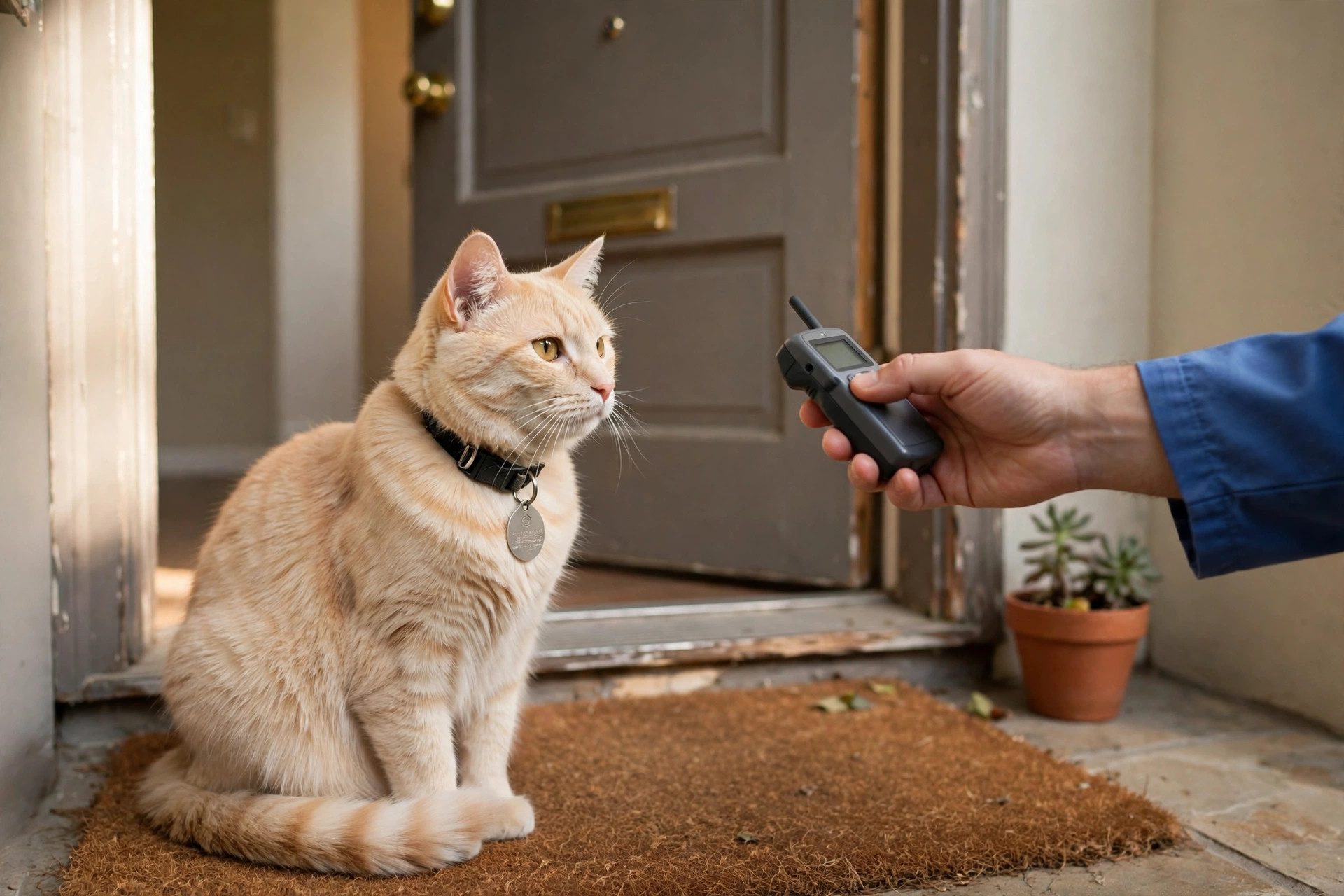
“She’s an indoor cat, she doesn’t need a chip” is the most expensive sentence in apartment pet care. Indoor pets get out through doors held open for movers, screens that give way, fire-alarm evacuations, and carriers that fail in parking garages — and a pet with no ID in an unfamiliar hallway or street has almost no way to tell anyone where home is. A microchip costs less than one pizza night. Here is how to do the chip — and the three layers around it — properly.
Why indoor apartment pets are the ones who need ID most
Outdoor pets develop street skills. Indoor pets have none, and they get lost in the hardest environment to be found in: a multi-story building or a dense city block. Shelter data consistently shows the gap ID makes: dogs with registered microchips are returned to owners at more than double the rate of unchipped dogs, and for cats the difference is far more dramatic — chipped cats go home at roughly twenty times the rate of unchipped cats, largely because most lost cats are never claimed at all without ID linking them to a person.
The apartment-specific escape routes are worth naming, because owners underestimate all of them:
- Door dashes during deliveries, guests, and maintenance visits — the number one route for cats. A held-open door plus a hallway that smells interesting is all it takes; see our front-door darting prevention guide for the management side.
- Window and balcony failures — a screen flexing under a leaning cat, a sliding door left cracked for air. The window locks guide for high-rises covers the hardware half of this risk.
- Evacuations and alarms. A 2 a.m. fire alarm with a crowded stairwell is a lost-pet machine. Pets slip carriers, bolt from arms, and get left with neighbors who do not know their names.
- Moves and vet trips. Carrier latches fail in garages and parking lots with remarkable regularity, usually at the exact moment the cat is most stressed.
An indoor pet that gets out is also harder to search for than an outdoor pet: it hides close, stays silent when called, and may still be inside the building — in a stairwell, a utility chase, or three floors down — for days. ID does not prevent the escape. It converts “a cat someone found” into “this cat, this owner, this phone number” the moment anyone scans or reads it.
The microchip itself: types, cost, and what the vet visit looks like
A microchip is a passive RFID capsule about the size of a grain of rice, injected under the skin between the shoulder blades with a slightly larger needle than a vaccine. No battery, no GPS, no signal — it answers only when a scanner within a few inches asks. That limitation is exactly why the layers later in this guide matter, but the chip remains the one form of ID that cannot fall off, be removed by a stranger, or fade.
What it costs. Expect $25–$75 at a private vet, including the injection. Many shelters, humane societies, and municipal clinics chip for $10–$25, and some include it free with adoption or spay/neuter. Registration is where the pricing models diverge: some registries charge a one-time fee (often $20–$25), some bundle the first year into a subscription service ($20–$25 per year), and at least one major registry — the Michelson Found Animals registry — registers any chip for free. More on choosing in the next section; the headline is that the chip hardware is the cheap part.
Which chip to ask for. Request a 15-digit ISO-standard chip (134.2 kHz) if there is any chance your pet will travel internationally — it is the format EU and most other scanners expect. In the U.S., universal scanners read all common frequencies (125, 128, and 134.2 kHz), so a non-ISO chip is not a problem domestically. If your pet is ever scanned and nothing reads, a mixed-frequency chip is the usual culprit at older clinics — worth knowing before you panic.
The appointment, honestly described. It takes about ten seconds. Most pets react like a vaccine — a brief flinch. No anesthesia, no sedation, no recovery period. The vet then scans the chip to confirm it reads, and hands you the chip number on a sticker or discharge sheet. Photograph that sheet before you leave the parking lot. That number is the key to every registry correction you will ever make, and roughly half of all lost-pet ID failures trace back to the events of the next 24 hours — which brings us to the registry.
Registration: where most microchips quietly fail
An unregistered chip is a number attached to nothing. And here is the uncomfortable pattern clinics see every week: the chip is registered, but to the vet clinic that implanted it, to an old phone number, to a previous owner, or to an address from two apartments ago. The chip worked. The paperwork did not.
Do these four things within 24 hours of chipping, and repeat the audit once a year:
- Register the chip yourself, in your name, even if the clinic says they handled it. Ask which registry they use — common ones include HomeAgain, AVID, PetLink, and 24PetWatch — then create your own login and confirm your phone number and email appear exactly as you would type them at 2 a.m.
- List two phone numbers. Yours, plus a person who does not live with you and will answer an unknown number. Recoveries fail at the “voicemail full” stage more often than at the “nobody scanned” stage.
- Look the chip up on the AAHA Universal Pet Microchip Lookup (petmicrochiplookup.org). It does not store your data; it tells you which registry holds the chip so you can verify your record is live and points where you think it does.
- Update on every move and number change. Apartments mean moves every year or two. Put “pet chip record” on the moving checklist next to mail forwarding — a change-of-address that omits the chip silently breaks the whole system. Our moving with a cat checklist has the relocation sequence this slots into.
One more trap: premium registry subscriptions. Several registries sell annual plans with extras like lost-pet alerts and vet helplines. Those are optional services, not the registration itself — your contact record typically stays in the database even if the subscription lapses. Do not let a lapsed $25 subscription convince you the chip “stopped working,” but do verify your record by lookup once a year, subscription or not. And if your pet came from a shelter, confirm the shelter transferred the record to you rather than leaving themselves as the contact.
| ID layer | Typical cost | Works when | Limitation |
|---|---|---|---|
| Microchip + current registry record | $25–$75 implant; registration $0–$25 | A vet, shelter, or rescue scans the pet | Passive — someone must find and scan the pet |
| Engraved collar tag | $8–$18 | Anyone who can safely approach the pet | Collars slip off; cats need breakaway collars that are designed to release |
| QR-code tag (e.g., ByteTag-type) | $15–$30, some with plans | Finder scans with a phone; can ping owner with location | Also collar-dependent; needs finder to act |
| GPS tracker (Fi, Whistle-type) / Bluetooth tag (AirTag-type) | $35–$150 plus $8–$15/mo for GPS | Proactive tracking from your phone | Battery life, size on small cats, subscription |
Collars and tags: the layer that works at hallway distance
A chip requires a scanner and a trip to a vet or shelter. A tag works at arm’s length, in your own building, in the first ten minutes — which is when most apartment recoveries happen. The finder of an escaped indoor pet is usually a neighbor, a doorman, or a building maintenance worker one floor away, not Animal Control.
For dogs: a flat collar with an engraved tag — your mobile number and the building or neighborhood, not your full address — plus a second tag or a collar with the number embroidered on it. Tags get lost; embroidery does not. If your dog wears a harness for walks, the collar with ID stays on at home. Bare-necked at home is how “he just slipped past me into the hall” becomes a real search.
For cats: breakaway collars only — the clasp is designed to release if the collar snags on furniture, which indoor cats manage with impressive creativity. Accept that breakaway collars sometimes break away; that is the trade working as intended. Put your number on a lightweight engraved tag, and consider embroidering or writing the number inside the collar itself as backup. Cats that flatten their ears and hiss at finders still get identified at the shelter by the chip — the tag is for the friendly scenario, the chip for the rest.
QR tags (ByteTag is the widely sold example, roughly $20–$30) split the difference: a finder scans the code with any phone camera and sees your pet’s profile and your chosen contact method, and many models notify you with the scan location. They hold more info than fits on a stamped tag — medications, vet, “shy, please do not chase” — and keep your number semi-private. They still hang from a collar, so they complement the chip rather than replace it.
GPS and Bluetooth trackers are the proactive layer. Cellular GPS collars (Fi and Whistle are the common examples, roughly $100–$150 hardware plus $8–$15 per month) give real-time location but are bulky for small dogs and impractical for most cats. Bluetooth tags like Apple’s AirTag (about $29) are tiny and cheap, but they only report location when passing near a compatible phone, and Apple does not design or endorse them for pets — the separate question of AirTag collars versus true GPS is worth five minutes if you are choosing gear for a door-dashing dog. For a confirmed escaper in a dense city, GPS earns its subscription; for the average indoor cat, chip plus tag is the honest cost-benefit answer.
The building layer: paperwork that recovers pets before posters do
The most underused ID tools in apartment life cost nothing, because they live in your building’s own systems:
- Register your pet with building management or the HOA if the building keeps a pet registry — many do after an incident. A photo on file means the concierge can confirm “yes, that’s the cat from 14B” in minutes.
- Give your doorman, super, or a trusted neighbor a one-page pet card: photo, name, your number, vet, and “if found, please contain in the service area and call.” The people who find hallway escapees are building staff, and a found cat’s first hour usually happens in a back corridor or laundry room.
- Keep a current photo set on your phone: face, both sides, belly markings, any scar or distinctive patch. Posters and lost-pet posts (Nextdoor, local lost-pet groups, PawBoost-type services) go up faster and work better with real photos than with memory descriptions written while panicking.
- During any move or renovation, confine the pet in a labeled closed room with the collar on and the carrier inside. Doors propped open for furniture are the classic escape window; a “CAT INSIDE — DO NOT OPEN” sign on a closed door has saved more cats than any gadget.
Test the whole system once a year on a calm evening: scan your pet at the annual vet visit to confirm the chip still reads (migration away from the shoulder blades happens, rarely), run the AAHA lookup, call the numbers on the tag, and check the registry address. Ten minutes, once a year, and every layer of the ID stack is verified working rather than assumed working. That audit habit — not any single device — is what turns “indoor pet, somehow outside” into a phone call and a short elevator ride home.
FAQ
Does an indoor cat really need a microchip?
Yes — indoor cats are the pets least equipped to be lost and the least likely to be claimed at a shelter without ID. Escapes happen through delivery doors, failed screens, moves, and evacuations. Chipped cats are returned to owners at roughly twenty times the rate of unchipped cats, because the chip is the only link between a silent, hiding cat and a phone number.
How much does it cost to microchip a pet, and does registration cost extra?
The implant itself is typically $25–$75 at a private vet and $10–$25 at many shelters and municipal clinics. Registration is separate: some registries charge a one-time fee around $20–$25, some sell optional annual service plans, and the Michelson Found Animals registry registers any chip for free. Always confirm your own contact details are on the record, not just the clinic’s.
Will a microchip let me track my pet’s location?
No. A microchip is passive — it has no battery or GPS and only responds when a scanner passes within a few inches. If you want proactive location, you need a separate collar device: a cellular GPS tracker (like Fi or Whistle, roughly $100–$150 plus $8–$15 per month) or a Bluetooth tag, which only reports near compatible phones and is not designed by Apple for pet tracking.
What should I check to make sure the chip will actually work?
Once a year: ask your vet to scan the chip at a routine visit to confirm it still reads, look the number up on the AAHA Universal Pet Microchip Lookup (petmicrochiplookup.org) to confirm which registry holds it, and verify the phone numbers and address on the record are current. Update the record after every move or number change.