Best Quiet Pet Hair Dryers for Apartment Grooming
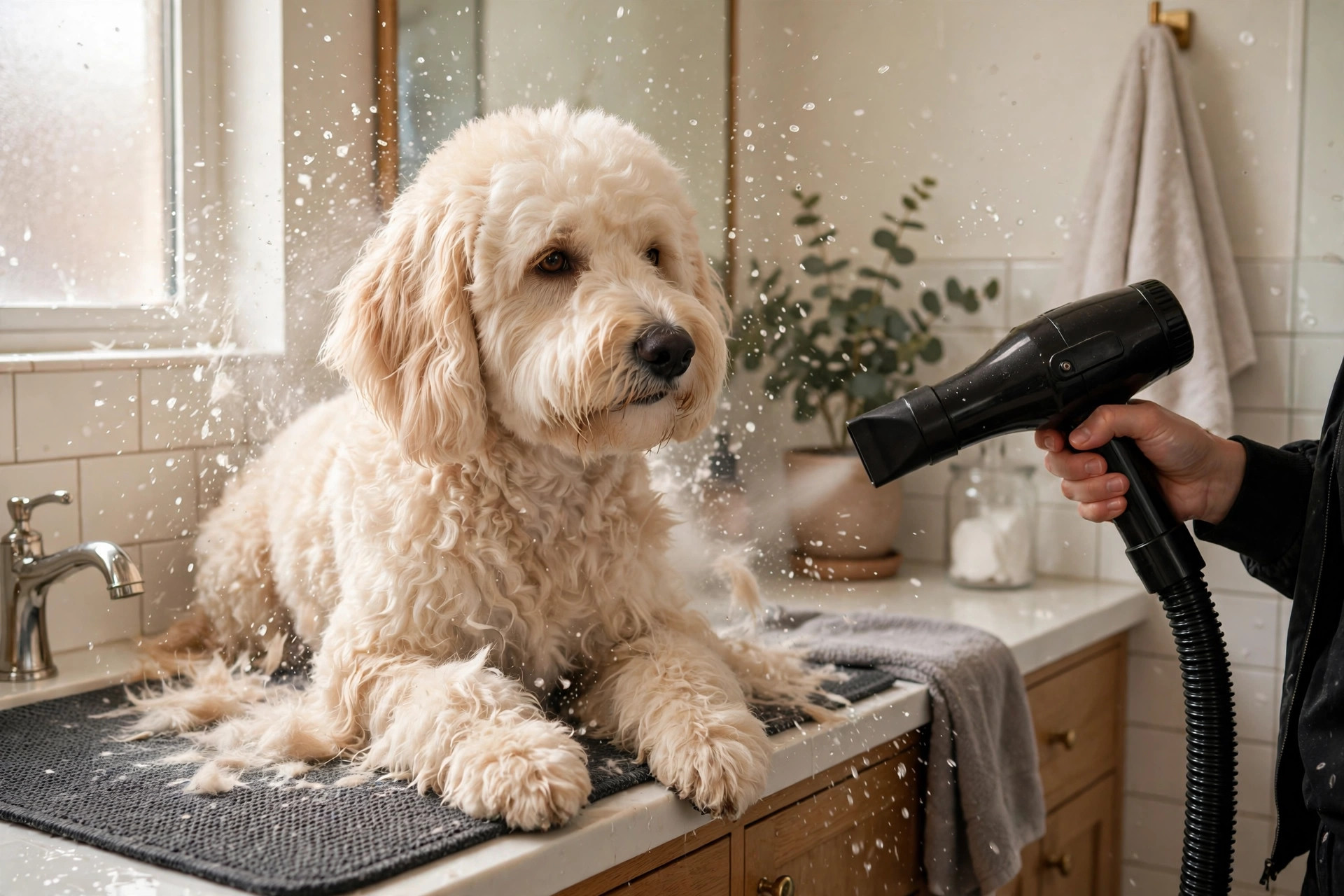
The bath is the easy part. The hard part is the forty minutes after, when a wet dog is shaking across your studio apartment, the humidity fogs every window, and the damp-undercoat smell sets up permanent residence in the sofa. Air-drying works for short-haired dogs in summer. For everyone else — thick coats, winter baths, rainy-season mud — a pet dryer turns the soggy aftermath into a fifteen-minute routine and leaves the coat fluffier than any towel can manage.
Why your human hair dryer is the wrong tool
It is tempting. It is already in the bathroom. But human dryers and pet dryers are built for opposite jobs:
- Heat. Human dryers run hot — 140°F+ on high — because human hair is dead and tough. A dog’s skin burns far more easily, especially on thin areas like the belly and inner legs. Pet dryers work by moving a huge volume of room-temperature-to-warm air; the water gets blown off, not baked off.
- Noise profile. A human dryer is a high-pitched scream, typically 75–85 dB. Pet force dryers are a lower rumble, usually 60–70 dB, and the quiet ones dip into the 50s on low. Through shared walls, pitch matters as much as volume — the high whine of a human dryer carries through drywall in a way a low rumble does not.
- Drying mechanics. Human dryers rely on heat to evaporate water. Pet dryers use high-velocity air to physically push water off the coat — which is dramatically faster on a double coat, where heat never reaches the undercoat anyway.
- The undercoat problem. This is the real reason: a thick-coated dog towel-dried and left to air-dry can stay damp at the skin for hours. Trapped moisture against warm skin breeds the musty smell and, in bad cases, hot spots. A force dryer blasts the undercoat dry in minutes.
The exception: very small, short-haired dogs in warm weather genuinely do fine with a towel and a low-heat human dryer held at distance. If the coat dries to the skin within an hour, you do not have a problem that needs solving.
Five dryers that work in real apartments
Every dryer below is a real, widely sold product — no salon fantasies, no no-name blowers. Prices are typical street prices.
| Dryer | Best for | Usually | Apartment note |
|---|---|---|---|
| XPOWER B-2 | Most apartment dogs | $60–$80 | Compact, warm-air option, stores in a cabinet |
| XPOWER B-4 | Thick and double coats | $180–$220 | Serious airflow, variable speed; overkill for small dogs |
| Shernbao Pet Dryer | Noise-sensitive homes | $70–$100 | Quieter motor design; good mid-range balance |
| oneisall Pet Hair Dryer | Tight budgets | $40–$60 | 2-in-1 dryer/brush; gentle, slower on thick coats |
| XPOWER B-3 | Small spaces, small dogs | $90–$120 | Compact canister, dual-motor option; the tidy pick |
XPOWER B-2 — the everyday pick
The B-2 is the dryer that converted a generation of home bathers: a compact canister (about the size of a small toolbox) with a flexible hose, a warm-air setting that stays safe on skin, and enough velocity to blast a medium coat dry in 15–20 minutes. It is not the quietest dryer on this list — expect a solid blower rumble — but it is dramatically less piercing than a human hair dryer, and most dogs accept the low, steady sound faster than the human-dryer whine. It fits in a bathroom cabinet, which in an apartment is a genuine feature.
XPOWER B-4 — the double-coat pick
Huskies, shepherds, golden retrievers, anything with an undercoat that laughs at towels: the B-4’s variable-speed motor moves serious air, and the difference on a dense coat is not incremental — it is the difference between 20 minutes and 45. The noise climbs with the speed, so run it at the lowest setting that gets the job done; for most of the coat that is well below maximum. The price is real money, but if you bathe a thick-coated dog monthly, it pays for itself against one professional blowout.
Shernbao — the quiet pick
If your walls are thin and your dog is sound-sensitive, Shernbao’s motor design runs noticeably quieter than the XPOWER units at comparable airflow — a lower, softer rumble that most dogs tolerate better and that neighbors barely register. You give up a little top-end power compared to the B-4, so it is not the pick for the densest coats, but for medium coats in noise-sensitive buildings it is the sweet spot. The hose and nozzles are standard and replaceable.
oneisall — the budget pick
The oneisall 2-in-1 combines a dryer with a pin brush — you dry and brush in one motion, which short-haired and medium-coated dogs find less strange than a hose pointed at them. It is gentler and slower than a true force dryer, so thick undercoats will still take a while, but at half the price of the B-2 it is the honest entry point. Good first dryer for a small dog; plan to upgrade if you ever get a double-coated breed.
XPOWER B-3 — the compact pick
The B-3 squeezes near-B-2 performance into a smaller canister that lives happily on a bathroom shelf — a meaningful difference when your storage is one cabinet and a hook. The dual-motor versions step up airflow for medium coats without stepping up the footprint. Slightly pricier than the B-2 for similar drying power; you are paying for the smaller body and the tidier hose management, which in a 500-square-foot apartment is money well spent.
Noise reality check: a pet force dryer at 60–70 dB is roughly the volume of a normal conversation to a running shower. It will not wake the baby next door. What it will do is startle a dog that has never heard one — which is a training problem, not a hardware problem, and it is solved in a week with treats.
The 15-minute apartment drying routine
The goal is a dog that is dry to the skin, a bathroom that is not a swamp, and a dryer the dog does not dread. This order matters:
- Towel first, always (3 minutes). Squeeze — do not rub — the coat with a dedicated absorbent towel. Toweling removes the surface water the dryer would otherwise blast into the air (and onto your walls). Microfiber beats cotton here; it holds far more water per pass.
- Dryer on low, at a distance (2 minutes). Start with the hose 2–3 feet from the dog on the lowest setting, pointed at the body, not the face. Let the dog investigate the airflow. Treats for standing still. This is the desensitization minute — do not skip it even with a dog that has been dried before.
- Work in sections, skin-out (8 minutes). Hold the nozzle a few inches from the coat and move steadily — never park it in one spot, which is how skin gets too warm. Work from the rear forward, lifting the coat so air reaches the undercoat. On double coats, you will see a visible line where wet meets dry; chase that line.
- The face and ears last (2 minutes). Low setting, more distance, quick passes. Most dogs dislike face airflow; keep it brief and follow with a treat. Damp ears folded against the head are a hot-spot risk, so do not skip this.
Test dryness by parting the coat down to the skin on the chest and behind the ears — the two spots that lie about being dry. If the skin is cool and damp, keep going. A coat that looks dry but is damp at the skin is the source of the classic next-day wet-dog smell.
Three dryer mistakes that ruin the routine
2. Skipping the cool-down check. Warm air on a stationary nozzle burns skin. Keep the nozzle moving, keep your free hand on the coat feeling the temperature, and if the dog flinches at one spot, move on — it is telling you the truth about the heat.
3. Storing the dryer damp. Coil the hose loosely, leave the canister open for an hour after use, and store it somewhere airy. A dryer packed wet into a closed cabinet grows a smell that then gets blown onto the next bath — which is how dogs learn to hate the dryer for reasons that have nothing to do with noise.
FAQ
Will a pet dryer freak out my noise-sensitive dog?
It might at first — the airflow sensation is as strange as the sound. The fix is the same as for nail grinders: a week of desensitization (dryer on across the room + treats, gradually closer, then brief airflow on the body) before the first real session. Most dogs that hate human hair dryers do fine with force dryers because the sound is lower and steadier.
Can I use the dryer on my cat?
Generally no — most cats find forced air genuinely terrifying, and the stress is not worth it. Cats are efficient self-driers; towel gently and let them finish the job somewhere warm. The rare cat that was raised around dryers is the exception, not the rule.
How often should I bathe and blow-dry my dog?
Every 4–8 weeks for most apartment dogs, more often only if the dog gets genuinely dirty. Over-bathing strips the coat’s oils and creates the dry, flaky skin people then try to fix with more baths. The dryer does not change this math — it just makes each bath less of a production.
Do I need to clean the dryer itself?
Yes — the intake filter collects hair and dust, and a clogged filter makes the motor run hot and loud. Rinse or replace the filter monthly with regular use. A dryer that has gotten louder over time is usually a dryer with a dirty filter, not a dying motor.