Best Indoor Dog Agility Kits for Apartments
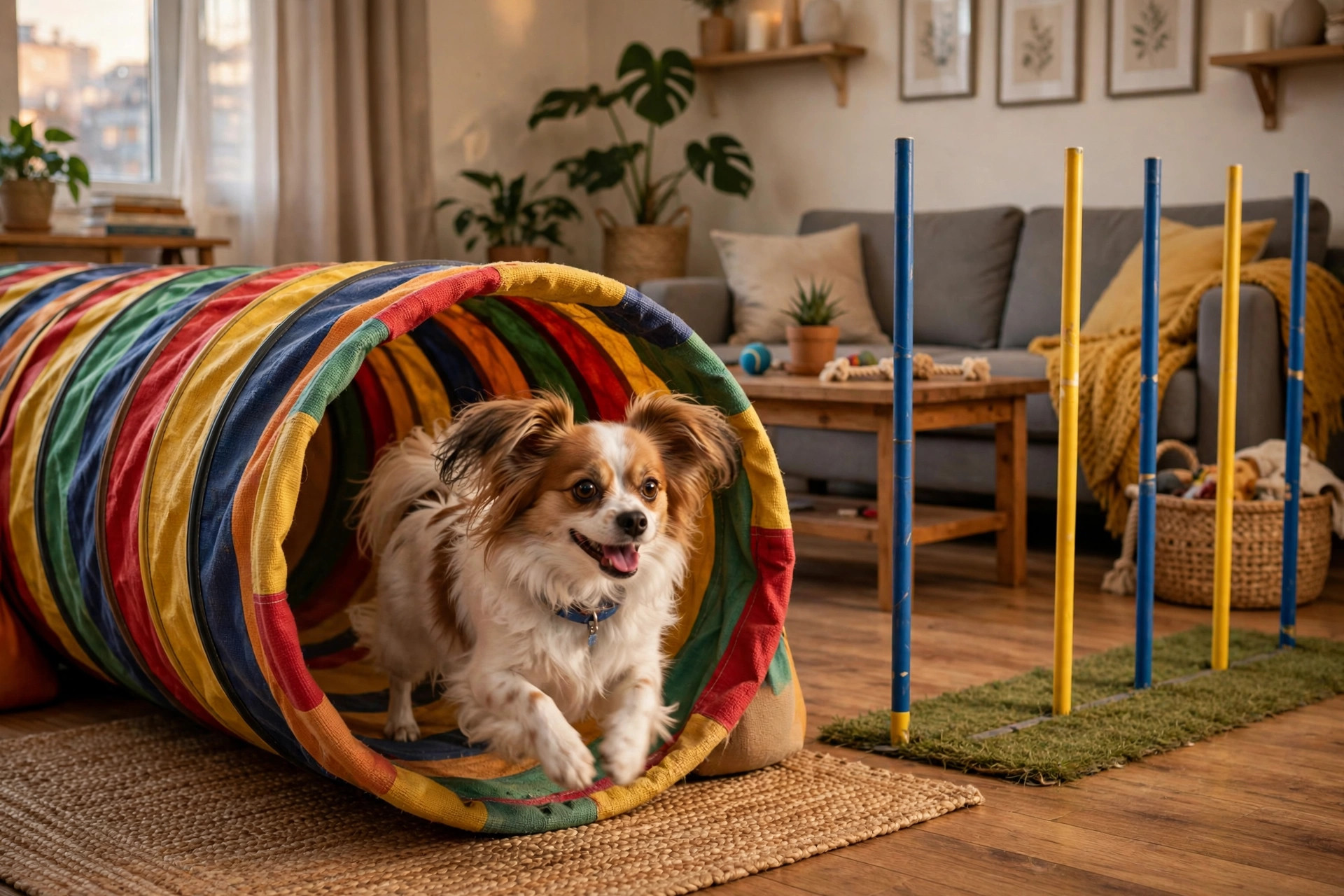
An under-exercised apartment dog invents its own sports: hallway sprints, couch vaulting, ankle tackling at 11 p.m. An indoor agility kit redirects that energy into something you control — a tunnel under the coffee table, weave poles down the hallway, a jump over a broom-width bar. Done right, ten minutes of living-room agility tires a dog out the way a 40-minute walk never does, because thinking is exercise too.
- Indoor kits are training toys, not competition gear — prioritize light, collapsible, floor-safe pieces over regulation heights and speeds.
- Budget $50–$150. Below that, poles snap and tunnels collapse on the dog; above that you are paying for outdoor-grade hardware.
- You need about a 6×10-foot clear run for a useful setup. Measure before buying; a hallway or a living room with the coffee table pushed aside usually qualifies.
- Tunnels and weave poles earn their space. Jumps are the optional third piece, and the A-frame belongs in a yard, not your living room.
- Ten focused minutes beats thirty distracted ones. Mental work — sequencing, weaving, targeting — is what tires the dog, not speed.
Apartment agility has its own rulebook
Outdoor agility is about speed and height. Indoor agility is about control, quiet, and not destroying the security deposit. Set these rules before the first run:
- No full-height jumps indoors. Competition jumps hit 20–26 inches; indoors, keep bars at 4–8 inches. The point is the sequencing and the cue, not the altitude. Low jumps also protect joints on hard floors and protect your downstairs neighbor from impact noise.
- Floor protection is non-negotiable. One interlocking foam mat run ($25–$40 for a 6-pack of 24-inch tiles) under the course does three jobs: grip for the dog, noise dampening for the neighbor, and scratch protection for hardwood. Skip the mats and every session costs you floor damage.
- Session length: 10 minutes max. Agility is intense interval work. Two 10-minute sessions with a break between beat one 30-minute session, which is where mistakes, frustration, and knocked-over furniture live.
- No equipment near the front door, kitchen, or stairs. An excited dog weaving at speed will not stop for an open dishwasher. Set up in one room and gate it.
Four kits that survive apartment life
| Kit | What’s included | Typical price | Small-space note |
|---|---|---|---|
| Outward Hound ZipZoom Indoor Agility Kit | Weave poles, adjustable jump, tunnel | Usually $80–$100 | Designed for indoors; soft poles, compact 5-ft tunnel. |
| Better Sporting Dogs Starter Kit | Weave poles, jump, pause box, tunnel | Usually $110–$150 | The most complete beginner set; everything stores in one bag. |
| PawHut 4-Piece Agility Set | Weave poles, jump, tunnel, square tunnel | Usually $60–$80 | Budget full set; poles are stiffer — better on carpet than hardwood. |
| TRIXIE Dog Activity Agility Starter Set | Hurdle, slalom poles, tunnel | Usually $50–$70 | Compact European set; good for dogs under 25 lbs. |
Outward Hound ZipZoom Indoor — the purpose-built pick
Most agility kits are outdoor gear shrunk down. The ZipZoom Indoor was designed for living rooms: the weave poles are soft, flexible sticks on low-profile bases (no heavy outdoor feet chewing your floor), the jump adjusts down to a few inches, and the tunnel is a compact 5-foot collapsible tube that springs flat into a carry bag. It is the kit least likely to damage anything or anyone. The trade-off is scale: dogs over about 40 lbs will find the tunnel snug and the poles close together, so it suits small and medium dogs best. At $80–$100 it sits in the middle of the range and holds up to real use.
Better Sporting Dogs Starter Kit — the complete package
If you want to try everything — weaves, jump, a pause box for stays, and a tunnel — in one purchase, this is the set. The weave poles use a channel design that is easier for beginners to learn than stick-in-the-ground poles, the jump’s bar displaces (falls off) instead of holding rigid, which is the safety feature you want with an overenthusiastic dog, and everything packs into the included carry bag that fits in a closet. At $110–$150 it is the priciest pick here, but it replaces two or three separate purchases, and the build quality survives daily use without the poles loosening — the usual failure mode of cheap sets.
PawHut 4-Piece — the budget full course
Four real pieces — weave poles, adjustable jump, round tunnel, and a square tunnel for variety — for $60–$80 is genuine value. The catch is that the poles and jump feet are stiffer outdoor-style plastic: fine on carpet, but on hardwood they can skitter and scratch unless you lay foam tiles underneath (which you should be doing anyway). The tunnels are the standard spring-steel type that collapse flat. For a renter on a budget who already owns floor mats, this is the most course per dollar.
TRIXIE Starter Set — the small-dog kit
TRIXIE’s set is scaled for dogs under about 25 lbs — shorter tunnel, lighter slalom poles, a lower hurdle — which is exactly the dog most apartment owners have. The compact sizing means the whole course genuinely fits a 10-foot hallway: tunnel at one end, slalom down the middle, hurdle at the far end. Build quality is solid German pet-gear mid-range: not fancy, not flimsy. At $50–$70 it is the cheapest way to find out whether your dog even likes agility before committing to a bigger set.
Setting up in a real apartment
You need less space than you think, and more planning than you think. The minimum useful footprint is a 6×10-foot straight run — a hallway, a living room with furniture pushed to the walls, or a long bedroom. Lay it out in this order:
- Mats first. Cover the whole run with interlocking foam tiles before any equipment goes down. Butt the edges tight — a tile edge flipping up under a paw at speed is how ankles get twisted.
- Tunnel at one end, secured. A tunnel that slides across hardwood when the dog enters at speed teaches the dog that tunnels are scary. Anchor the ends with sandbags, the storage ottoman, or purpose-made tunnel bags.
- Weave poles in the middle, spaced 20–24 inches apart. Standard spacing is wider; tighter spacing slows the dog down, which is what you want indoors. Fewer poles are fine to start — three or four teaches the pattern.
- Jump last, bar at 4–6 inches. The jump goes at the far end so the dog finishes moving away from you, not toward the furniture.
Total setup time once you have done it twice: about five minutes. Teardown: three. If setup takes longer than the session, you will stop doing it — which is the real argument for a kit that stores in one bag in the closet rather than a pile of parts behind the couch.
The goal of indoor agility is not a fast dog. It is a thinking dog. Every second your dog spends figuring out the weave entry or waiting for your jump cue is mental work — and a mentally tired dog is the one that naps through your evening instead of redecorating it.
The four-week beginner plan (10 minutes a day)
Introduce one obstacle at a time. Dogs that are rushed through all three in week one learn none of them and learn that the equipment is stressful.
- Week 1: the tunnel only. Collapse it to 2 feet long so the dog can see through. Lure through with treats, 5–8 reps per session. Extend it a foot every two days as confidence builds. Celebrate exits like the dog won a prize.
- Week 2: add the jump. Bar on the ground at first — a pole lying across two low blocks. The dog learns to step over on cue (“over”). Raise to 4 inches mid-week, 6 by the end. Never lure a dog over a bar it cannot see; let it walk the line first.
- Week 3: introduce weaves. Use 3 poles with wide spacing and lure the dog through in an S-pattern. This is the hardest skill; expect a full week before it looks like weaving. Short sessions, high-value treats, end on a success every time.
- Week 4: sequence two obstacles. Tunnel → jump, or poles → tunnel. Two in a row is plenty. Three-obstacle sequences come in month two, when the dog’s confidence is solid.
If the dog freezes, barks at an obstacle, or runs around it: you advanced too fast. Go back one step and stay there for three sessions. Agility learned slowly is agility learned permanently; agility rushed is a dog that avoids the equipment.
Keeping the peace: noise and the downstairs neighbor
Indoor agility’s biggest risk is not the furniture — it is the person below you. A 30 lb dog landing a jump transmits through most apartment floors. Mitigations that actually work: foam mats under the whole course (not just under the jump), sessions before 8 p.m., no jumping drills on days the neighbor works from home directly below — ask, once, politely — and substituting tunnel-and-weave days for jump days when you need quiet. Weave poles and tunnels are nearly silent; jumps are the noise. A weekly schedule with two jump days and three weave/tunnel days keeps everyone happy, including the dog, which gets variety.
- Want gear designed for living rooms → Outward Hound ZipZoom Indoor.
- Want everything in one purchase → Better Sporting Dogs Starter Kit.
- Want the most course per dollar → PawHut 4-Piece, with foam mats underneath.
- Small dog, small hallway → TRIXIE Starter Set.
FAQ
How much space do I really need for indoor dog agility?
A 6×10-foot clear run handles a tunnel, 3–4 weave poles, and a low jump — a hallway or a living room with the coffee table moved. You do not need a whole room; you need one straight line with the furniture pushed aside and foam mats down.
Is agility safe for puppies?
Low-impact foundation work — tunnels, targeting, flat-pole weaves — is fine for puppies over about 4 months. Skip real jumping until growth plates close (around 12 months for small breeds, 18 for large), keeping bars at ground level or 2–4 inches. Ask your vet if you are unsure about your breed.
My apartment is all hardwood. Will agility destroy the floors?
Not if you mat the course. Interlocking foam tiles ($25–$40 for a six-pack) give the dog grip, dampen noise, and protect the finish. Equipment sliding on bare hardwood is the damage vector — mats eliminate it.
Can a senior dog do indoor agility?
Yes, at senior pace: tunnels, low weaves with wide spacing, and ground-level poles for stepping over. Skip jumps entirely. Ten minutes of gentle sequencing is excellent mental stimulation for an older dog that can no longer do long walks. Check with your vet about arthritis first.
My dog is scared of the tunnel. What do I do?
Shorten it until the dog can see daylight through it, and let the dog walk through on its own terms with treats — never push or pull a dog through. Most dogs that fear a full tunnel will happily walk a 2-foot one, and confidence extends a foot or two per session from there.