Best Couch Protectors for Dog Nails That Look Nice
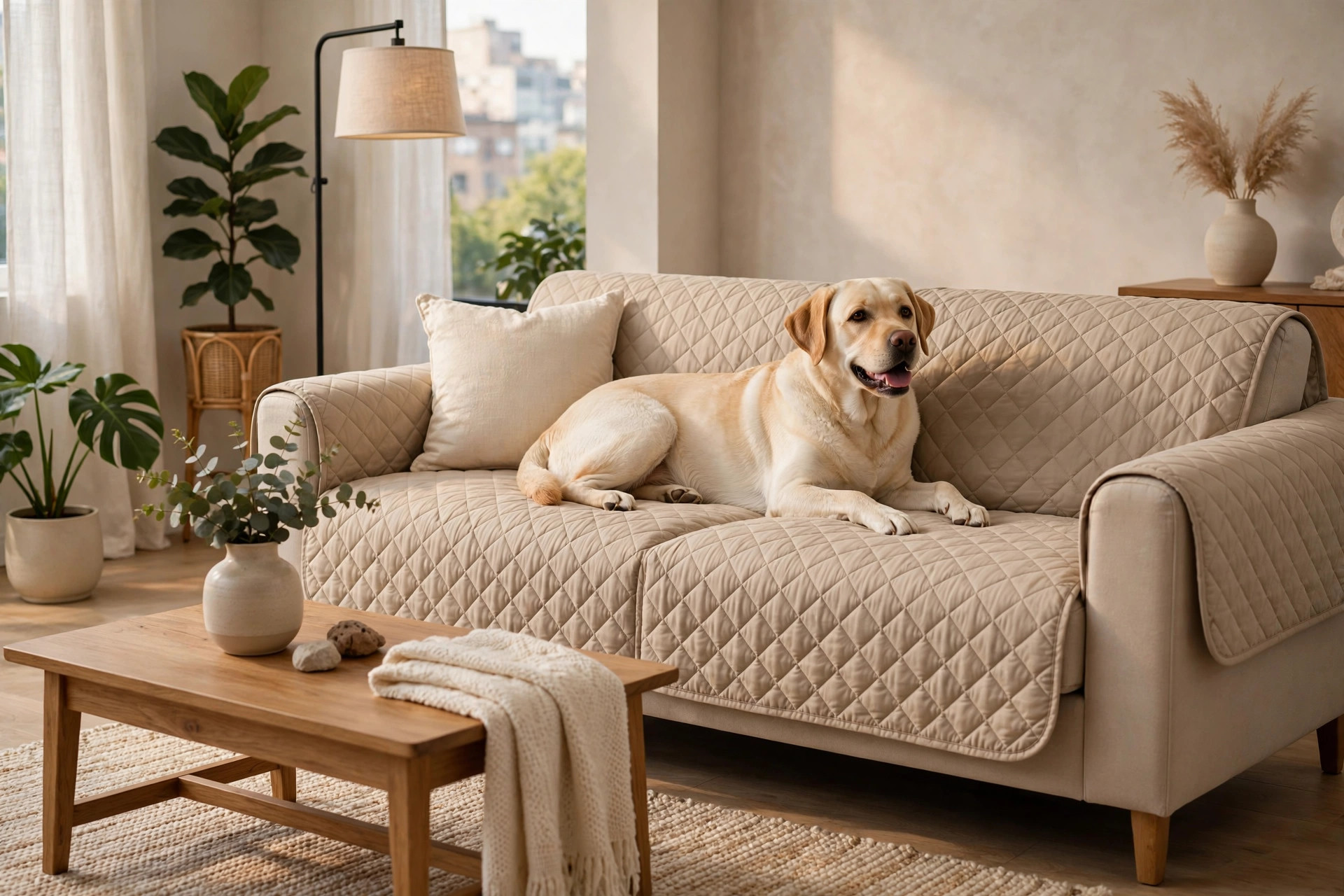
The dog is getting on the sofa. This is not a training problem you will win — the sofa is the warmest, highest, most you-scented spot in the apartment, and every dog on earth has done the same cost-benefit analysis. The real question is whether the sofa survives it. A 60-pound dog launching off the armrest drives its nails into upholstery with the full force of its body weight, and a thousand launches later the fabric tells the story. A good protector takes that damage instead — and the good ones do not look like a tarp.
How nails actually destroy a couch (know your fabric)
Not all upholstery dies equally. Where your sofa sits on this scale decides how urgent the protector is:
- Loose-weave linen and cotton. The worst case. Nails catch individual threads and pull them into runs — one enthusiastic launch can start a visible pull. If this is your sofa, a protector is not optional.
- Velvet and chenille. Nails do not tear velvet so much as crush and mark it; the damage shows as worn patches and pulled loops on cheaper velvets. Protectors help a lot here.
- Microfiber. Surprisingly resilient — the tight weave resists snagging and cleans well. Nails still scratch the surface over time, but microfiber sofas survive dogs better than their price suggests.
- Leather and faux leather. Nails scratch the finish rather than tearing it. Small scratches blend into patina on real leather; faux leather cracks and peels where scratched repeatedly. A protector on the launch zones (seat edge, armrest) is enough for most leather sofas.
The damage pattern is also predictable: the seat edge where the dog launches, the armrest used as a springboard, and the back cushions where the dog digs its turning circle. A protector that covers exactly these zones — rather than the whole sofa — looks better and stays in place better.
The four protector types, ranked for apartments
- Quilted furniture protectors. A padded, quilted cover shaped for sofas, with straps and foam anchors that wedge into the crevices. The best balance of protection, looks, and staying power — and the category most picks below belong to.
- Stretch slipcovers. A fitted fabric skin over the whole sofa. Looks the most “designed” but offers the least nail protection — thin stretch fabric tears under direct nail pressure. Good for fur and dirt, weak against claws.
- Waterproof liners + decorative throw. A waterproof pad underneath for accident protection, topped with a throw blanket for looks. The most practical for puppies and seniors; the least elegant, since throws migrate.
- Targeted covers (armrest, seat-only). Small covers for just the launch zones. The minimalist option — nearly invisible, but leaves the rest of the sofa exposed to fur and the occasional accident.
For most apartment dogs: a quilted furniture protector in a color close to your sofa. It reads as intentional upholstery, survives the nails, and comes off for washing.
Measure once: the 3-minute sizing guide
Couch protectors fail most often on sizing, not quality. A protector two inches too short migrates with every launch until it lives on the floor:
- Seat width. Measure across the seating area, armrest to armrest, in inches. This is the number the size charts (sofa, loveseat, sectional) are built on — but verify against your actual measurement, because “standard sofa” varies by 8+ inches between brands.
- Seat depth. Front edge to the back cushion. Deep-seated modern sofas need the larger size even when the width says otherwise.
- Back height. Seat to top of the backrest, for the flap that drapes behind. Too short and it pulls forward with every use.
Between sizes, size up — excess fabric tucks into the crevices with the foam anchors, while a too-small protector cannot be stretched into covering the launch zones.
Five protectors that survive nails and look good
Every protector below is a real, widely sold product. Prices are typical street prices for the standard sofa size.
| Protector | Best for | Usually | Style note |
|---|---|---|---|
| Gorilla Grip Slip-Resistant Sofa Cover | Most dog sofas | $35–$55 | Quilted, stays put; the stay-on champion |
| Easy-Going Reversible Couch Cover | Looks-first homes | $30–$45 | Two colors in one; genuinely attractive quilting |
| EASELAND Sofa Cover | Waterproof needs | $30–$40 | Waterproof layer; puppies and seniors |
| H.VERSAILTEX Couch Cover | Plush feel | $35–$50 | Soft microfiber face; the cozy pick |
| Granbest Sofa Cover | Budgets | $30–$40 | High-stretch knit; easy fit, lighter protection |
Gorilla Grip — the everyday pick
The problem every other protector has is migration: the dog launches, the cover shifts, and within a day it is bunched at one end. Gorilla Grip’s combination of a non-slip backing, elastic straps, and foam anchors that wedge into the seat crevices genuinely solves this — it is the rare protector that looks the same at 9 p.m. as it did at 9 a.m. The quilting is dense enough to blunt nail pressure, and the fabric reads as a deliberate design choice rather than a pet concession. Machine washable, which it will need to be.
Easy-Going Reversible — the style pick
Two usable faces in complementary colors means it coordinates with the room either way, and the diamond quilting looks like actual furniture upholstery rather than a pet product. The water-resistant (not waterproof) finish handles drool and damp paws; it will not survive a full bladder accident. Fit is generous with elastic edges plus straps — good for the deep-seated sofas that defeat smaller covers. If the sofa is the visual center of a small living room, this is the one that keeps it that way.
EASELAND — the waterproof pick
For puppies in training, senior dogs with occasional accidents, and the dog that drinks a lake and then naps: EASELAND’s waterproof membrane sits under the quilted face, so liquids never reach the upholstery. The tradeoff is a slightly crinklier feel than the non-waterproof options — noticeable to bare legs, invisible under a throw pillow. This is the protector that saves a security deposit.
H.VERSAILTEX — the comfort pick
A plush microfiber face that the dog will prefer over the bare sofa — which is strategically useful, because a protector the dog likes is a protector the dog stays on instead of migrating to the unprotected armchair. The fabric resists nail snags well and the colors are rich rather than flat. Slightly warmer to sit on than the quilted cotton options; in a hot apartment, consider the lighter Easy-Going instead.
Granbest — the budget pick
A high-stretch knit that fits almost any sofa shape in minutes — the easiest install on this list, and genuinely decent-looking in the solid colors. The knit is thinner than the quilted options, so it is a fur-and-dirt protector first and a nail protector second: fine for small dogs and cats, underpowered for a 70-pound launcher. At this price, buy it as the stopgap while you decide on the long-term pick.
- Foam anchors are non-negotiable. The cylindrical foam pieces that wedge into the crevice between seat and back are what stop migration. Use all of them, on every install.
- Match the color to the sofa. A protector in a close color reads as upholstery; a contrasting one reads as a drop cloth. When in doubt, go one shade darker than the sofa — it hides fur better.
- Wash monthly, not weekly. Frequent washing breaks down the water-resistant finish and the non-slip backing. Shake out fur weekly, wash monthly — and always air-dry or tumble low, since high heat kills elastic.
- Rotate two. One on the sofa, one in the wash. A $35 spare eliminates the “naked sofa weekend” that undoes a month of protection.
Three protector mistakes that defeat the purpose
2. Choosing white to “keep it bright.” White shows every paw print within a day and needs washing twice as often — which wears it out twice as fast. Medium tones and subtle patterns hide fur between washes and last years longer in practice.
3. Skipping nail maintenance because the sofa is covered. The protector handles the furniture; the nails still need regular grinding. Long nails snag even good protectors, scratch hardwood when the dog launches off the sofa onto the floor, and change the dog’s gait over time. The protector is not a substitute for the grinder.
FAQ
Won’t a couch cover just slide off constantly?
Cheap ones do — that is the number-one complaint in reviews. The fix is the fit system, not the fabric: foam crevice anchors plus elastic straps plus a non-slip backing, which is exactly what the Gorilla Grip and Easy-Going picks have. A cover with all three stays put; a cover with none of them lives on the floor.
Can I use a regular throw blanket instead?
For fur and light dirt, yes — a washable throw is fine. Against nails, no: a single-layer throw offers almost no puncture resistance, migrates constantly, and a big dog’s nails go straight through to the upholstery. Throws are the supplement, not the protection.
How do I clean a quilted protector?
Machine wash cold on gentle with mild detergent, no bleach, no fabric softener (it coats the water-resistant finish). Tumble dry low or line dry — high heat degrades the elastic straps and non-slip backing. Shake it out outdoors first; a protector full of fur will clog a washing machine filter.
My dog chews the protector. Now what?
Chewing usually targets loose corners and straps — tuck everything tight and remove dangling strap ends. A bitter-apple spray on the corners deters most chewers. If the dog is destroying the protector itself, the underlying issue is boredom or anxiety, not the fabric; address that with enrichment rather than a tougher cover.