Best Quiet Dog Nail Grinders for Apartments
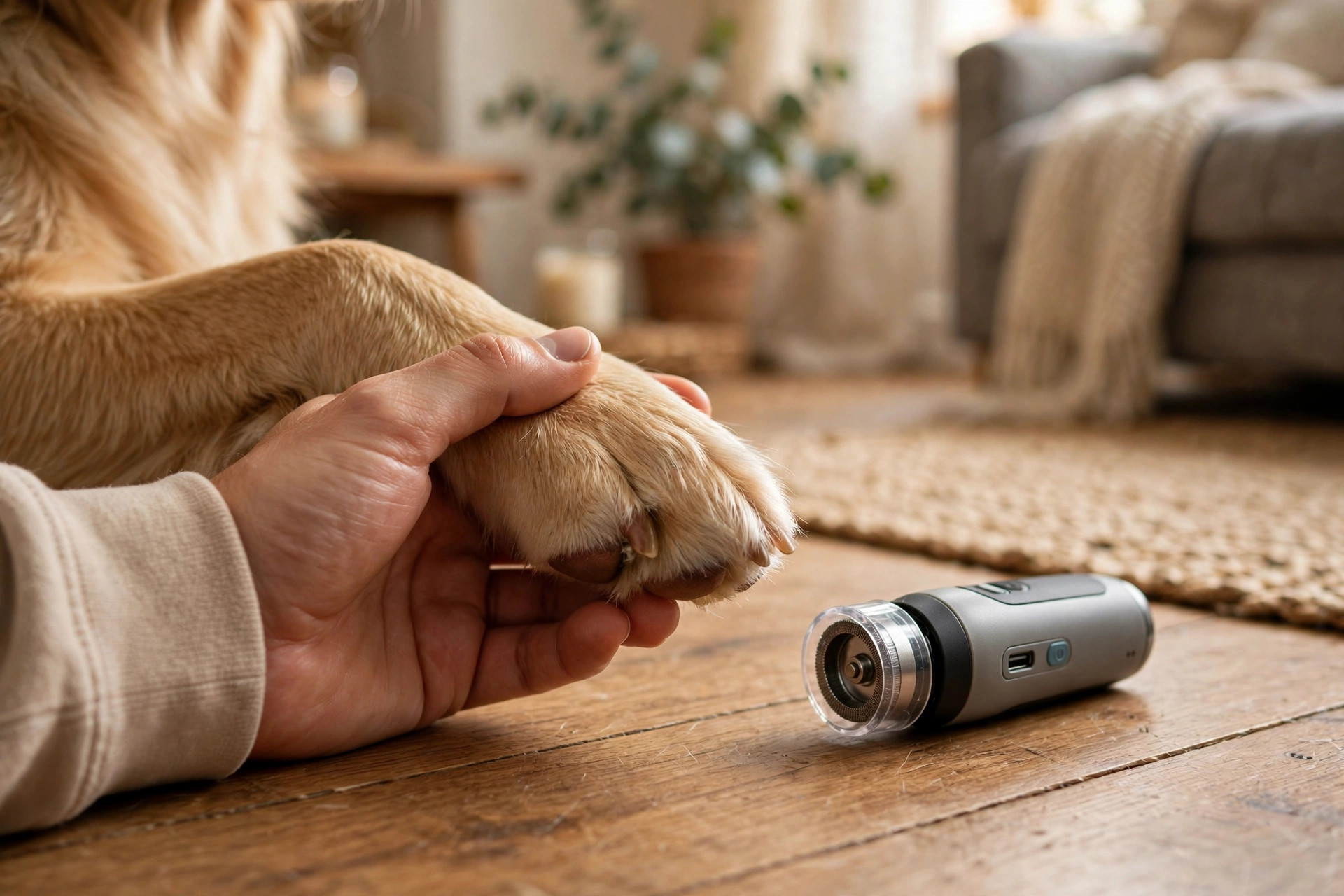
The guillotine-style nail clipper has one catastrophic failure mode: one squeeze too far, one yelp, one bloody paw — and your dog never lets you near its feet again. A nail grinder removes that cliff edge entirely: it files the nail down a little at a time, so there is no single moment where everything goes wrong. For apartment life, the right grinder also needs to be quiet enough for thin walls and a nervous dog, because the sound of the motor is half the battle.
Why grinders beat clippers for most apartment dogs
Clippers are faster in skilled hands. That is their only real advantage. Grinders win everywhere else, and the advantages compound in small homes:
- No quick-cut trauma. The quick — the blood vessel inside the nail — is easy to nick with clippers on dark nails. Grinders let you approach it gradually; the nail surface turns pale and chalky just before you reach it, which is a visible warning clippers never give.
- Smoother edges, fewer scratches. Clipped nails leave sharp edges that gouge hardwood floors, snag rugs, and scratch your legs when the dog launches off the sofa. Ground nails are rounded and floor-friendly.
- Dogs that fear clippers often accept grinders. The squeeze pressure of clippers around the nail is what many dogs actually hate. A grinder’s light touch feels different enough that it is worth trying on clipper-phobic dogs.
- The apartment noise problem is solvable. Yes, grinders make sound — typically 50–60 dB, about the level of a quiet conversation. That is dramatically less alarming through shared walls than a dog screaming from a quicked nail, which is the actual noise risk with clippers.
The honest tradeoff: grinding takes 3–5 minutes per session versus 60 seconds of clipping, and you need to do it slightly more often — every 2–3 weeks instead of every 3–4. If your dog is already calm about clippers and you are confident, stick with clippers. If either of those is false, the grinder is the upgrade.
Five grinders quiet enough for thin walls
Every model below is a real, widely sold grinder — no rebranded no-names, no “professional salon” fantasy specs. Prices are typical street prices; all five run under 60 dB on their working speed.
| Grinder | Best for | Usually | Apartment note |
|---|---|---|---|
| Casfuy Dog Nail Grinder | Most apartment dogs | $25–$35 | Whisper-quiet motor, USB rechargeable, 3 ports |
| LuckyTail Nail Grinder | Nervous beginners | $30–$40 | Very low vibration, LED light, gentle on first-timers |
| URPOWER Pet Nail Grinder | Tight budgets | $18–$25 | Decent power for the price; louder than the picks above |
| Petural Nail Grinder | Large and thick nails | $30–$40 | Stronger motor, 3 speeds; slightly more noise on high |
| Dremel 7350-PET | The power-tool pick | $25–$35 | Rotary-tool reliability, standard bits; the no-frills workhorse |
Casfuy — the everyday pick
Casfuy’s grinder became the default recommendation for a reason: the motor stays around 50 dB — genuinely quiet enough to run at 9 p.m. in an apartment without a second thought — and the three grinding ports (small, medium, large) keep the spinning stone away from fur and skin without you having to be precise. USB charging gives about 10 hours of runtime per charge, which at 5 minutes a session is effectively months. The included diamond bit files quickly enough that thick nails do not become a twenty-minute ordeal.
LuckyTail — the nervous-dog pick
If your dog startles at the vacuum, the grinder’s vibration matters as much as its sound. LuckyTail runs noticeably smoother than budget grinders — less buzz transmitted into the paw — and adds an LED light that helps you see the nail surface on dark nails. It is the slowest filer on this list, which is a feature for beginners: slower removal means more margin for error while you are learning the rhythm. The tradeoff is that giant-breed nails take patience.
URPOWER — the budget pick
The honest cheap option. It grinds perfectly well and the USB charging works, but the motor is audibly louder than the Casfuy — closer to 60 dB, the difference between background hum and something the dog notices. For a bombproof dog that does not care about noise, this is fine and saves $10. For a sound-sensitive dog, the savings are false economy; the dog’s objection will cost you more sessions than the price gap.
Petural — the thick-nail pick
Big dogs with thick, fast-growing nails — think shepherds, labs, pit mixes — can overwhelm underpowered grinders. Petural’s motor has noticeably more torque across its three speeds, so it does not bog down and heat up on dense nails. Use the lowest speed that gets the job done; the top speed is where the noise climbs. Keep sessions to a few seconds per nail with pauses, because a stronger motor also generates heat faster.
Dremel 7350-PET — the workhorse pick
Dremel’s pet kit is a real rotary tool with pet-appropriate bits, not a toy shaped like one. It will outlast every other grinder here — replacement sanding drums cost a few dollars and are available everywhere — and the build quality shows in how smoothly it runs. What it lacks: no USB charging (it uses its own charger), no fancy ports, no pet-specific ergonomics. For the owner who wants one tool for a decade, this is it.
- Low vibration. Dogs object to buzz more than hum. You cannot read this from a spec sheet — it is why the LuckyTail and Casfuy keep getting recommended.
- Multiple speeds. Low speed for learning and finishing, higher speed for thick nails. Single-speed grinders force compromises.
- Replaceable bits. The grinding stone wears smooth over months. If the bit cannot be replaced, the whole grinder is disposable.
- USB charging. Not a dealbreaker, but proprietary chargers get lost and the grinder becomes e-waste.
The two-week desensitization plan
Do not grind a single nail on day one. The dogs that “hate grinders” were almost always introduced to a running tool pressed against a sensitive paw with no preparation. Two weeks of boring homework fixes that:
- Days 1–3: the grinder is furniture. Leave it on the floor, off. Treat the dog for sniffing it, touching it, lying near it. The goal is “that object predicts chicken,” nothing more.
- Days 4–6: sound at a distance. Turn it on across the room while feeding high-value treats. Pair the buzz with the good stuff for 30-second sessions. If the dog freezes, increase the distance, not the treats.
- Days 7–9: vibration without nails. With the grinder running, touch the back of it (not the stone) to the dog’s shoulder, then paw, treating throughout. You are teaching that the vibration on the body is safe.
- Days 10–12: one nail, then done. Grind a single nail for three seconds, jackpot treat, session over. Quit while you are ahead — ending early is what makes the dog willing tomorrow.
- Days 13–14: build to a full paw. Add a nail or two per session. By the end, most dogs lie down for the routine the way they do for brushing.
The whole protocol fails if you skip steps because the dog “seems fine.” Seeming fine at step 3 and panicking at step 4 sets you back further than doing step 3 one more day.
Grinding technique that avoids the two classic injuries
Grinders have no catastrophic failure mode, but they have two annoying ones: heat and fur-wrap.
- Heat. Friction warms the nail. Grind each nail for 2–3 seconds, then move to the next paw — by the time you cycle back, the first nail has cooled. If the dog flinches mid-grind, it is almost always heat, not pain from the nail itself.
- Fur wrap. Long toe fur catches in the spinning stone and yanks. Push the fur back with your thumb before touching the stone to the nail, and use the port that matches the nail size so the stone stays exposed only at the tip.
Hold the paw firmly but not in a death grip — a tense hand telegraphs tension to the dog. Work at a 45-degree angle to the nail tip, shaping rather than flattening, and stop when you see the pale, chalky center approaching on the nail’s underside. That chalky dot is your warning: one more pass and you reach the quick.
The apartment-friendly nail schedule: one paw per evening, twice a week, beats a monthly wrestling match. Four nails take about two minutes, the dog never builds up dread, and you never have to carve out a “nail night” that everyone dreads — including the neighbors. Pair it with the calm evening routine and it becomes background maintenance.
FAQ
Will the grinder noise bother my neighbors?
No. A quality grinder runs at 50–60 dB — quieter than a normal conversation and far quieter than a TV. The neighbor-risk scenario is a dog yelping from a clipped quick, which is exactly what the grinder prevents. If you are worried, grind in the evening before 9 p.m. and it is a non-issue.
My dog is terrified of the sound. Is this hopeless?
Almost never. Sound fear responds well to the desensitization plan above — most failures come from rushing it. The rare truly sound-phobic dog may do better with a silent manual file used a little every day, or with the vet handling nails under mild sedation. Ask your vet before deciding it is hopeless.
How often should I replace the grinding bit?
When it stops cutting and starts just heating the nail — typically every 3–6 months of regular use. A worn bit is the number-one cause of “the grinder takes forever now” complaints. Diamond bits last longer than sanding drums; keep a spare so a dull bit never delays a session.
Can I use a grinder on my cat’s nails?
Technically yes, but most cats object more to the restraint than the tool, and cat nails are thin enough that sharp clippers are usually faster and less stressful. The grinder earns its keep for dogs; for cats, a calm two-person clipper routine is generally the kinder choice.