Best Corner Cat Trees for Small Apartments
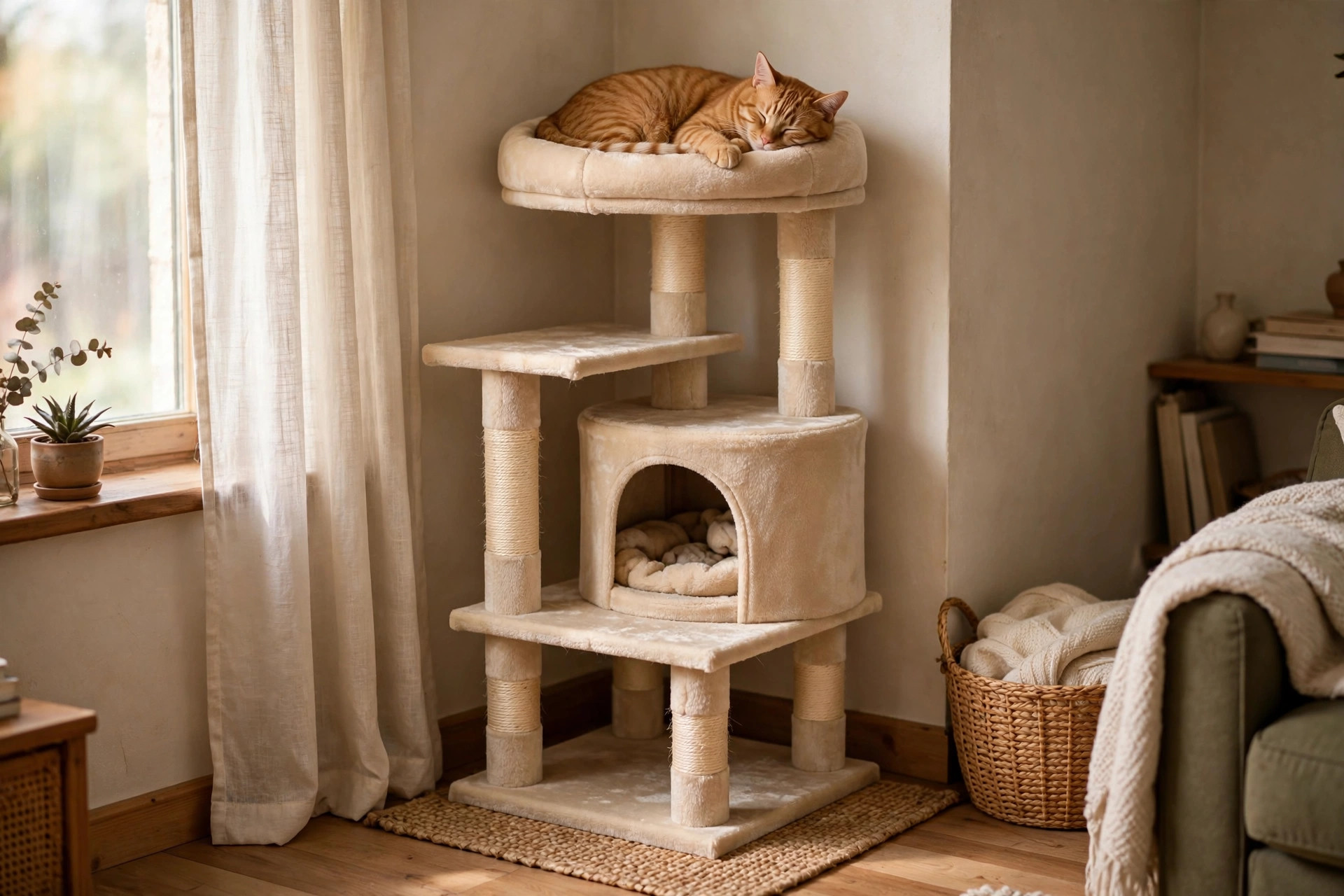
Indoor cats need vertical territory — somewhere high to survey the kingdom. A standard cat tree in a 600-square-foot apartment eats a whole corner and still wobbles when a 12-pound cat launches off the top. A corner-shaped tree fixes both problems at once: the base tucks flush against two walls, which kills the wobble and frees the footprint the middle of the room.
Five corner trees worth the floor space
These are widely sold trees with established track records in cat homes, compared on the criteria that matter in apartments: actual footprint, stability, perch sizes for real cats, and price. Typical US street prices — sales move them around.
| Model | Best for | Typical price | Small-apartment note |
|---|---|---|---|
| Frisco 52-in Corner Cat Tree | The true corner shape | Usually $65–$85 | Triangular base sits flush in corners; ~52" tall hits the sweet spot for most rooms. |
| Yaheetech 53.1-in Multi-Level Tree | Budget multi-cat homes | Usually $60–$90 | Square-ish base tucks into corners well; two condos and a hammock for the money. |
| FEANDREA 61-in Cat Tree | Tall rooms, big cats | Usually $90–$120 | Extra-large condo fits cats up to ~16 lbs; taller columns need a wall anchor. |
| Go Pet Club 72-in Cat Tree | Maximum vertical territory | Usually $70–$100 | Nearly 6 feet of climbing for the price of mid-range trees; wide base, big footprint. |
| New Cat Condos Premier Triple | Buy-it-for-life build | Usually $130–$150 | US-made with solid wood framing; far sturdier than particle-board trees. Heavier and pricier. |
Frisco 52-in Corner Cat Tree — the corner specialist
This is the one genuinely designed for corners: a triangular base that slides into a 90-degree corner with no wasted gap, and platforms staggered so a cat climbs up along both walls. At about 52 inches tall it clears most sofa backs without dominating the room, and Chewy shoppers consistently report that the wall-braced position eliminates the wobble that plagues freestanding trees of the same height. The condo is mid-sized — comfortable for cats under 12 pounds, snug for bigger ones. Sisal-wrapped posts handle the scratching load, and the price sits comfortably in budget territory.
Yaheetech 53.1-in Multi-Level — the value stack
For the money, this tree packs more features than anything else on the list: two condos, a hanging hammock, three top perches, and sisal posts on multiple levels. The base is roughly square, so it doesn’t hug a corner quite like the Frisco, but pushed into one it wastes very little space and the dual-wall position keeps it steady. Assembly takes 20–30 minutes and the instructions are the usual pictogram puzzle, but all hardware is included. The trade-off for the price is the usual one: particle-board platforms and carpet covering that will look tired after a year of heavy scratching — budget-friendly, not heirloom.
FEANDREA 61-in — the big-cat pick
Most budget trees are secretly designed for 8-pound cats; the FEANDREA’s extra-large condo (roughly 19 x 14 inches) actually fits a Maine Coon or a chunky 16-pounder. At 61 inches it’s one of the taller options that still works in standard 8-foot-ceiling rooms, and the wider stance base keeps it from feeling top-heavy. Because of the height, use the included wall anchor — it screws into the wall behind, so check your lease first; most landlords tolerate one small screw hole, and many renters’ guides to renter-friendly cat wall ideas cover how to patch it later.
Go Pet Club 72-in — the skyscraper
Nearly six feet tall with five levels, this is the maximum vertical territory per dollar on the market. In a studio or one-bedroom it becomes a piece of furniture in its own right — which is either a feature (a cat highway to nowhere else) or a problem (it will dominate a small room visually). The wide square base is genuinely stable even at full height, and the faux-fur covering is softer than most. The honest caveat: the condos and perches run small, so it suits average-sized cats better than large breeds, and at this height a corner placement with a wall anchor is strongly recommended.
New Cat Condos Premier Triple — the sturdy one
Most sub-$100 trees are particle board and cardboard tubes; New Cat Condos builds with solid wood framing in the USA, and you feel the difference the moment you assemble it — no wobble, no creaking when the cat launches. The Premier Triple stands about 46 inches with three carpeted levels and a roomy condo. It costs roughly double the budget picks, but owners routinely report these lasting five-plus years while cheap trees get replaced annually. If your cat is large, athletic, or you’re simply tired of rebuying wobbly trees, this is the math that works.
What actually matters in a small space
Shopping filters push color and "levels." Five specs decide whether a corner tree works in your apartment:
- True footprint, not just base size. Measure the corner including baseboards and any vent covers — a tree that needs 24 x 24 inches of flat wall won’t fit a corner with a floor vent. Triangular bases (Frisco) waste the least space; wide square bases need more room but stand steadier.
- Stability at the top perch. A tree is only as good as its top platform under a launching cat. Wall bracing — free with any corner placement — fixes most wobble. Above about 60 inches, add the wall anchor regardless.
- Perch and condo dimensions vs. your cat. Measure your cat stretched out. A 14-inch perch is a bed for an 8-pound cat and a joke for a 15-pounder. Manufacturer "weight limits" are optimistic; real comfort is about platform area.
- Scratching surface quality. Natural sisal rope outlasts carpet-wrapped posts by years. If the tree’s posts are carpet-only, plan to add a dedicated scratching post for small rooms nearby — otherwise the sofa arm becomes the scratcher.
- Rental friendliness. Freestanding corner placement needs no screws and leaves no marks — one of the strongest arguments for the corner shape. Wall anchors need one small hole; most leases tolerate it, but check yours first.
- Corner-shaped trees waste less floor space and wobble less than freestanding trees — two walls do the stabilizing for free.
- Budget $60–$150. Below $60 you get particle board that creaks; above $150 you’re paying for design or solid-wood builds.
- Match perch and condo size to your actual cat, not the marketing photos — measure the cat stretched out.
- Sisal-wrapped posts outlast carpet ones; add a dedicated scratcher if the tree skimps on scratching surface.
- Over 60 inches tall: use the wall anchor. Check the lease, patch the hole at move-out.
Placement: making the corner work
The corner is the whole point, so pick it deliberately:
- Near a window wins. A corner tree next to a window is the indoor-cat jackpot: height plus a view. If your best corner has no window, a window perch for apartment cats elsewhere in the room covers the view side.
- Not next to the litter box. Cats don’t like lounging above their bathroom. Keep the tree in the living area, not the litter corner.
- Leave a launch lane. Cats jump on and off trees at speed. Make sure there’s a clear landing zone — not a bookshelf edge or a lamp — on at least one side.
- Mind the sun. A top perch in direct afternoon sun becomes an oven; a perch with morning sun becomes the cat’s favorite spot in the house. Slight rotation of the tree matters more than you’d think.
The wobble test: after assembly, push the top platform firmly side to side. If it rocks more than an inch, tighten every bolt (they loosen in the first week as materials settle), then wedge it into the corner so two walls brace it. A tree that wobbles is a tree the cat stops using — and an unused tree is just expensive furniture.
Keeping it standing (and used) for years
Cat trees die from three things: loosening bolts, shredded scratching posts, and matted carpet. All three are fixable. Re-tighten every bolt monthly for the first three months — new trees settle and loosen noticeably. When sisal posts fray, replacement sisal rope costs under $15 and re-wrapping a post takes 20 minutes; it’s the single best life-extension trick for any tree. Vacuum the platforms with an upholstery tool every couple of weeks — fur buildup is what makes old trees look (and smell) done. And if the cat stops using the top perch, check the wobble before blaming the cat: nine times out of ten, something loosened.
FAQ
Will a corner cat tree damage my rental walls?
A freestanding corner tree needs no screws and only touches the walls lightly — no damage in normal use. If you use the wall anchor on a tall tree, it’s one small screw hole, easily patched with spackle at move-out. Put felt pads on any base corners that press against baseboards to avoid scuffs.
My cat ignores the tree and scratches the sofa. What now?
Usually a placement or surface problem, not a cat problem. Move the tree (or a scratcher) right next to the sofa arm they target — cats scratch where they already scratch. Make sure the tree has real sisal posts; carpet-only trees lose the texture contest to upholstery every time. A sprinkle of catnip on the new posts helps for the first week.
How tall should a cat tree be for a small apartment?
48–60 inches is the sweet spot: tall enough to satisfy the climbing instinct, short enough to stay stable without heroic anchoring and to fit under standard ceilings with clearance. Go taller only if you have the corner bracing and wall anchor to support it.
One big tree or two small perches?
For one cat in a small apartment, one good corner tree usually wins — it concentrates scratching, napping, and climbing in one maintained spot. For two cats, a corner tree plus a window perch in another room prevents territory disputes better than one crowded tree.