Best Cat Water Bowls for Whisker Fatigue
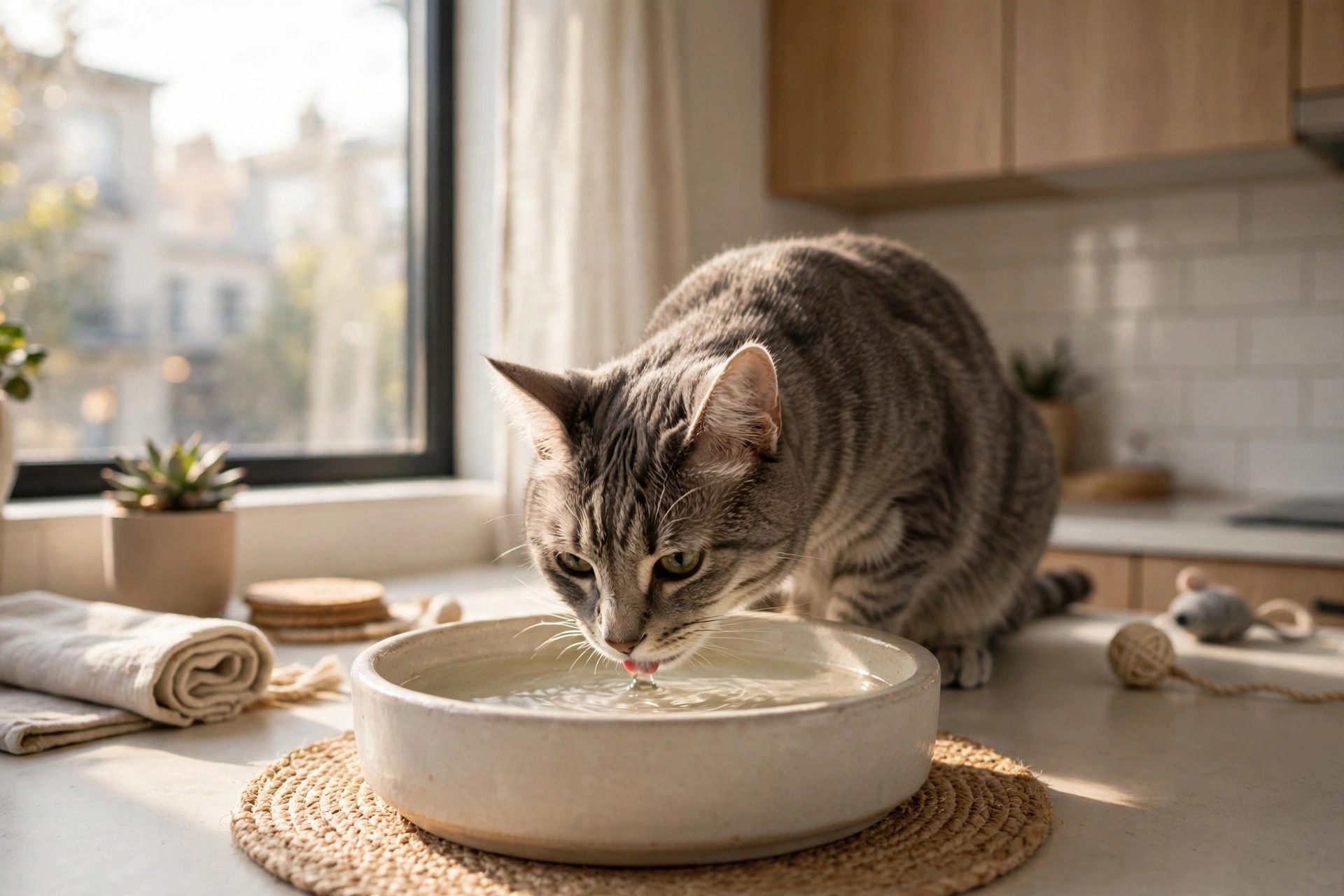
If your cat paws water out of the bowl, drinks only from the faucet, or abandons a full bowl after two laps, whisker fatigue may be the reason — not fussiness. A cat’s whiskers are exquisitely sensitive instruments, and pressing them against the tall sides of a standard bowl every time she drinks is genuinely uncomfortable. The fix costs less than a bag of treats: a wide, shallow bowl that lets her drink without her whiskers touching anything.
Whisker fatigue is not a disease, it is a design problem. A cat drinking from a saucer-width bowl never experiences it — the "condition" only exists because standard bowls were designed for human convenience, not cat faces.
What whisker fatigue actually is
Whiskers (vibrissae) are deeply rooted in a cat’s face, each follicle packed with nerve endings that report touch, air currents, and proximity. When a cat pushes her face into a narrow bowl, those sensors fire continuously from the sides pressing in — the equivalent of someone tapping your forehead the whole time you drink. Repeated several times a day, sensitive cats develop avoidance behaviors that look like pickiness: pawing water onto the floor first (drinking from a flat puddle where whiskers stay free), only drinking from wide sinks or dripping faucets, or eating from the center of the food pile and leaving a ring around the edges.
Veterinarians disagree on how universal the sensitivity is, but the behavioral pattern is well documented and the fix is harmless either way: a wider bowl never hurts. If your cat shows these signs, change the bowl before you spend money on a fountain.
Six bowls worth your kitchen counter
All of these are wide, shallow, and low-sided — the three properties that matter. Prices are typical street prices.
| Bowl | Material | Typical price | Apartment note |
|---|---|---|---|
| Dr. Catsby’s Bowl | Stainless steel | $25–$30 | The original whisker-relief design; wide and ripple-textured. Dishwasher-safe. |
| Necoichi Raised Cat Water Bowl | Ceramic | $18–$28 | Raised on a stand; easier on senior necks. Heavy enough not to slide. |
| Lorde Wide Cat Bowl (2-pack) | Ceramic | $20–$30 | Two shallow dishes; great for food + water pairing. Hand-wash paint. |
| Yaheetech Elevated Double Bowl | Ceramic + bamboo stand | $15–$22 | Budget elevated option; 15-degree tilt. Stand needs occasional wiping. |
| Corelle 6-inch saucer | Vitrelle glass | $4–$8 each | The honest cheap fix: a human saucer is already whisker-friendly. |
| CatGuru Premium Whisker Bowl | Melamine | $12–$18 | Lightweight and tip-proof shape; good for travel or second locations. |
Dr. Catsby’s Bowl — the purpose-built original
Designed specifically around whisker relief by a veterinarian, with a wide ripple-textured stainless surface that holds a thin, spread-out layer of water. At roughly 6 inches wide and barely an inch deep, whiskers clear the rim on every side. Stainless steel is non-porous, so it will not harbor the bacteria that cause feline chin acne the way scratched plastic does — a genuine health advantage beyond comfort. The downside is the price for what is essentially a metal saucer, but it is buy-once quality and survives the dishwasher.
Necoichi Raised Water Bowl — best for seniors
A wide ceramic bowl on an integrated stand, raising the drinking surface a few inches off the floor. Senior cats with arthritis or neck stiffness drink noticeably more from raised bowls because they do not have to crouch. Ceramic stays cool, looks good on a kitchen floor, and at over a pound empty it does not migrate across tile when the cat paws at it. Hand-wash the glazed finish to keep it pristine.
The $6 fix nobody markets
Before buying anything branded: a wide human saucer or a shallow pasta bowl from your own cupboard already satisfies every whisker-fatigue criterion — wide, shallow, low-sided. Corelle saucers are nearly indestructible and cost a few dollars. The branded bowls add non-slip bases, raised stands, and nicer materials, but the geometry that matters is free.
Sizing rules: the 5-by-2 test
A bowl is whisker-friendly when it is at least 5 inches wide and no more than 2 inches deep, with sides that slope outward rather than rising straight up. Test any bowl at home: fill it, watch your cat drink, and look at the whiskers — if they bend against the rim, the bowl fails regardless of what the packaging claims. Flat, wide saucers pass by design; deep soup mugs and tall tumblers fail by design.
- Material: ceramic, glass, or stainless steel. Avoid plastic — it scratches, harbors bacteria, and is linked to chin acne in sensitive cats.
- Stability: wide and low is inherently tip-resistant, but on slick floors a silicone mat ($8–$12) underneath stops the 3 a.m. sliding symphony your downstairs neighbor does not appreciate.
- Quantity: in a one-bedroom, two water stations beat one fancy bowl. Cats drink more when water is encountered during normal roaming — kitchen plus bedroom is the minimum.
Placement rules for small apartments
Where the bowl sits matters as much as its shape. Cats are hardwired to distrust water next to food — in the wild, water near a kill site may be contaminated — so placing the bowl directly beside the food dish is the single most common reason cats under-drink. Separate them by at least 3–5 feet, ideally in different rooms. Other apartment-specific rules: not next to the litter box (odor + dust), not in a high-traffic hallway where the cat gets startled mid-drink, and not on a wobbly table she can knock over. A quiet corner of the bedroom and a spot in the living room cover most one-bedroom layouts. If you run an automatic feeder, keep water well away from it for the same contamination instinct.
If the bowl change is not enough
Some cats still under-drink after the bowl fix, and chronic low intake matters — it is linked to urinary and kidney issues, the vet bills for which dwarf any bowl budget. Next steps in order: (1) add a second water station in a new room; (2) refresh water daily and wash the bowl — cats reject stale water far sooner than humans expect; (3) try running water via a pet fountain (the movement triggers drinking instinct); (4) add wet food, which is 75–80% water and the single biggest lever on feline hydration. If intake drops suddenly rather than gradually, that is a vet visit, not a bowl problem. Our cat grass guide covers another enrichment angle for indoor cats, and a harness opens supervised outdoor stimulation that often increases overall activity and drinking.
FAQ
Is whisker fatigue real or marketing?
The sensitivity of whiskers is real anatomy; whether every cat experiences "fatigue" is debated. What is not debated: cats show clear preference for wide, shallow bowls, and switching eliminates pawing and avoidance behaviors in most cats that show them. The fix is cheap and risk-free.
Do the same rules apply to food bowls?
Yes — arguably more, since cats press their faces into food bowls longer. Use wide, shallow dishes for wet food too; the "leaving a ring of food around the edges" habit disappears immediately for most cats.
Should I get a fountain instead?
A fountain solves a different problem (water movement and freshness). If your cat shows whisker-avoidance behaviors, fix the geometry first — many fountains have narrow drinking surfaces that recreate the same problem. A wide bowl plus fresh water beats a narrow fountain.
How often should I wash the water bowl?
Daily rinse, full wash with soap every 2–3 days. Biofilm — the slimy layer that forms on any standing water — is the top reason cats reject bowls that look clean to us.