Best Cat Beds for Small Apartments Cats Actually Use
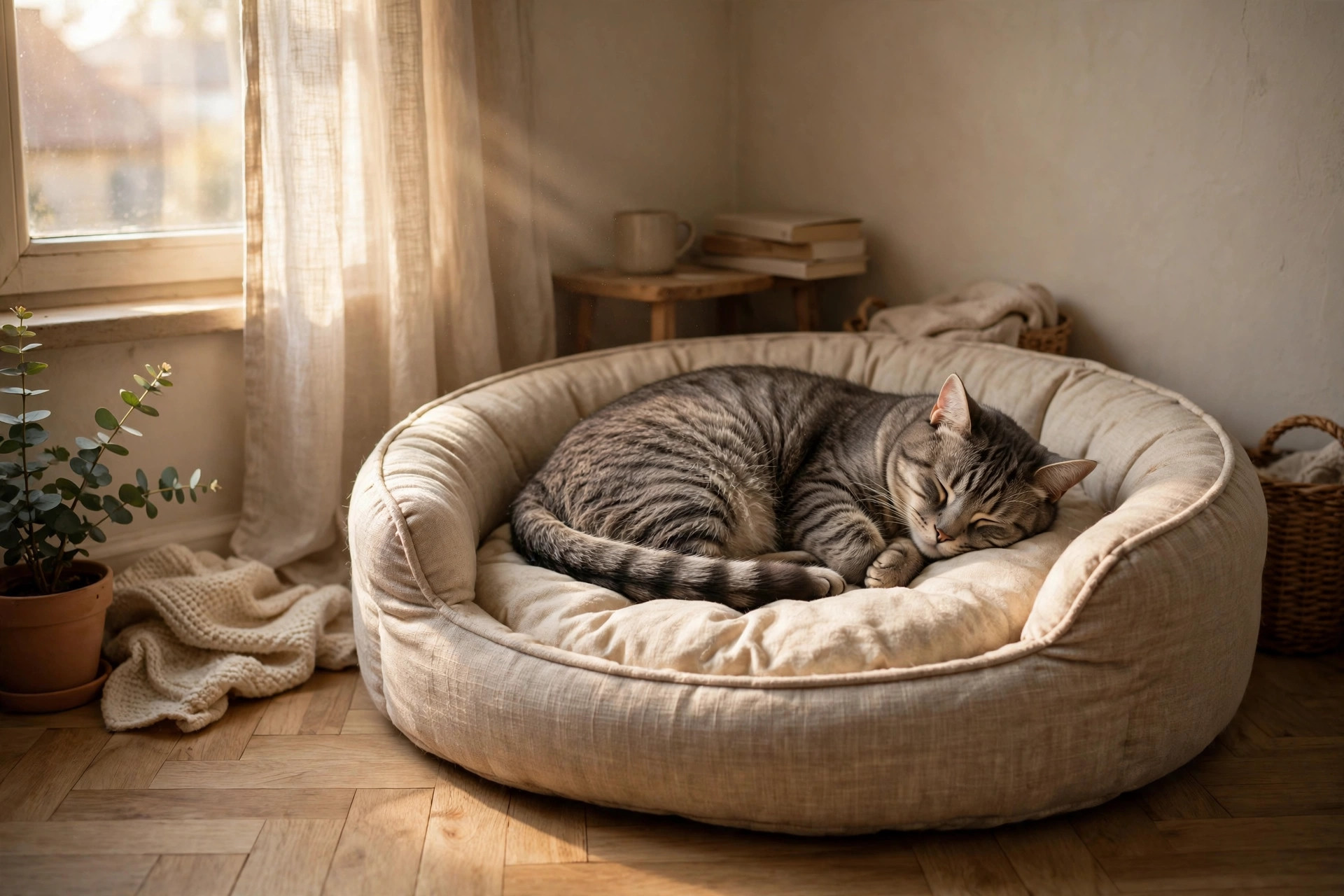
You unwrap a carefully chosen bed, set it in the perfect corner, and the cat walks past it to sleep in the cardboard box it came in. The lesson: cats pick sleeping spots by a strict checklist of warmth, scent, shelter, and vantage point, and most store-bought beds fail half of it on day one. In a small apartment, where every square foot competes for your floor space, you cannot afford a decorative cat bed. Here is how to buy one the cat will actually use.
- Cats choose warmth, familiar scent, and a sheltered edge — not price tags. A $25 bed in the warm corner beats a $120 bed in a drafty one.
- Size the bed like a coat, not a couch: about 18–20 inches across for an average cat. Oversized beds feel exposed and get ignored.
- The calming donut (Best Friends by Sheri) and the heated pad bed (K&H Thermo-Kitty) are the two best-selling apartment beds for a reason: both match how cats actually sleep.
- Plan on a two-week adoption period. The bed will sit empty at first, and that is normal — scent and routine need time.
- Pair the bed with the right corner: see our cat rest corner setup guide for placement rules.
Why your cat ignores every bed (and why the box wins)
Your cat runs a quiet election every evening. Sleeping spots are chosen on four criteria, in roughly this order:
- Warmth above everything. Cats sleep deepest at 72–80°F, warmer than most homes sit. That is why the sun patch, the radiator side, and your freshly vacated sofa spot all win: they are the warmest real estate in the apartment.
- An edge to curl against. Watch a cat settle: it noses the rim and folds itself against a boundary. A flat cushion mid-floor feels exposed, no matter how soft. Bolsters, cave walls, and box corners all satisfy this instinct.
- Familiar scent, no new-chemical smell. A new bed smells like a factory; your laundry pile smells like home. Until the bed absorbs the household scent — a week or two — the laundry wins.
- A defensible position. Cats want their backs protected and the door visible. A bed in a busy path loses to the spot under the coffee table with a wall at its back.
Notice what is not on the list: softness. A $15 blanket folded into the right corner outperforms an expensive memory-foam bed in the wrong one. Placement is half the battle — see our rest corner guide for the full temperature, traffic-flow, and noise rules.
Five beds that match how cats actually sleep
Each pick matches a real sleeping style. Prices are typical US street prices and move with sales.
| Bed | Best for | Typical price | Small-apartment note |
|---|---|---|---|
| Best Friends by Sheri Calming Donut Cuddler | Curl-sleepers; anxious cats | Usually $25–$40 | 23-inch donut fits a corner; raised rim is exactly what curlers want. |
| K&H Pet Products Thermo-Kitty Bed | Cold apartments; older or thin-coated cats | Usually $40–$60 | Low-wattage heater only warms under the cat; needs an outlet nearby. |
| Frisco Bolster Cat Bed | The budget all-rounder | Usually $20–$35 | 20-inch bed with a 4-inch bolster; machine washable and light enough to move daily. |
| Meowfia Premium Felt Cat Cave Bed | Cats that hide under furniture | Usually $50–$65 | Merino wool cave, one entrance; holds its shape and hides hair between washes. |
| Snoozer Cozy Cave Covered Cat Bed | Burrowers and blanket-stealers | Usually $50–$80 | Hooded design with a sherpa interior; doubles as a decorative throw pillow when unused. |
Best Friends by Sheri Calming Donut Cuddler — the safe default
The donut shape is not a gimmick: the raised rim lets a cat drape its head over the edge exactly the way curl-sleepers do, and the faux-fur texture comforts anxious cats. The standard 23-inch size suits cats up to about 12 lbs, with a 30-inch version for larger cats. Machine wash and air-dry — the dryer mats the fur. If you buy exactly one bed, buy this one.
K&H Pet Products Thermo-Kitty Bed — the cold-apartment specialist
If your rental sits at 65–68°F all winter and your cat keeps migrating to the radiator, this is the answer. The low-wattage heater holds about 102°F and only activates under the cat's weight, so it is safe for unsupervised daytime use. Apartment trade-offs: it needs an outlet within cord reach, and the cord should run behind furniture in a cover if the cat chews. The removable cover is machine washable, which matters because warm beds get slept in hard.
Frisco Bolster Cat Bed — the budget all-rounder
Chewy's house-brand classic: 20 inches across with a 4-inch rim. Two of them — living room and bedroom — still cost less than most premium beds. Machine washable, light enough to carry as the sun patch moves, and a sensible first buy if you do not know your cat's style yet.
Meowfia Premium Felt Cat Cave Bed — for the under-the-sofa crowd
Some cats do not want to be seen sleeping. This hand-crafted merino wool dome gives maximum shelter in a 20-inch footprint, and wool naturally masks odor between washes — useful in a studio where the bed sits feet from your bed. Buy only if your cat already seeks enclosed spots like under the bed; open-sightline cats will reject it.
Snoozer Cozy Cave — for burrowers
Cats that sleep under your blankets are asking for overhead cover, and this hooded sherpa bed gives them a burrow without needing yours. It reads as a decorative throw pillow on the sofa — useful when the bed is always in sight. Skip it for sprawlers; buy it for the cat that digs into the duvet.
What to skip
Two categories waste apartment space. Novelty beds shaped like tacos or cacti are rejected at the same rate as everything else — except now you own a cactus. Oversized orthopedic foam beds (30+ inches) fail the “edge to curl against” test for average cats and eat a huge chunk of floor. Buy for your cat's observed sleeping style — curl, burrow, hide, sprawl — not for the photo.
Size it like a coat, not a couch: the numbers
“Cozy” is not a dimension. Use these targets when you shop:
- Interior diameter: 18–20 inches for a 9–11 lb cat; 22–24 inches for large breeds. If your cat's favorite curl fits a 12-inch box, do not buy a 24-inch bed.
- Bolster or rim height: 3–5 inches — high enough to rest a chin on, low enough to step over without a hop.
- Weight rating: check the stated limit — a bed that buckles under a big cat feels broken and gets abandoned.
- Total footprint: a 20-inch round bed plus clearance is a 2×2 ft square — plan it like furniture before you buy.
- One-bedroom rule of thumb: two $25 beds in two warm spots beat one $60 bed in one spot. Cats rotate locations by time of day; cover the living room and the bedroom.
The most common sizing mistake is buying bigger “so the cat has room.” Cats are burrowers, not sprawlers. An oversized bed feels like sleeping in a field — the cat moves to your sweater drawer, which is the right size.
The two-week adoption plan: teaching the cat the bed is theirs
About 10 minutes a day, and never force the cat into the bed — picking a cat up and placing it there makes the bed feel like a trap and adds weeks to the timeline.
- Days 1–3: scent, no pressure. Rub a worn t-shirt into the bed, put it in the target corner, and ignore it. Let the cat investigate on its own terms.
- Days 4–7: pay in treats. Drop a treat on the bed whenever the cat walks past, and feed one meal a day next to — not in — the bed.
- Days 8–10: move the competition. The step everyone skips. Cat sleeps on your sweater pile? Move the top sweater onto the bed. Cats choose by texture and scent more than by location.
- Days 11–14: warm it up. Warmth is almost always the missing variable: move the bed 3 to 6 feet from the sunny window. A bed that is 5°F warmer gets chosen.
Still empty after two full weeks? Re-score the placement, not the bed: unnoticed drafts and foot-traffic paths within arm's reach are the top two causes of rejection. Our rest corner guide has the full checklist.
Keeping the bed clean without a washing-machine war
In a small apartment, the cat bed sits near your bed and sofa, so maintenance is a purchase criterion. Three things to check:
- Removable, machine-washable cover. Every bed on this list has one; without it, you are eventually hand-washing a whole bed in the bathtub.
- Air-dry faux-fur and felt beds — heat mats the texture and shrinks wool; a warm radiator-side spot dries a cover overnight.
- Hair management between washes. A weekly lint-roller pass keeps the bed and apartment under control; felt and wool beds hide hair better than faux fur.
Wash rhythm: cover wash every two to three weeks in normal use, weekly during heavy shedding season. If the bed starts to smell despite washing, the foam insert is holding odor and needs replacing — most inserts last a year or two in daily use.
FAQ
My cat sleeps on my bed, not the cat bed. Is anything wrong?
Nothing is wrong — your bed wins on warmth, scent, and company. Stop competing with the mattress: put the bed where the cat naps while you are away, and measure success by afternoon use, not midnight.
Should I buy one expensive bed or two cheap ones?
Two cheap ones. Cats rotate spots by time of day — daytime near household activity, nighttime near where you sleep. Two $25 beds in the living room and bedroom get more total use than one $60 bed matching only one time of day.
Are heated beds safe to leave on while I am at work?
Thermostat-controlled beds like the K&H Thermo-Kitty are designed for unsupervised use — the heater only activates under the cat's weight. The cord matters more: route it behind furniture and plug into a surge protector. Skip human heating pads, which run hotter.
How do I know the bed is too big?
The cat sits in it but will not sleep in it, or drapes itself half on and half off. That means it fails the “edge to curl against” test — downsize to 18–20 inches for an average cat.
Can a window perch replace a bed?
For daytime, often yes — a sunny window perch beats a floor bed for warmth and entertainment. Keep a floor bed too: cats want a ground-level option for nighttime and for hot afternoons when the glass runs too warm.