Best Apartment Litter Bag Disposal Routine for Small Homes
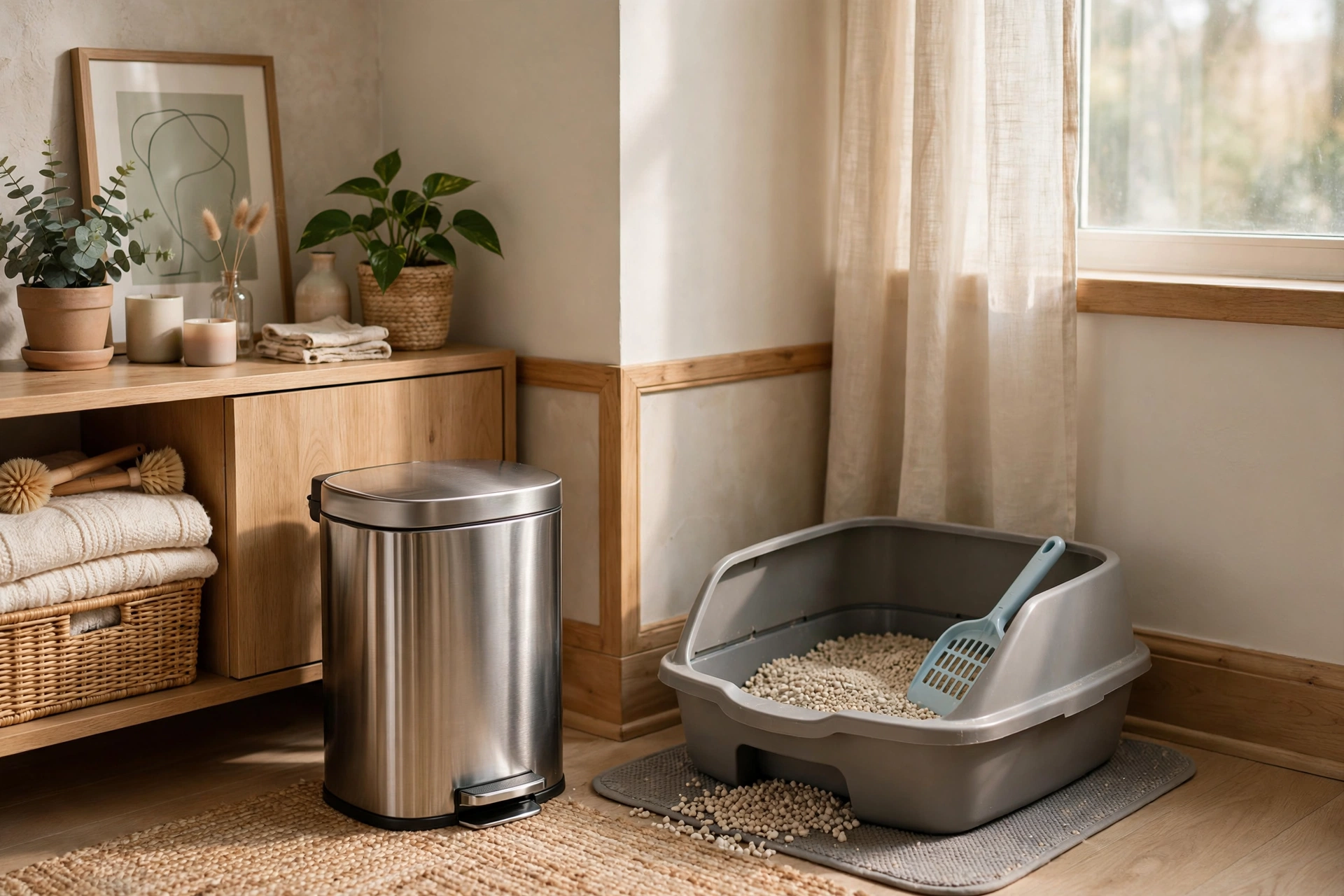
You scoop twice a day like a responsible cat owner, tie the bag, and drop it in the kitchen trash — and by evening the whole studio smells anyway. The problem isn't your scooping. It's what happens to the waste after you bag it. This is the 90-second routine that fixes it: the right sealed container, the double-bag method, and trash-day math for small homes.
Why a tied bag still stinks up a small home
A knotted grocery bag is not airtight — it's a slow leak. Cat waste keeps producing ammonia and sulfur compounds for 24–48 hours after scooping, and in a studio or one-bedroom there is nowhere for that smell to go but your living space. Three things make it worse in apartments specifically:
- Warm indoor air. Apartments sit at 70–75°F year-round, and warmth accelerates bacterial off-gassing. A bag that seems fine at noon can smell by dinner.
- The kitchen trash trap. Dropping litter bags in the kitchen can feels efficient, but food waste plus litter waste in one warm bin is the fastest route to a smelly apartment.
- Trash day gaps. Many buildings collect twice a week. A bag tied on Monday night sits until Thursday — four days of slow leaking.
Container showdown: 4 sealed options compared
You need a dedicated, lidded, gasket-sealed container that lives next to the litter zone — never the kitchen trash. Here's how the realistic options stack up for small homes:
| Option | Best for | Typical cost | Small-home notes |
|---|---|---|---|
| Litter Genie | Set-and-forget scoopers | Usually $20–30, refills $15–20 | Footprint of a small trash can; the continuous-bag system means you never touch a full bag. Refill cost adds up — roughly $60–80/year. |
| Ubbi steel diaper pail | Odor control maximalists | Usually $70–90 | Steel body + rubber gasket seals better than plastic; uses regular trash bags so no proprietary refills. Heavier and pricier up front. |
| 5-gallon bucket + gamma-seal lid | Budget DIY | Usually $12–18 total | The cheapest airtight option. Ugly, but it lives in a closet anyway. Line it with a bag for easy emptying. |
| Small lidded step can | Studio dwellers | Usually $25–40 | A 1.5–3 gallon stainless step can fits beside any litter box and looks like normal decor. Empty it into the building trash every 2–3 days. |
Any of these beats the kitchen trash. Pick the one you'll actually empty on schedule — the best seal in the world doesn't help if the container sits full for a week.
The 90-second routine, step by step
Do this at every scooping session — morning and evening — and waste odor stops being a background feature of your home:
- Scoop into the bag (30 sec). Scoop directly into a small bag — dog-waste bags, produce bags, or the Litter Genie cartridge. Don't let clumps sit in the scoop.
- Double-bag the wet ones (15 sec). Urine-heavy clumps go in a second bag. This one habit cuts leak-through smell roughly in half.
- Seal and drop (15 sec). Knot the bag, drop it in the sealed container, close the lid fully. A half-closed lid is an open lid.
- Wipe the scoop (15 sec). Quick wipe with a damp paper towel keeps the scoop itself from becoming a smell source.
- Hands (15 sec). Wash. Every time.
Trash-day math: how often to empty the container
Your sealed container is a holding cell, not a landfill. Use this schedule based on your building's pickup:
- One cat, pickup 2×/week: empty the sealed container into the building trash the night before each pickup. It never holds more than 3–4 days of waste.
- One cat, pickup 1×/week: empty mid-week anyway — take the tied container bag to the chute or dumpster on day 3 or 4, even if it's half full. Old waste is the enemy, not volume.
- Two cats: halve every interval above. Two cats produce roughly twice the waste, and the container fills — and ripens — twice as fast.
- Summer rule: in warm months, move everything one day earlier. Heat is an accelerant.
Mark it on the same recurring reminder as trash night. The routine fails when emptying the container relies on memory.
Odor absorbers that actually help (and ones that don't)
A sealed container does 90% of the work. These are the remaining 10% — ranked honestly:
- Activated charcoal sachets — help. A $8–12 pack of charcoal bags hung inside or taped under the container lid absorbs ambient odor between emptyings. Replace or "recharge" (sunlight for an hour) monthly. The best supplement to a sealed container.
- Baking soda — helps a little. A thin layer at the bottom of the container or sprinkled in the bag neutralizes acids on contact. Cheap and safe, but it saturates fast — reapply every 2–3 days, not monthly.
- Scented trash bags — mostly masking. They make the bag smell like lavender instead of nothing. In a sealed container, unscented bags + charcoal beats scented bags alone.
- Plug-in air fresheners near the litter zone — skip. They don't remove odor molecules; they add fragrance molecules on top. Worse, strong fragrances near the box can put cats off using it. If guests are coming, ventilate instead.
- Enzyme spray on the container — helps. A monthly spritz inside the empty container breaks down the biofilm that makes old plastic smell permanently. This is the difference between a container that lasts a year and one that smells forever after three months.
A note on "compostable" bags: many are only compostable in industrial facilities, not home compost — and cat waste shouldn't go in home compost anyway due to pathogens. Buy them if you like the material, but don't pay extra for a compost claim you'll never use. Standard unscented bags in a sealed container remain the best value.
FAQ
Can I just flush cat waste instead?
Not safely in most cases. Cat feces can carry Toxoplasma gondii, which survives wastewater treatment and harms marine life — many municipalities prohibit flushing it. Tofu litters marketed as "flushable" are the exception some owners use, but check your local plumbing and building rules first, and never flush clay litter.
Are scented litter bags worth it?
They help marginally, but a sealed container with unscented bags beats scented bags in an open bin every time. Scent covers; seals contain. Spend the money on the container.
My building has a trash chute — can I toss bags down it daily?
Yes, and chute buildings are actually ideal: bag, double-bag the wet clumps, and chute it the same day. Just make sure bags are knotted securely so they don't burst in the chute — your downstairs neighbors will thank you.
How do I clean the sealed container itself?
Monthly: empty it, spray with enzyme cleaner or a 1:10 vinegar-water solution, let sit 10 minutes, wipe dry. If the gasket smells permanently, replace the gasket or the lid — plastic absorbs odor over time, which is one reason steel pails last longer.