Best Apartment-Friendly Cat Toy Rotation Ideas
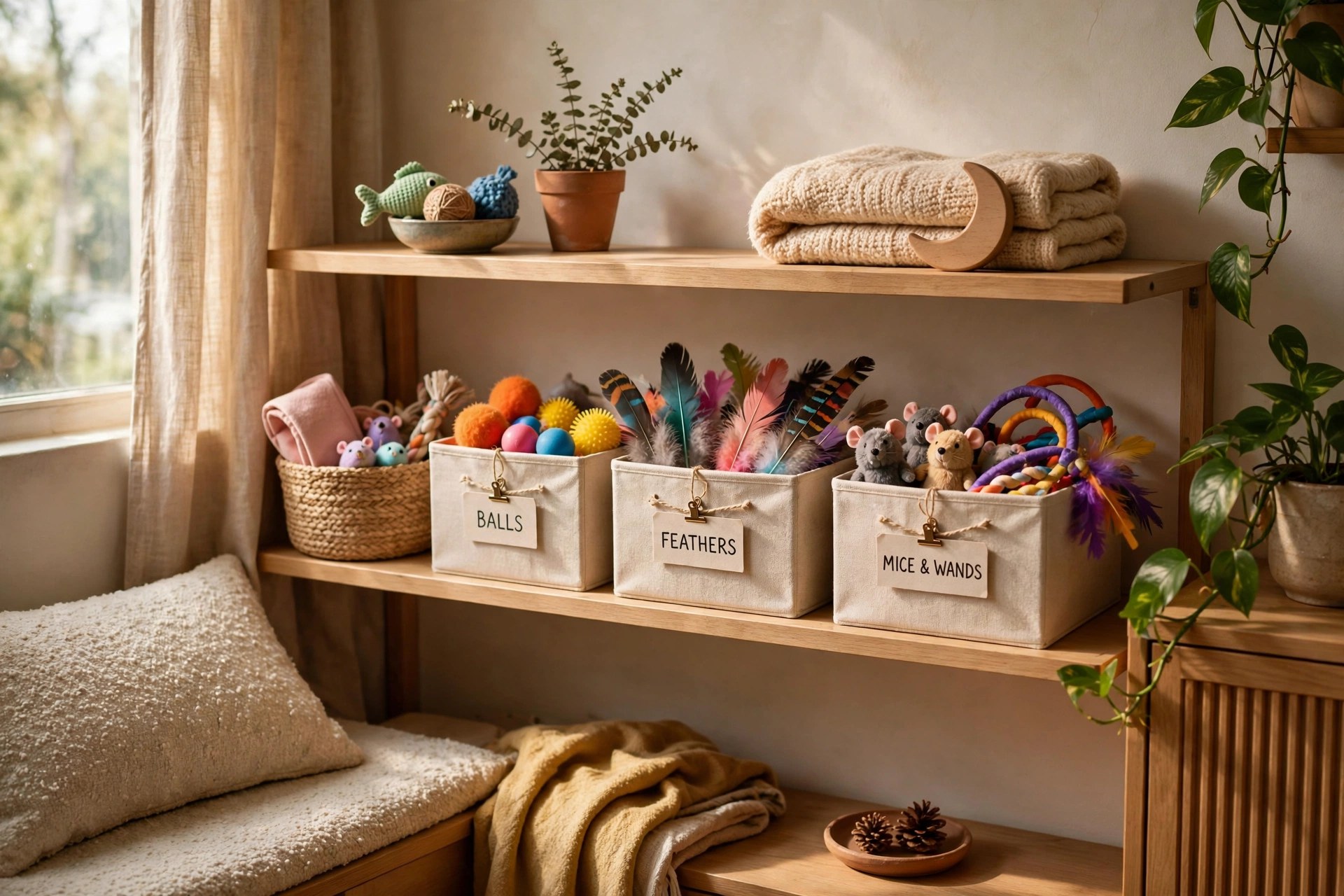
Your cat isn't bored of toys — she's bored of these toys, right now. Cats habituate fast: a toy left on the floor for two weeks becomes furniture. Rotation exploits the opposite effect — a toy that disappeared for ten days comes back as good as new. In a small apartment, where you can't just buy more space, a rotation system is the cheapest enrichment upgrade there is: it turns the toys you already own into a library that never gets stale.
Why rotation works (the 10-day rule)
Feline behaviorists observe a consistent pattern: most cats lose interest in a specific toy after 7–14 days of constant access, but regain interest after a similar absence. Call it the 10-day rule — out of sight for about ten days, and the toy resets to "novel." This is why buying more toys stops working: the problem was never quantity, it was permanent availability.
Rotation also solves the apartment-specific problem of toy sprawl. Twenty toys scattered across 600 square feet means tripping hazards for you and background noise for the cat. A rotation keeps 4–6 toys out at a time — enough for choice, few enough that each one registers.
The four-box library system
Sort every toy you own into four boxes (shoeboxes work; label them). Each box holds one category of play, and only one box is "open" per week:
Box 1 — Chase toys
Wand and teaser toys: a Cat Dancer 101, a feather wand like Neko Flies or Frisco's bird teaser, a simple ribbon on a stick. These are interactive-only toys — they come out when you play, and go back in the box when the session ends. Never leave wand toys out unsupervised; strings are a strangulation and ingestion hazard.
Box 2 — Solo hunters
Toys the cat bats alone: crinkle balls, small mice, Yeowww! catnip cigars, SmartyKat skitters. Put 3–4 out during the box's week and let them live on the floor. These are the workhorses — cheap (usually $5–$12 for a multi-pack) and endlessly re-rotatable.
Box 3 — Puzzle and forage
Food puzzles and treat-dispensing toys: a LickiMat casper, a Doc & Phoebe's indoor hunting feeder set, a muffin tin with balls over the cups. These engage the "hunt-eat" sequence and are the best box for overweight or food-obsessed cats. Rotate the puzzle design, not just the toy — a new challenge resets interest faster than a new color.
Box 4 — Comfort and texture
Catnip pillows, silvervine sticks, a small fleece blanket for kneading. This box is for low-energy days and senior cats. Silvervine (matatabi) works on roughly 80% of cats, including many that ignore catnip — if your cat is in the "catnip does nothing" camp, this box is your fix.
The weekly schedule
Rotation day is Sunday (or whatever day you reliably do chores). The whole swap takes five minutes:
- Sunday — Swap. Collect all of last week's toys into their box. Open the next box in sequence. Wipe puzzle toys; toss anything damaged (see the retirement checklist).
- Monday–Wednesday — Observe. Note which toys get touched. The ignored ones go back in the box early — no guilt, that's data.
- Thursday — Midweek refresh. Move the week's toys to new spots: a mouse that lived under the couch moves to the hallway. Location change is a free novelty boost.
- Friday–Saturday — Interactive focus. Two 10-minute wand sessions (Box 1 toys can guest-star any week). End each session letting the cat "catch" the toy — a hunt with no catch frustrates more than it enriches.
After four weeks you've cycled all boxes, and Box 1's toys have been gone long enough to feel new again. If a particular toy is a superstar every time it appears, promote it to permanent resident status — one or two all-time favorites can live outside the system.
Match the box to your cat's play style
Cats have play personalities. Rotating the wrong category just rotates the boredom. Watch your cat for a week and pick a branch:
The Chaser — ignores stealth, wants speed. Crinkle balls down hallways, laser-pointer-style chase (always end on a physical toy they can catch). Weight toward Box 2 with high-motion toys. These cats do best with twice-daily short bursts rather than one long session.
The Wrestler — grabs, bunny-kicks, chews. Needs kickable size: Yeowww! cigars, 8-inch kick sticks, knotted fleece. Weight toward Box 2 and Box 4. Inspect wrestle toys weekly — these are the ones that get destroyed, and loose stuffing is an ingestion risk.
The Watcher — senior, shy, or low-energy. Prefers to observe before engaging. Weight toward Box 4 (silvervine, catnip) and slow-moving Box 2 toys. Don't mistake low energy for no interest — watchers often play at 2 a.m. when the apartment is quiet.
The toy retirement checklist
Rotation extends toy life, but nothing lasts forever. Retire a toy immediately if you see any of these:
- Exposed string, elastic, or wire — especially in wand toys. Ingested string can require emergency surgery.
- Loose stuffing or foam poking through seams. Wrestlers destroy seams first; check weekly.
- Small detachable parts — glued-on eyes, bells with broken housings, feathers pulling free in clumps.
- Catnip toys gone flat — when the smell is gone (usually 3–6 months), the toy is just a fabric mouse. Either refresh with loose catnip or retire it.
- Battery toys that stutter — a dying electronic toy that moves erratically can startle a nervous cat into avoiding the whole box.
Retired doesn't always mean trash: a much-loved but unsafe toy can be "reborn" by removing the hazardous part (cut off the string, restuff the mouse). When in doubt, throw it out — toys are cheap, vet visits aren't.
FAQ
How many toys should be out at once in a small apartment?
Four to six. Fewer than three and there's not enough choice to discover a preference; more than six and they become background clutter the cat stops noticing. The rest live in their boxes, which also keeps your floors clear.
My cat ignores every toy. Is rotation pointless?
Almost certainly not — it usually means the category is wrong, not the concept. Try the play-style branches above: "ignores everything" cats are often Watchers who need silvervine instead of catnip, or Hunters who need interactive wand play instead of solo toys. Also rule out pain or illness with a vet if a previously playful cat goes fully flat.
Can I rotate between two cats with different preferences?
Yes — run two mini-rotations. Give each cat their own Box 2 (solo toys) matched to their style, and share Boxes 1, 3, and 4. In multi-cat apartments, having enough "hunt" outlets per cat actually reduces inter-cat tension, since boredom is a common trigger for bullying.
Do I need to wash the toys?
Solo fabric toys benefit from a monthly wash (mesh bag, gentle cycle, air dry) — saliva and floor dust build up fast. Hard plastic puzzle toys should be washed weekly if used with wet food. Wand toy attachments get replaced, not washed, when grimy.