How to Teach Door Manners to Apartment Cats
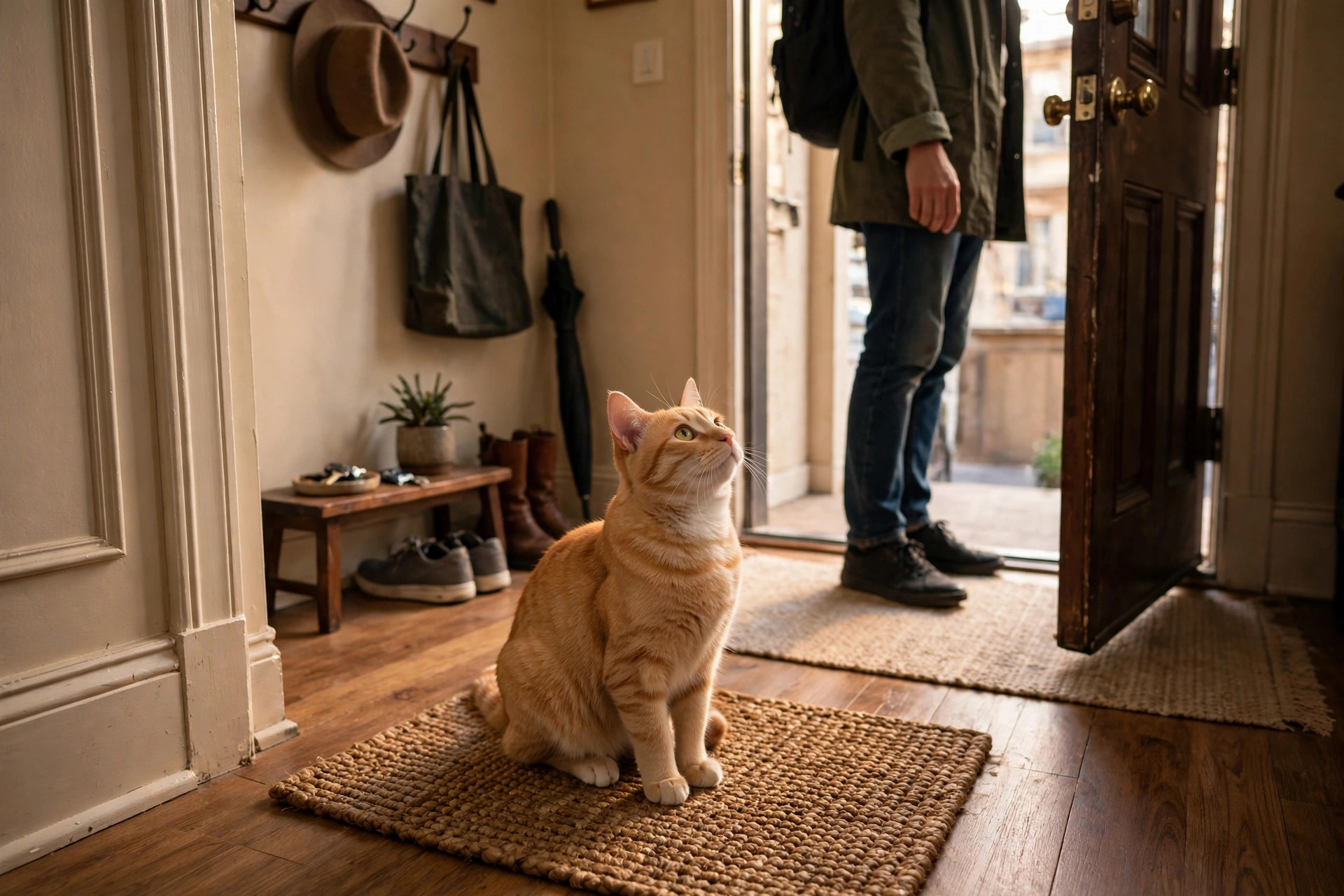
An apartment front door is the highest-stakes door a cat will ever meet. Beyond it lies a hallway full of strangers, an elevator shaft, a stairwell, and a lobby door that opens onto traffic — and unlike a house, there is no mudroom, no second door, no margin for error. Cats do not dart out of spite; they dart because the door is the most interesting moving object in a small home and nobody has taught them a better job. Door manners for cats are entirely trainable, and they rest on two pillars: a physical setup that forgives mistakes, and a station behavior that gives the cat somewhere to be instead.
- Build a renter-friendly “airlock” at the entryway first — training reduces darting, but a physical backup catches the failures.
- Teach station training: the cat goes to a mat or perch on cue and stays there while the door operates. This is the core skill.
- Desensitize the door itself — the sounds, the motion, the light change — so it stops being the most exciting event of the day.
- Never punish darting. Punishment teaches the cat to bolt faster and earlier, which is the opposite of door manners.
- Two weeks of short daily sessions produces a reliable station for most cats; the airlock stays forever as insurance.
Why apartment doors are the riskiest doors
In a house, a cat that slips out lands in a yard. In an apartment building, a cat that slips out lands in a shared hallway with no familiar scents, where the nearest hiding spots are behind other people’s doors, inside the elevator, or down six flights of stairs. Lost indoor cats in apartment buildings are disproportionately found in stairwells and parking garages — stressful, hard to search, and full of hazards. The escape itself usually takes under three seconds: the cat has been rehearsing the approach every time the door opens, and one day the timing lines up.
Cats rehearse because the door is genuinely fascinating. It moves, it makes sounds, light and new smells pour through it, and interesting humans appear in it. Telling a cat “no” at the door is asking impulse control from an animal that was never given an alternative. The training below does not fight the fascination — it redirects it onto a station behavior that pays better than the doorway does. For the emergency side of this topic — what to do if prevention fails — see how to keep your cat from darting out the front door.
Build the airlock: a renter-friendly entryway buffer
Training is the long game; the airlock is tonight’s insurance. An airlock is simply a second barrier between the cat and the hallway, so that a failed training rep ends at a gate instead of in the stairwell.
The simplest version: a tension-mounted pet gate with a cat door ($50–$90; Carlson and Regalo make pressure-mounted models with small pass-throughs) installed a few feet inside the front door, creating a small vestibule. You step through the gate, close it, then open the front door — the cat is always behind one closed barrier. For narrow entryways where a gate will not fit, a freestanding exercise-pen panel ($35–$70) angled across the entry works; it does not need to be pretty, it needs to be in the way.
Two details matter. First, the airlock zone itself should be boring — no food, no cozy bed, no reason to hang out there — so the cat does not learn to loiter at the inner gate the way it used to loiter at the door. Second, make the barrier part of your every entry and exit, including the quick “just grabbing the delivery” moments. Darting happens on the casual openings, not the planned ones. Guests get the 20-second briefing: “close the inner gate before you touch the front door.”
Station training: the core skill, step by step
Station training teaches the cat to go to a specific spot — a mat, a small rug, a perch — and stay there until released. It is the single most useful behavior for door manners, because “go to your spot” is incompatible with “stand in the doorway.” You will need a clicker or a consistent marker word (“yes!”), and pea-sized high-value treats (freeze-dried chicken or commercial cat treats the cat genuinely loves — kibble rarely motivates this work).
Days 1–3: the station pays for existing. Place the mat a few feet from the door — not at it. Any time the cat steps on, sniffs, or looks at the mat, mark and treat. Toss treats onto the mat so the cat keeps returning to it. Most cats are offering “go to mat” deliberately by day 3, because cats are excellent economists.
Days 4–7: add the cue and duration. Say “spot” (or “place,” “mat” — pick one word) right before the cat steps on, then mark and treat. Gradually delay the treat: 2 seconds on the mat, then 5, then 10, treating for staying rather than for arriving. If the cat leaves, no scolding — just wait; the next rep is a fresh start.
Days 8–14: bring the door into it. Cue “spot,” then walk toward the door — treat the cat for staying. Touch the handle — treat. Open the door two inches — jackpot treat (three or four in a row). Build to a fully opened door with you stepping halfway out, the cat holding station. The sequence becomes: door sounds start → cat goes to spot unprompted → treats rain. That unprompted move is the graduation moment, and most cats reach it inside two weeks because the payoff history is so rich.
| Method | Best for | Time to reliability | Notes |
|---|---|---|---|
| Station training | Most cats; the default choice | 10–14 days | Gives the cat a job; works for guests too |
| Target training (nose to stick) | Cats slow to offer station | 2–3 weeks | Lure the cat away from the door, then station |
| Airlock only | Senior or untrainable cats | Immediate | Management forever; no behavior change |
| Spray bottles / yelling | No one | Never reliable | Teaches faster, sneakier bolting |
Desensitize the door itself
A cat that has learned station may still break when the door does something novel — a loud knock, the deadbolt’s clack, a guest arriving with luggage. Spend a few sessions decoupling the door’s drama from the cat’s arousal. With the cat at a comfortable distance (treats in hand), rattle the handle and treat; open the door an inch and treat; let it swing and treat. Knock from the inside and treat. The pattern is monotonous by design: door does a thing, cat gets paid, nothing exciting happens. Three to five minutes, a few times a week, folded into the station sessions.
Also audit what the door promises. If the hallway routinely delivers the building’s most interesting smells and the apartment’s interior is under-enriched, the door will always win the motivation contest. A cat with a window hammock, a daily play session, and rotating toys has less reason to treat the hallway as the only adventure available. Door manners get dramatically easier when the apartment itself is worth staying in.
The daily protocol that makes it stick
Training creates the skill; routine preserves it. Fold these into normal life:
- Every exit: cue “spot” before your hand touches the handle. Treat, step through the airlock gate, close it, then open the front door. Thirty seconds, every time.
- Every entry: come in, close the front door first, then greet the cat. Entering to a cat already holding station earns a jackpot treat — reward the behavior you want to see repeated.
- Guests: brief them once (“toss a treat to the mat when you come in”) and put a small treat jar by the door. Guests who participate become part of the training team instead of its saboteurs.
- Deliveries: the highest-risk moment, because you are distracted and the door stands open. Cue station before opening, or simply leave the airlock gate closed and collect the package around it.
- Refresh weekly: one 2-minute station session per week keeps the behavior sharp indefinitely. Behaviors that stop paying fade; a weekly jackpot keeps “spot” valuable for life.
The goal was never an obedient cat — it was a cat with a better offer. “Spot” works because the mat reliably produces chicken and the doorway reliably produces nothing but a closed gate. Cats do the math fast. Make sure the math favors you.
FAQ
My cat is 12 and has never been trained. Is it too late?
No — older cats learn station training readily, sometimes faster than kittens, because they are less distractible. Keep sessions to 2–3 minutes, use exceptionally high-value treats, and lean harder on the airlock as the primary safety layer while training progresses.
Can I use a spray bottle to keep the cat from the door?
It backfires. The cat learns the door is dangerous when you are watching and bolts faster when you are not — which is exactly when escapes happen. It also damages trust, making all future training harder. Station training plus an airlock outperforms punishment on every metric.
What if I have a studio with no entryway for an airlock?
Use a freestanding pen panel angled to create even a 3-foot buffer zone, or train the station to be as far from the door as the room allows (the bed corner, say). In true studios, the station behavior carries more of the load — invest the extra week to make it rock solid, and consider a harness by the door as a last resort for high-risk moments.
The cat meows at the door constantly. Is that related?
Often, yes — door fixation and door vocalizing share a root in under-stimulation plus a history of the door “paying” with excitement. Station training helps, but also see how to stop a cat from meowing at the door for the vocalizing side specifically.