How to Pet-Proof Electrical Cords in a Studio
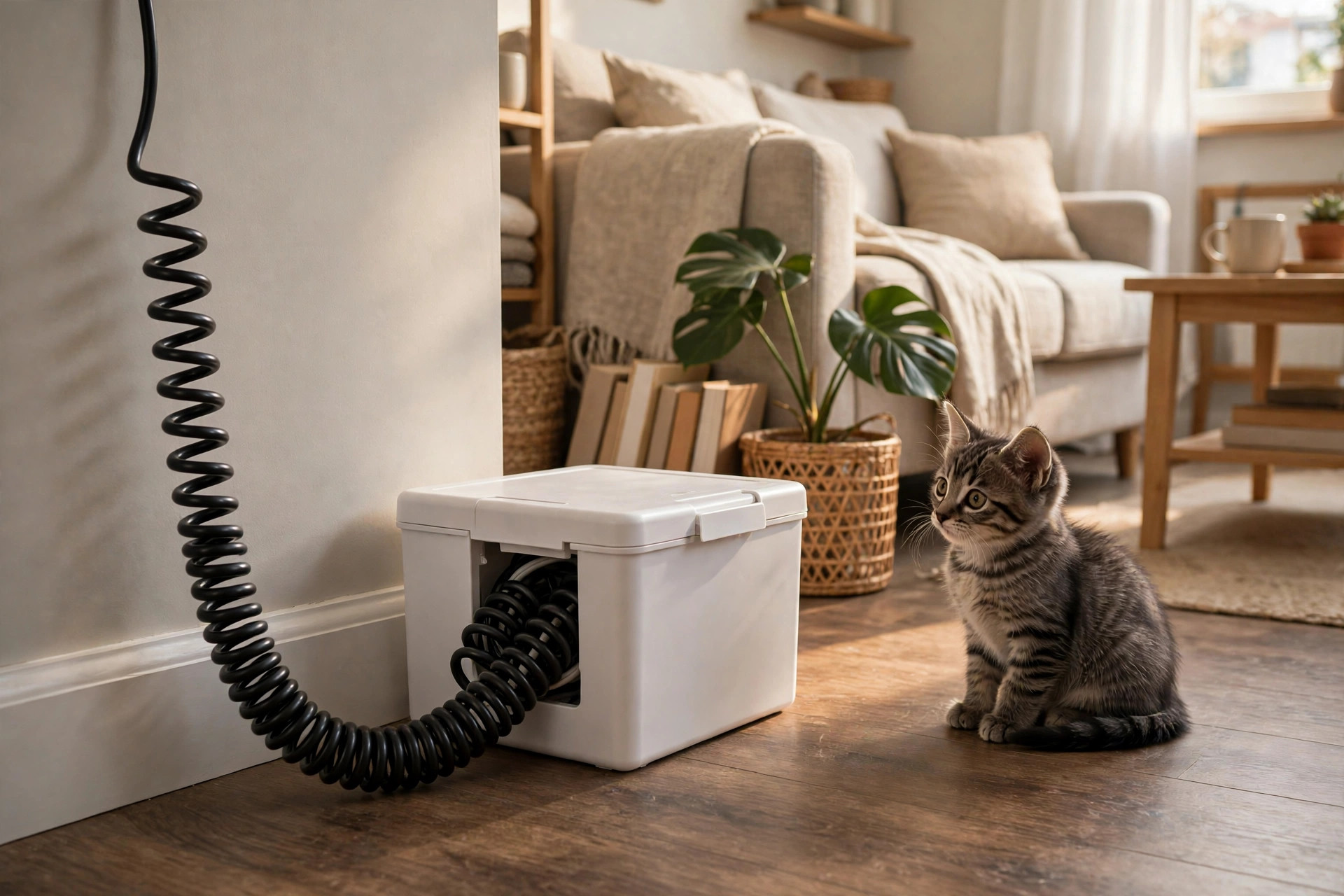
In a studio, every cord lives within twelve feet of your pet at all times — there is no spare room to close off. Kittens chew cords during teething, puppies chew them during everything, and adult cats bat at the ones that dangle. A bitten-through lamp cord can deliver a serious shock, start a fire behind furniture you cannot see, or leave a puppy with burned mouth tissue. Cord-proofing a studio is a one-afternoon project, and it is one of the highest-value safety upgrades per dollar in this entire guide library.
- Cover every accessible cord with a chew-resistant sleeve or rigid raceway — bitter spray alone fails on determined chewers.
- Eliminate dangling cords first: secure them flat to baseboards or furniture so they stop reading as toys.
- Unplug and store what you are not using. A disconnected cord cannot shock anyone.
- Provide legal chew outlets: a teething kitten or bored puppy chews cords because nothing better is available.
- Know the emergency response: unplug at the wall (never yank the pet off), then call the vet — mouth burns can swell shut hours later.
The 20-minute cord audit
Walk your studio with your phone’s notepad and list every cord a pet can reach — which, at cat-jump height and puppy-nose height, means essentially everything below 4 feet plus anything dangling from above. The usual suspects in a studio:
- Phone and laptop chargers — thin, dangly, chewed most often. The #1 victim category.
- Lamp cords — run along the floor behind the sofa, exactly where cats patrol.
- TV and console cables — a whole spaghetti nest behind the media stand; kittens treat it as a playground.
- Kitchen appliance cords — toaster, kettle, coffee maker; often hang off counters at perfect cat-batting height.
- Extension cords and power strips — the studio’s dirty secret: too few outlets means cords crossing open floor.
- Holiday lights and fans — seasonal, thin insulation, irresistible.
Rank each by risk: thin + dangling + low = fix today. Thick + flat against the wall + behind furniture = fix this weekend.
What actually stops chewers
| Solution | Typical price | Best for |
|---|---|---|
| Split-loom tubing (25 ft) | $8–$15 | Bundling the TV/console nest; cheap whole-room coverage. |
| CritterCord covers | $12–$18 | Individual lamp and charger cords; citrus-scented deterrent built in. |
| Rigid cord raceway (6 ft) | $15–$25 | Cords along baseboards; paintable, nearly chew-proof. |
| Cord management box | $15–$30 | Hiding a power strip + its plug nest behind the desk. |
| Grannick’s Bitter Apple spray | $8–$12 | Supplement, not solution; works on ~70% of pets, fails on the determined. |
| Outlet plug covers | $5–$8 (pack) | Unused outlets at nose height; puppies nose them curiously. |
Split-loom tubing: the whole-room workhorse
A 25-foot roll of corrugated split tubing costs less than a pizza and covers an entire studio’s cord runs. The split lets you press cords inside without unplugging everything, and the ribbed plastic is unpleasant to chew — most cats try once and quit. Bundle the TV nest into one or two thick looms rather than five thin ones; a thick bundle reads as "furniture," thin singles read as "toy." Secure looms to baseboards with adhesive cable clips ($5 for a bag) so they cannot be dragged out and worried like prey.
Rigid raceways: for the determined chewer
Some dogs — terriers, herding breeds, power-chewing puppies — go straight through plastic tubing. For them, rigid PVC or metal raceways along the baseboard are the answer: paintable to match the wall (landlord-friendly, removable with a putty knife), and genuinely chew-proof. Run lamp and charger cords through raceway from outlet to furniture and the cord simply ceases to exist as far as the dog is concerned.
Bitter spray: the honest assessment
Grannick’s Bitter Apple is the best-known deterrent, and it works on a solid majority of cats and mild chewers — one taste and they move on. But roughly a third of determined chewers either do not mind it or learn to chew anyway, and it needs reapplication every few days as it dries. Use it as a supplement on top of physical covers, never as the only defense on a live cord. For the broader chewing problem (furniture, shoes, everything), our cord protector guide covers the puppy-specific arsenal.
Routing tricks for studios
- Go vertical, then hide. Run cords up behind furniture to outlets rather than across open floor. A cord nobody can see is a cord nobody chews.
- Box the power strip. A cord management box with the strip inside and only short tails exiting eliminates the most dangerous nest in the apartment — the strip behind the desk where plugs sit half-exposed.
- Charge in a drawer. A charging station inside a closed drawer or cabinet takes the #1 chew victim (thin charger cables) completely out of play. Drill-free cable pass-throughs exist for renters.
- Elevate the lamp cord. Run lamp cords up the back of the side table and behind it, clipped to the table leg, instead of trailing across the floor to the wall.
- Unplug seasonally. Fan in winter, space heater in summer (see heater safety): unplug and coil-store what the season does not need. A stored cord is a safe cord.
Cats chew cords most during teething (4–6 months) and out of boredom; puppies chew during teething (3–7 months) and out of anxiety. A kitten with a catnip toy rotation and a puppy with frozen Kongs chews dramatically fewer cords — enrichment is cord-proofing.
If your pet bites a live cord
Act fast and in this order: 1. Unplug the cord at the wall — do not pull the pet off the cord with your hands while current may be flowing; flip the breaker if you cannot reach the plug safely. 2. Check responsiveness and breathing. 3. Look in the mouth: electrical burns show as pale or ulcerated tissue on the tongue, lips, or palate, sometimes with drooling. 4. Call your vet or an emergency clinic immediately, even if the pet seems fine — mouth burns swell over hours and can obstruct breathing, and lung fluid (pulmonary edema) can develop up to 12 hours after a shock. Keep the pet calm and do not offer food or water until the vet advises. Then find and fix the cord before the pet goes near it again — animals that survive a shock often return to the same cord.
FAQ
Are wireless chargers safer around chewers?
Marginally — the pad’s own cord still needs proofing, and a chewed pad is e-waste. The real win is cable pass-through charging drawers, which remove thin cables from the environment entirely.
Will my landlord object to raceways?
Adhesive-mounted raceways are renter-standard: they peel off with a putty knife and a dab of touch-up. Avoid screwing into walls or baseboards without permission. Keep the packaging to prove removability at move-out.
My cat only chews cords when I’m asleep. What then?
Nighttime chewing is boredom chewing. Confine charging cables to a closed drawer overnight, put cord covers on the rest, and add a pre-bed play session plus a puzzle feeder — a tired cat sleeps instead of shopping for cables.
Do cord covers work for rabbits or other small pets too?
Rigid raceways, yes; thin tubing, often no — rabbit teeth go through plastic loom easily. This guide is written for cats and dogs; small mammals need metal conduit for anything they can reach during free-roam time.