How to Give a Cat or Dog Pills Safely at Home
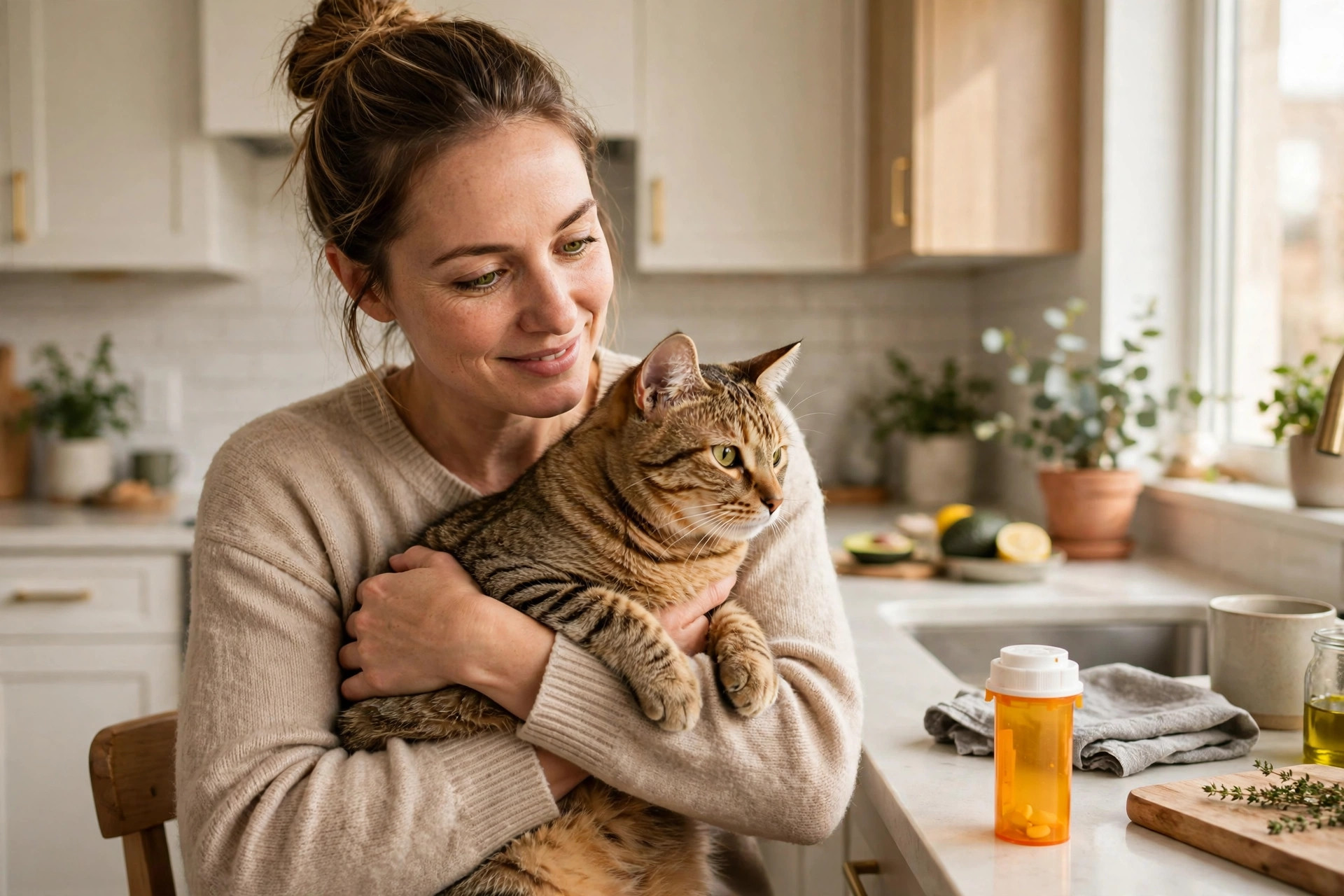
The vet hands you a bottle of pills, your cat reads your intention from across the room, and the next twenty minutes are a wrestling match that ends with the pill dissolved under the sofa and everyone upset. Pilling a pet badly is not just stressful — a bitten finger, an aspirated pill, or a crushed slow-release tablet are real medical risks. The good news: the order of operations matters more than force. Start with the sneaky methods, escalate to tools, and keep direct pilling as the trained technique it is.
- Always try hiding the pill first — pill pockets ($8–$10), a dab of peanut butter, or a meatball of wet food works for most dogs and some cats.
- A pill popper/pill gun ($5–$12) is safer than fingers for direct pilling: it places the pill past the tongue hump without your hand in the mouth.
- Never crush or open a pill unless the vet says so — enteric-coated and slow-release tablets can overdose or burn the esophagus when broken.
- Follow every pill with water or food: pills that lodge in the esophagus cause strictures, especially in cats. A syringe of water or a treat chaser fixes this.
- Stop and call the vet if the pet vomits the pill twice, if you cannot open the mouth safely, or if the pet has bitten or scratched you.
Level 1: hide it — the method that works most of the time
Before anyone wrestles anyone, try the easy wins in order. Pill pockets (Greenies Pill Pockets, about $8–$10 for a 30-count bag) are soft treats with a built-in pouch — drop the pill in, pinch closed, and most dogs swallow the whole thing as a treat. They come in dog and cat sizes, though cats are notoriously pocket-skeptical. The meatball method works for both species: wrap the pill in a small ball of wet food, cream cheese, or peanut butter (xylitol-free — check the label, since xylitol is lethal to dogs), then feed two plain meatballs first, the pill meatball third, and a plain one last. The sequence builds swallowing momentum so the pill goes down before the tongue starts investigating.
Buttering the pill is the old vet-tech trick for cats: roll the pill in a thin coat of butter or squeeze cheese. The coating makes the pill slide down instead of sticking to the tongue, and the taste distracts for the critical two seconds. It does not work for pets who chew suspiciously — if your dog crunches the pill and spits out the bitter half, skip to the tools. One hard rule for this level: if the vet said the medication must be given on an empty stomach, hiding it in food may reduce absorption — confirm with the clinic first. Our guide to storing pet medications safely covers the timing questions around food.
Level 2: the pill popper — safer than fingers
A pill popper (also sold as a pill gun, $5–$12 at pet pharmacies) is a plastic syringe with a soft tip that holds the pill and a plunger that ejects it. It lets you place the pill past the base of the tongue — the hump where the swallowing reflex triggers — without putting your fingers between teeth. For cats especially, it is the single biggest safety upgrade: most pilling bites happen to fingers, not to poppers.
The technique: load the pill into the tip. With the pet facing away from you (a cat on a counter or table, a small dog on a raised surface), tilt the head gently back with your non-dominant hand under the jaw — do not crank the neck, just a slight upward angle. Slide the popper along the side of the mouth to the back, depress the plunger, then close the mouth and stroke the throat or blow gently on the nose to trigger the swallow. Follow immediately with 3–5 ml of water from a syringe or a lick of wet food. Watch for the swallow — a lick of the lips is the tell — and check the floor, the blanket, and the pet’s cheek pouches (dogs) afterward. Pets that spit pills are professionals; check twice.
Level 3: direct pilling by hand — the trained technique
Direct hand-pilling is a skill, not a shove. Hold the pill between the thumb and forefinger of your dominant hand. With your other hand, tilt the head back slightly and press the lips against the teeth on either side of the upper jaw — the pressure makes the mouth open without prying. Drop the pill as far back on the tongue as you can reach in one smooth motion, close the mouth, hold it shut for two or three seconds, and stroke the throat downward. Then the water chaser: a syringe of water or a treat, every time. Pills — especially doxycycline and other antibiotics — can lodge in a cat’s esophagus and cause painful strictures; the chaser is not optional.
For cats, the towel burrito helps: wrap the cat snugly in a large towel with only the head exposed, placed on a table or counter. It prevents the scratch-and-twist escape and keeps claws away from your arms. For large dogs, back the dog into a corner or against a wall so it cannot reverse out of the pilling. If the pet is growling, snapping, or panicking, stop. A bitten hand needs medical attention (cat bites in particular infect fast), and a pet that learns pilling is a fight gets harder every single time — ask the vet about compounded liquid or transdermal alternatives instead.
What never to do with pills
| Mistake | Why it is dangerous |
|---|---|
| Crushing a pill without asking | Slow-release and enteric-coated tablets dump the full dose at once (overdose) or burn the esophagus and stomach when the coating is destroyed. |
| Opening capsules into food | The powder is often intensely bitter — the pet stops eating entirely, and you lose both the dose and the meal. |
| Dissolving in the water bowl | You cannot measure the dose, the drug may degrade, and the pet may refuse to drink for hours. |
| Splitting pills meant to be whole | Scored tablets are splittable; unscored ones are not. Uneven splits mean uneven doses. |
| Chasing with dry kibble only | Kibble does not reliably push a pill past the esophagus. Water or wet food is what prevents lodging. |
The crushing question comes up constantly, so here is the bright line: ask the pharmacist or vet for every medication. Some pills (plain immediate-release tablets) crush fine; others (anything labeled ER, XR, SR, enteric-coated, or a capsule) must not be. When in doubt, do not crush — a phone call to the clinic takes two minutes and the answer is definitive.
Apartment logistics: multi-pet homes and missed doses
In a small apartment, the pilling audience is the problem: a second pet watching may steal the meatball, and a stressed pet has nowhere to decompress. Pill in a separate room with the door closed, and keep the other pet occupied with its own treat. If a pill gets spit out twice, do not give a third — call the vet for the missed-dose protocol, because doubling up is sometimes worse than missing. Log doses on your phone (a simple note with date and time); in a two-person household this prevents the classic “did you pill him?” double dose.
For chronic medications, ask about alternatives at the next visit: many common drugs come as flavored chews, compounded liquids ($15–$30 extra per fill), or for cats, transdermal gels applied to the ear flap. A pet that needs daily medication for life deserves a method that does not damage your relationship every morning.
Pill, chase, confirm. Every pill gets a water or food chaser, and every pilling ends with a floor check — spit-out pills are found by toddlers and other pets first.
FAQ
My cat spits out the pill no matter what I try. What now?
Switch to the pill popper with a buttered pill, and make the water chaser non-negotiable. If the cat still defeats you, call the vet before the next dose is due — many medications can be compounded into a liquid or a transdermal ear gel, which removes the pilling battle entirely.
Can I crush the pill into wet food?
Only if the vet or pharmacist says this specific medication is crushable. Slow-release, enteric-coated, and capsule formulations must stay intact. When in doubt, call — it is a two-minute question with a definitive answer.
How do I know the pill actually went down?
Look for the swallow (throat movement, lip lick), then check the mouth, the floor, the blanket, and a dog’s cheek pouches. Wait five minutes and watch for the “spit” cough some pets do when you are not looking. The water chaser also makes regurgitation less likely.
My dog ate the meatball but left the pill. Now what?
That dog needs the popper or direct technique — it has learned to dissect meatballs and will only get better at it. Do not re-dose without checking with the vet, since a partially chewed pill may have delivered a partial dose.