Calm Greeting Routine for Jumpy Apartment Dogs
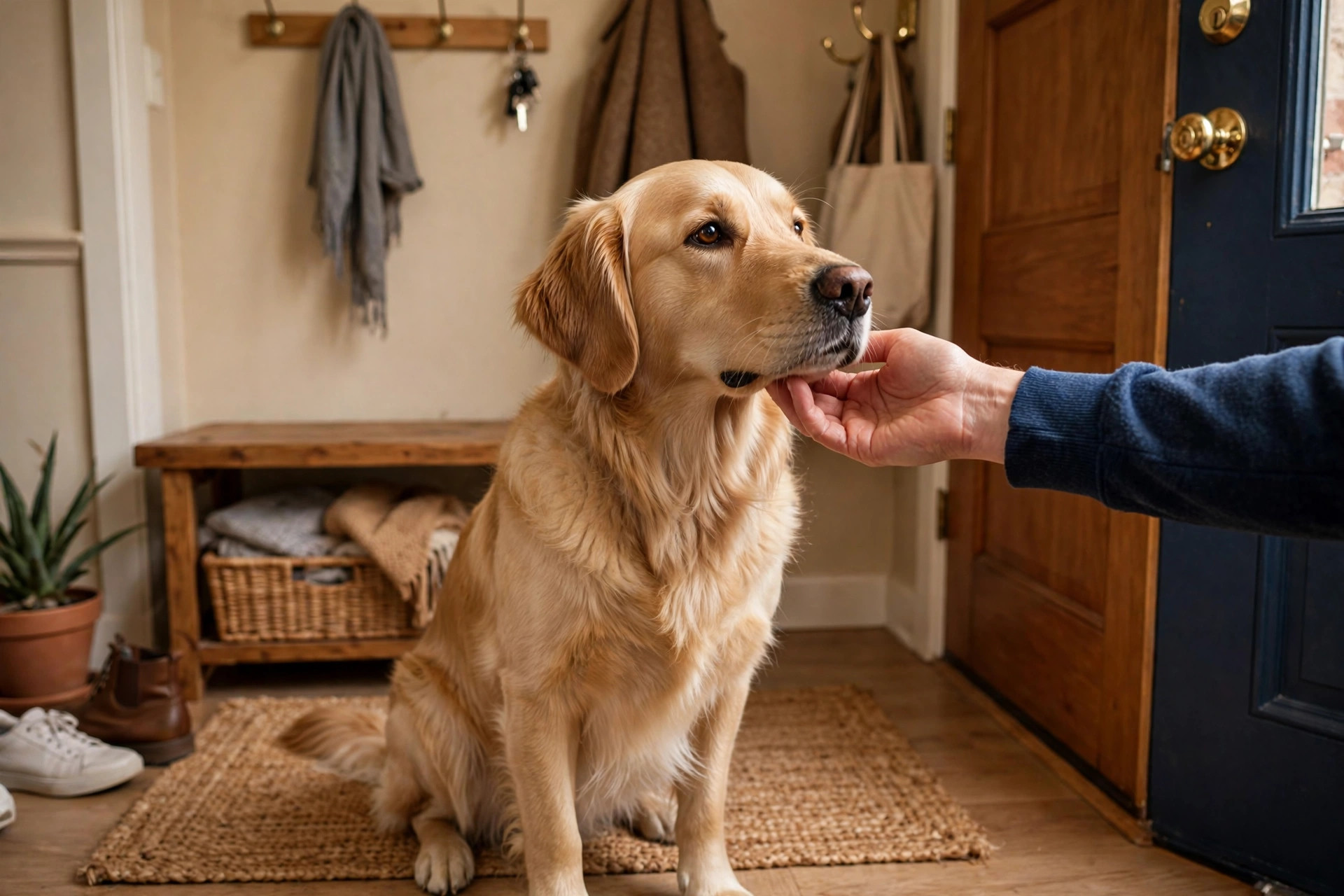
A jumping dog in a house knocks over a throw pillow. A jumping dog in an apartment launches at your guest in a four-foot hallway, claws the neighbor’s kid in the elevator lobby, and turns every doorway into a liability event. Jumping is a friendly behavior with unfriendly physics — and apartment physics are the worst kind, because there is no space for the dog to miss safely. The fix is not scolding the jump out. It is installing a greeting ritual so rehearsed that the dog defaults to it before the jump impulse even fires.
- Install one rule: all four paws on the floor earn greetings; jumping earns the immediate withdrawal of attention. Everyone follows it, every time.
- Give the dog a physical job at greetings — a mat settle a few feet from the door beats trying to suppress excitement by willpower.
- Brief every guest with a 20-second script before they arrive. Untrained guests are the number one reason greeting training fails.
- Set up the entryway so calm is the easy choice: leash station, treat jar by the door, mat in position.
- Expect real change in 3 weeks of consistent practice — faster for young dogs, slower if the jumping has been rehearsed for years.
Why jumping lands harder in apartments
Three apartment realities turn jumping from a nuisance into a problem worth a training plan. Proximity: greetings happen in hallways and entryways measured in feet, not yards — the dog is already within jumping range when the guest appears, with no approach distance to bleed off excitement. Strangers: apartment dogs meet far more non-dog people than house dogs — neighbors, delivery drivers, maintenance workers — many of them elderly, small, or afraid of dogs. A jump that your friend laughs off can genuinely injure a frail neighbor. Rehearsal volume: thin walls and shared hallways mean more greeting events per week, and every successful jump (the guest pets the dog, laughs, or even just reacts) reinforces the behavior. Apartment dogs often get more jumping practice than suburban dogs, not less.
The good news buried in that: the same density that causes the problem supplies the training reps. You will get more practice opportunities per week than a house owner — if you run the same protocol every time.
The core rule: four on the floor
Every greeting protocol in existence reduces to one contingency: paws on the floor make good things happen; paws on people make good things stop. The mechanics:
When the dog jumps, become instantly boring — turn sideways, fold your arms, look at the ceiling, step back if needed. No talking, no pushing (pushing is attention, and many dogs read it as play), no eye contact. The instant all four paws hit the floor, mark it (“yes!”) and deliver the greeting the dog wanted — petting, a treat, warm attention. The dog learns the actual economics within days: jumping switches the human off, landing switches the human on.
Two refinements make this work in real hallways. First, pre-empt rather than react: watch for the pre-jump signals — the crouch, the locked stare, the weight shifting forward — and cue an incompatible behavior (sit, or “go to mat”) before the launch. A dog that is sitting cannot be jumping; interception beats correction every time. Second, keep greetings short at first: thirty seconds of calm greeting, then you cheerfully move on. Long, exciting greetings are where impulse control fails — end them while the dog is still winning.
The 2-minute greeting drill (practice without guests)
Do not debut this protocol on real guests. Rehearse it with a helper first, in daily 2-minute sessions:
- Set the stage. Dog on leash (held loosely, not tight — a tight leash adds arousal), helper outside the door or at the hallway corner, treat pouch on you.
- Helper approaches. The moment the dog’s paws leave the floor, the helper freezes and turns away — becoming a statue. You say nothing.
- Four paws land. The instant all paws are down, helper turns back, approaches calmly, and delivers a treat low (treats delivered at nose height or below keep the head down; treats tossed upward invite jumping).
- Repeat 5–8 times. Then the helper “leaves” and re-approaches — arrivals are the trigger, so practice arrivals.
Progress the difficulty across days: calm helper → excited helper voice → helper with a bag → two helpers → helper who kneels (the ultimate temptation). Each level gets 2–3 clean sessions before advancing. If the dog fails a level twice, drop back one — training is not linear, and the dog is always right about what it can handle today.
| Common mistake | Why it backfires | Do this instead |
|---|---|---|
| Pushing the dog down | Physical contact is attention; many dogs read it as wrestling | Turn away; reward the landing |
| Yelling “no!” / “off!” | Loud aroused voice adds excitement through thin walls | Silent withdrawal, then mark the calm |
| Kneeing the chest | Risks injury; teaches the dog to jump from farther away | Step back out of range; no contact |
| Only training with family | Dog learns the rule applies to 2 people, not to guests | Rehearse with varied helpers weekly |
| Long exciting greetings | Impulse control fails with duration | 30-second greetings; end while winning |
Give the dog a job: the greeting station
Impulse control is a finite resource; a management setup that removes the decision beats willpower. Place a mat or bed 6–10 feet from the front door — far enough that the dog is not in the blast zone, close enough to feel included. Train a solid settle there (see how to teach a dog to settle on a mat), then chain it to arrivals: knock → “go to mat” → jackpot treats rain on the mat → guest enters → guest tosses a treat to the mat → dog released for a calm greeting only when settled.
The leash helps during the learning phase: keep a lightweight house leash (a short 2-foot tab, typically $8–$12) on the dog during high-traffic hours so you can calmly guide to the mat without grabbing the collar — collar grabs during arousal can trigger opposition reflex and even snapping in sensitive dogs. The tab comes off once the station habit is solid, usually around week 3.
The guest script (20 seconds that saves the training)
Guests undo greeting training more than dogs do. A visitor who squeals “ohhh puppy!” and crouches with open arms has just paid the jump a jackpot — one rep can cost you a week. Send this text before anyone visits:
“Quick favor — we’re training calm greetings. When you come in, please ignore the dog completely for the first minute (no eye contact, no petting, no talking to him). I’ll have him on his mat. Once he’s calm, I’ll tell you when to say hi — and please pet him low, under the chin, not over the head. He learns fast when everyone does the same thing!”
Keep a treat jar by the door ($5 for the jar, priceless for the training) so guests can participate correctly: toss treats to the mat, never hand-feed at face height during the learning phase. For the chronic offender — the friend who “doesn’t mind jumping” — be direct: “I know you don’t mind, but the neighbor’s kid was knocked over last month, so we’re strict about it now.” A concrete reason ends the debate.
Entryway setup: make calm the easy choice
Arrange the physical space so the right behavior is the path of least resistance:
- Mat in position, always. The greeting station lives in its spot permanently during training months — not fetched out when the doorbell rings.
- Leash station by the door. A hook with the house tab leash and treat pouch, so you are never fumbling while the dog rehearses jumping.
- Treat jar at guest height. Visible, labeled if needed (“dog treats — toss to mat!”).
- Baby gate option. For the first two weeks with highly aroused dogs, a gate across the entryway ($40–$80, pressure-mounted) lets guests enter while the dog practices calm behind a barrier — management while the skill builds.
- Your own arrivals count. You are the most frequent guest. Run the same protocol when you come home — ignore the jumping, reward the landing — or the dog learns the rule has an exception shaped exactly like you. See separation anxiety training if your departures and arrivals are high-drama in general.
The 3-week timeline
Week 1: family-only reps, helper drills daily, mat station installed. Jumping at real guests still happens — manage it with the gate and the boring-statue response, do not expect training to hold yet. Week 2: helper difficulty rises (excited voices, bags, kneeling), first briefed real guests. You will see the dog start to offer sits unprompted at arrivals — jackpot those moments hard. Week 3: real guests with the full ritual, mat station carrying most of the load, house tab coming off for calm dogs. Most dogs are dramatically better by day 21; dogs with years of rehearsed jumping may need 6–8 weeks, which is still fast for undoing a long-practiced habit.
If progress stalls completely by week 3 — the dog cannot contain itself despite correct practice — consider whether arousal is the real issue rather than manners. Dogs that cannot settle anywhere, not just at greetings, may need more daily exercise and mental work first; a tired dog learns impulse control far faster. And if jumping pairs with mouthing, nipping, or an inability to disengage, a certified trainer (CPDT-KA) can assess whether frustration or anxiety is driving it.
FAQ
Should I use a prong or e-collar to stop jumping?
No. Aversive tools suppress the jump through pain or fear without teaching the alternative, and they carry fallout — increased anxiety, redirected aggression, and a dog that jumps when the collar is off. The four-on-the-floor protocol teaches the actual skill and works without side effects.
My puppy jumps on my kids constantly. Is the protocol different?
The mechanics are the same, but management matters more: never leave a jumpy puppy unsupervised with small children, and teach kids the statue game (fold arms, look up, be boring). Kids are the hardest “helpers” because they squeal — which the puppy reads as play — so adult-supervised practice sessions are essential.
What if guests won’t follow the script?
Use management instead of persuasion: gate the dog during that visitor’s stay, or put the dog in another room with a stuffed Kong. You do not need every human trained — you need the dog’s overall reinforcement history to favor calm. A few unmanaged greetings will not ruin the protocol if the other 95% are correct.
Is it too late for my 6-year-old dog who’s always jumped?
Not at all — it just takes longer, because you are replacing thousands of reinforced reps. Expect 6–8 weeks instead of 3, lean heavily on the mat station (management carries more weight for chronic jumpers), and celebrate the incremental wins: a jump cut short halfway is progress.