Safe Holiday Candles & Decorations With Pets
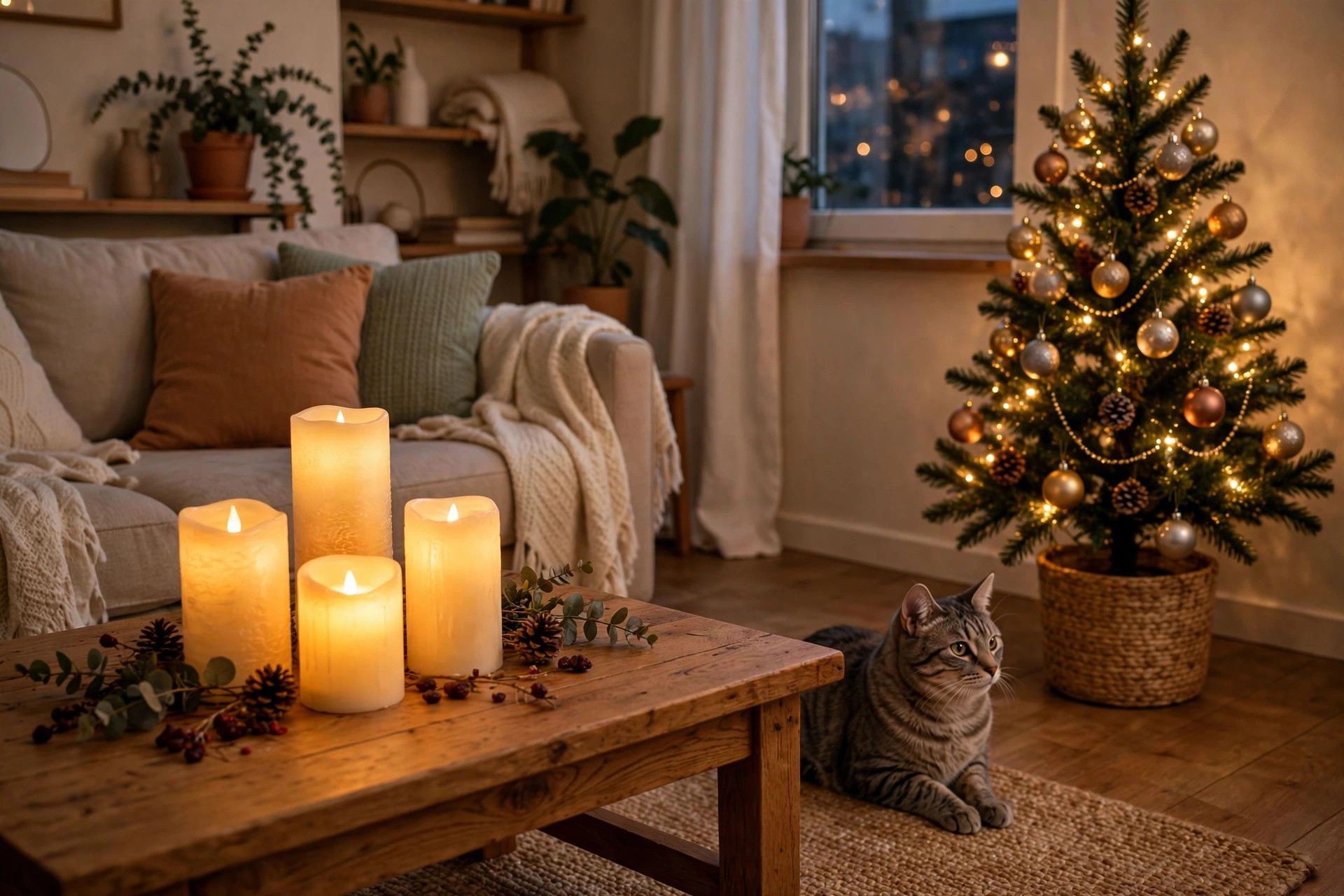
December in a 650-square-foot apartment is a different game from December in a house. The tree stands three feet from the couch, the candles sit on the coffee table at tail height, and the cat has a front-row seat to every shiny thing that dangles. Standard holiday advice — “just put it higher” — falls apart when there is no higher. The good news: nearly every holiday hazard has a pet-safe swap that looks just as good, and the leftovers can be handled with a single 20-minute sweep before the first guest arrives.
- Switch every open flame to a flameless LED candle. In a small apartment, a wagging tail or a jumping cat can reach any flame you can reach.
- Skip tinsel entirely. It is the single most common holiday foreign-body surgery in cats, and it looks identical to a toy.
- True lilies are deadly to cats — not “upsetting,” deadly. Keep them out of the apartment completely, including gifted bouquets.
- LED string lights run cool and use low voltage; secure the cords with renter-friendly hooks so they cannot be chewed.
- Do the 20-minute sweep once: cords covered, ornaments above pet-swipe height, plants swapped, candles flameless. Then enjoy the season.
Why small apartments multiply holiday hazards
Holiday safety guides are written for houses, where the tree gets its own room and the candles live on a mantel the dog never visits. Apartment life erases those buffers. In a one-bedroom, the average dog tail sweeps a radius of about two feet at exactly coffee-table height, and a cat can reach any shelf it can jump to — which, in a 500-square-foot studio, is every shelf. There is no “pet-free zone” when the whole home is one zone.
Small space also concentrates the risks that are merely annoying in a house. Scented plug-ins and reed diffusers fill a studio with fragrance at triple the intended concentration, because the product was designed for a 400-square-foot room and your whole apartment is 450. A knocked-over candle in a house lands on a hardwood floor; in an apartment it lands on the rug, next to the couch, under the curtains. The fixes below are chosen for exactly this reality: swaps that work when there is nowhere to hide the hazard.
Flameless candles that don’t look cheap
The single highest-value swap is replacing every open flame. Real candles combine three apartment hazards at once: an open flame at tail height, hot wax a curious nose can touch, and fragrance that concentrates in small rooms. Flameless LED candles remove all three and have quietly become good — the flicker technology in the better ones fools most guests at dinner-table distance.
What to buy depends on where the candle lives. Luminara pillars (typically $25–$45 each) use a patented flicker plus a real wax shell, and they read as genuine candles in photos and across a room; one or two as a centerpiece carry the whole table. Homemory LED tea light sets (usually $10–$15 for a pack of 12–24) are the workhorses for windowsills, bathroom counters, and the entryway console — buy the warm-white 2700K versions, not the harsh cool-white ones. Vinkor and similar mid-range brands ($15–$25 for sets of 3–9 pillars) sit between the two: decent flicker, built-in timers, remote included.
Three specs matter more than brand. First, a built-in timer (4, 6, or 8 hours) so candles turn themselves off — you will forget, and a candle glowing all night teaches the cat it is furniture. Second, warm color temperature around 2700K; cool-white LEDs scream “fake” and ruin the mood you bought them for. Third, batteries you can actually replace: rechargeable tea lights sound green until you realize you own 24 of them and no charger big enough. Standard CR2032 or AA models win on practicality.
One honest caveat: a determined chewer can still crack open an LED tea light and reach the button battery inside. Button batteries are a genuine emergency if swallowed. The flameless swap removes the fire risk, not the supervision rule — keep small LED candles out of reach of puppies and heavy chewers, same as you would any small object.
| Option | Fire risk | Pet-chew risk | Typical cost |
|---|---|---|---|
| Real wax candle | High — open flame at tail height | Burns, hot wax | $5–$20 each |
| Flameless LED (wax shell) | None | Button battery if cracked open | $15–$45 each |
| LED tea light sets | None | Button battery if chewed | $10–$15 per dozen |
| Wax warmer (plug-in) | Low — no flame | Hot wax spill if tipped | $15–$30 |
String lights and cords in a rental
String lights are one of the safer decorations by default — modern LED strands run cool to the touch and use low voltage — but the cords are the problem. A light strand draped along the baseboard is a chew toy that plugs into the wall, and kittens especially go through a phase of tasting every cable in the home.
Run strands up, not along: windows, door frames, and the top of bookshelves, using 3M Command light clips ($5–$8 for a pack) that peel off without damaging paint. Keep the transformer plug and any extension connections behind furniture or inside a cord box, and never run a strand across the floor between two points — that is a trip wire for humans and a chew invitation for puppies. Battery-operated fairy lights (usually $8–$12 for a 33-foot copper-wire strand) eliminate the wall plug entirely for small accents like jars and wreaths; the thin copper wire is less tempting to chew than a thick rubber cord, though it is not chew-proof.
Put the whole display on a timer plug ($10–$15). Lights that turn off at midnight remove the overnight temptation for the cat to bat at glowing strands while you sleep, and they cut the electricity worry that makes renters hesitate. Our full breakdown of fragrances, diffusers, and air quality lives in the candle and essential oil safety guide, which pairs well with this one.
Ornaments, tinsel, and the tree in 600 square feet
The tree is the centerpiece and the biggest single hazard, so it deserves a deliberate setup. If you are buying a tree for a small apartment, a 4–5 foot slim-profile artificial tree fits a corner without eating the room, and it drops no needles for the dog to eat. Real trees are fine too, but the fallen needles irritate paws and stomachs, and the stand water often contains preservatives or fertilizer — cover the stand with a tree skirt tucked tight, or use a covered stand, so nobody drinks from it.
Ornament rules for pet homes are simple and non-negotiable. No tinsel, no angel hair, no curly ribbon. Linear foreign bodies — long thin strands that anchor in the stomach while the intestine keeps moving — are a classic holiday emergency surgery in cats, and tinsel is the textbook cause. Use shatterproof ornaments (plastic or wood, $15–$30 for a set of 24–30) on the lower three feet of the tree, and save any glass heirlooms for the top where a swatting paw cannot reach. Hang ornaments with ribbon loops or ornament hooks crimped closed rather than open wire hooks, which can snag a curious mouth.
Anchor the tree itself. A cat launching into a 5-foot tree in a studio apartment will take it down, and a falling tree lands on whatever is nearby — often the TV stand or the radiator. A wide, heavy stand helps, but the reliable fix is a discreet anchor: fishing line from the top of the tree to two wall hooks (Command hooks hold fine for this) keeps it upright through the worst ambush. Our step-by-step anchoring method is in how to secure a Christmas tree with cats in a small apartment.
The plant and scent swaps
Holiday plants deserve a blunt ranking, because the internet is full of softened claims. True lilies (Easter, Tiger, Stargazer, Asiatic — anything in the Lilium genus) can cause fatal kidney failure in cats from pollen on fur alone. They do not belong in a cat apartment at all, including in gifted bouquets — check every arrangement that comes through the door. Poinsettias are the opposite story: mildly irritating at worst, causing drooling or an upset stomach if a lot is eaten, but not the killer their reputation suggests. Still, keep them on a high shelf. Mistletoe and holly berries sit in the middle: genuinely toxic enough to warrant a vet call if eaten, so hang mistletoe high and skip holly berries within reach.
For scent, small apartments punish heavy fragrance. Plug-in oil diffusers and reed diffusers concentrate scent in a studio and coat surfaces with oil residue that cats walk through and then groom off. The safer hierarchy: an unscented candle look (flameless, above) for visuals; a stovetop simmer pot (orange peel, cinnamon sticks, cloves in water) for scent while you are home and awake — never leave it unattended; and plain ventilation for everything else. If you love a specific holiday scent, a single cotton ball with one drop of pet-safe scent tucked inside a closed closet gives a hint when the door opens without fumigating the living space. Anything you would not want on your pet’s paws does not belong diffusing into their air.
Check every gifted bouquet at the door. Well-meaning relatives send lilies more often than you would think, and a cat only needs to brush against the pollen and groom it off. A two-second scan of the stems before the flowers come inside is the cheapest life insurance in this entire guide.
The 20-minute pet-proof sweep
Do this once, the day decorations go up, and the season mostly takes care of itself:
- Cords (5 min). Walk every strand from plug to end. Lift cords off baseboards onto hooks, box the transformers, unplug anything crossing open floor.
- Tree zone (5 min). Skirt tucked over the stand water, shatterproof ornaments on the lower branches, anchor line to the wall, no tinsel anywhere in the home.
- Surfaces (5 min). Every real candle becomes flameless or leaves the room. Small LED candles move above chew height. Scented plug-ins come out of the outlets.
- Plants and food (5 min). Lilies out, poinsettias up high, chocolate and xylitol-containing treats into latched cabinets. Gift wrap ribbon goes straight into a closed bin — it is tinsel’s less-famous cousin.
Then the maintenance rule for the rest of the season: when you leave the apartment, the tree lights go off (timer plug handles this) and any decoration the pet has shown interest in gets moved or removed that day, not “eventually.” Pets escalate with success — the ornament batted twice becomes the ornament eaten on the third try. For the full year-round holiday hazard list, see our holiday hazards checklist.
FAQ
Are flameless candles really safe if my dog chews one?
Safer than a real candle, not perfectly safe. The fire and burn risk is gone, but small LED tea lights contain button batteries, which are an emergency if swallowed. Keep flameless candles out of reach of heavy chewers and puppies, and check tea lights periodically for tooth marks.
Is Christmas tree water actually dangerous for pets?
It can be. Stand water often contains preservatives, fertilizer, or aspirin added to keep the tree fresh, plus stagnant bacteria after a few days. Cover the stand so pets cannot drink from it, or use a covered stand. Plain water in a clean stand is low risk, but covered is still better.
Are poinsettias really deadly to cats?
No — this is one of the most overstated holiday claims. Poinsettias cause mild irritation: drooling, maybe vomiting if a large amount is eaten. They are not in the same universe as lilies, which can be fatal. Still, keep poinsettias out of easy reach rather than at floor level.
What about scented pine cones and potpourri?
Both are risky in pet homes. Scented pine cones are coated in fragrance oils that irritate airways and stomachs, and potpourri — especially liquid potpourri — can cause chemical burns in a cat’s mouth. Use unscented natural pine cones for the look, and skip the potpourri bowl entirely.