How to Introduce Leash Walking to Indoor Cats
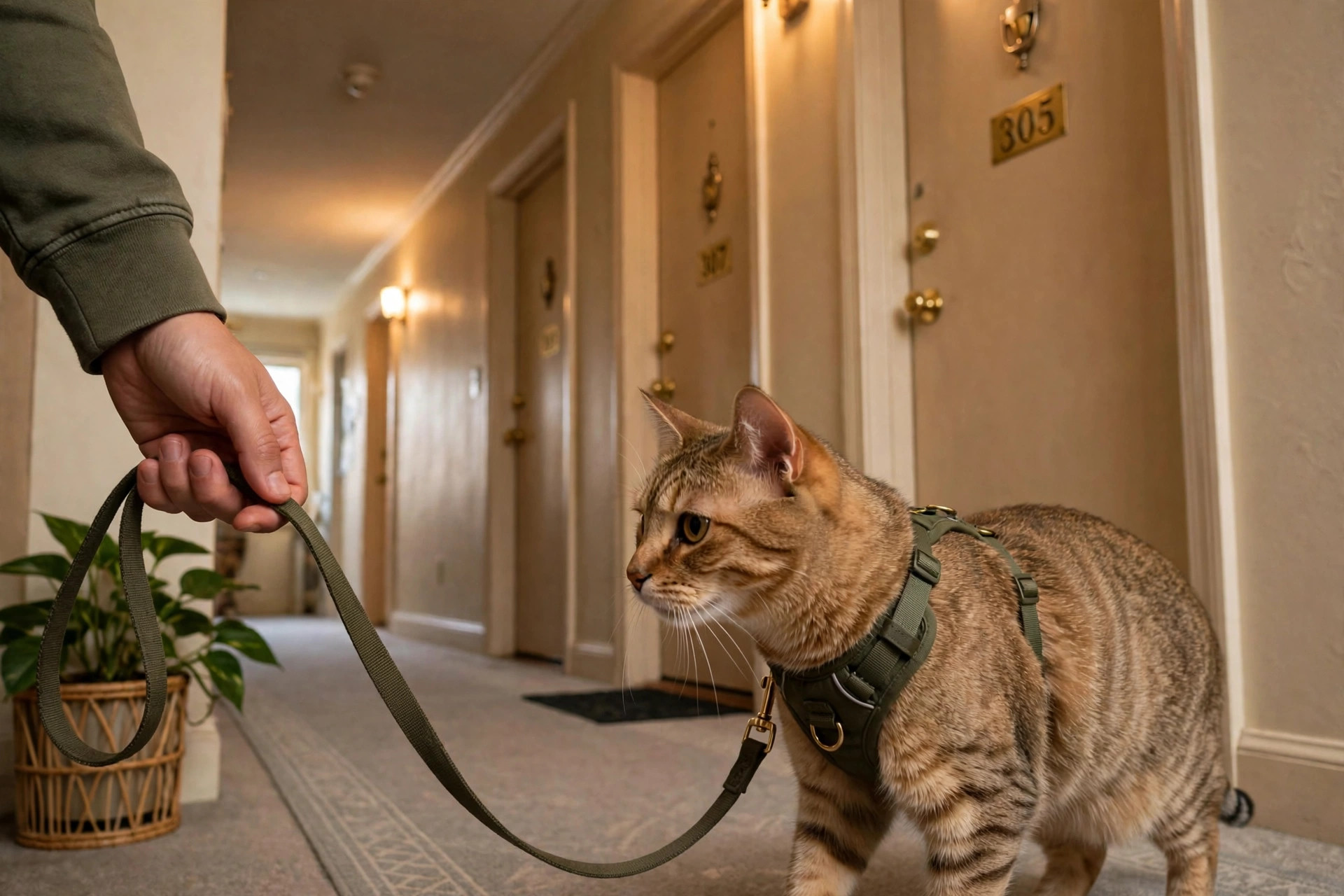
Leash walking a cat is nothing like walking a dog — and that is exactly why most attempts fail in the first ten minutes. There is no heeling, no route, no destination. A leash walk for a cat is supervised outdoor sniffing at the cat’s pace, in the cat’s chosen direction, with you as the safety anchor. Done right, it is the richest enrichment an apartment cat can get. Done wrong — harness slapped on, cat dumped on the sidewalk — it is a panic event that sets training back weeks. This guide starts where apartment life starts: inside, with the harness, on the cat’s terms.
- Buy an H-style or vest harness that fits snugly — you should barely fit one finger under the straps. Most “escapes” are fitting failures.
- Plan 3 weeks indoors before the first real outing: harness desensitization, then leash-dragging, then hallway sessions.
- Let the cat choose the direction. You manage safety (dogs, traffic, other cats); the cat manages the itinerary.
- Apartment buildings add specific challenges: elevators, stairwells, off-leash hallway dogs, and lobby doors. Rehearse each one.
- Some cats never enjoy it, and that is a valid outcome — a stressed cat gets nothing from forced walks.
Harness first: fit is everything
A collar is not a leash-walking tool for cats — feline necks and heads make collars escapable by design. You need a harness, and the fit matters more than the brand. The test: with the harness on, you should be able to slide one finger snugly under every strap, but not two. If you can fit two fingers, a startled cat can back out of it — the classic “my cat escaped the harness” story is almost always a loose harness story.
Two styles dominate for good reason. H-style harnesses (like the Rabbitgoo Cat Harness, typically $12–$17) use two loops — neck and chest — connected by a back strap, with a leash clip between the shoulders. They are light, adjustable, and the default recommendation for beginners. Vest harnesses (like Travel Cat’s “The True Adventurer”, typically $35–$40) wrap more of the torso in breathable mesh, distribute pressure, and are harder to wriggle out of — worth the premium for escape artists and larger cats. Measure the cat’s chest behind the front legs and neck before ordering; sizes run small across most brands, and between sizes, size down for security.
Pair the harness with a lightweight, non-retractable leash (4–6 feet, typically $8–$15). Retractable leashes are wrong for cats: the constant tension teaches pulling, the thin cord can injure, and the locking mechanism fails at exactly the wrong moment. A simple nylon or biothane leash with a small clip is all you need.
Week 1: the harness becomes furniture
The goal of week one is not walking — it is making the harness boring. Leave the harness near the cat’s food for a day so it absorbs familiar smells. Then drape it over the cat for a few seconds, treat, remove. Next session: one loop on, treat, remove. Build to the full harness worn for 30 seconds, then a minute, then five minutes — always paired with treats, play, or meals, and always removed before the cat gets annoyed.
Expect the harness freeze: many cats go statue-still or walk like the floor is lava the first few times. This is normal, not a sign of suffering — the cat is processing a novel sensation. Do not comfort excessively (which can signal that something is indeed wrong); just let the cat unfreeze on its own, treat the first normal steps generously, and keep sessions to 5–10 minutes. Most cats move normally in the harness within 3–5 sessions. If the cat is still frozen or distressed after a full week of gradual work, pause and try a different harness style — some cats object to vest pressure but accept H-styles, or vice versa.
Week 2: leash pressure and indoor “walks”
Clip the leash on indoors and let it drag (supervised — never leave a leashed cat unattended, even inside). The cat needs to learn that leash tension is information, not restraint. When the cat hits the end of the leash, do not pull back; instead, follow the cat for a few steps, then lure it back toward you with a treat so the tension releases. The lesson you are installing: tension eases when the cat moves with you, not against you.
Practice the two handling skills you will need outside. The scoop: if the cat panics, you will need to pick it up smoothly while controlling the leash — rehearse scooping with one hand under the chest while the other gathers leash, so it is muscle memory before you need it. The anchor: stepping on the leash (with flat shoes, gently) as an emergency stop if the cat bolts toward danger — practice the foot placement indoors where the stakes are zero. Our cat harness and leash guide covers gear details if you are still choosing.
| Week | Where | Goal | Success looks like |
|---|---|---|---|
| 1 | Living room | Harness acceptance | Cat moves, plays, eats normally in harness |
| 2 | Whole apartment | Leash pressure | Cat yields to gentle tension; you can steer loosely |
| 3 | Hallway, stairwell | Novel environments | Cat explores calmly, recovers from startles |
| 4+ | Outside | Real walks | Cat sniffs and strolls; you handle surprises |
Week 3: the hallway as training ground
Apartment buildings offer a perfect intermediate step that house owners lack: the hallway. It is outdoors-ish — new smells, new sounds, different flooring — but enclosed, dog-manageable, and ten seconds from your front door if the cat melts down.
Start with the doorway session: harness on, leash on, open your front door, and let the cat decide whether to step into the hallway. Do not carry the cat out — a cat that chooses to exit is a cat that feels in control, and control is the antidote to panic. First sessions may last 90 seconds and cover six feet. That is a complete success. Gradually extend along the hallway, then try the stairwell (fewer surprise dogs than the elevator), always letting the cat set the pace and direction.
Rehearse the building’s specific hazards before they surprise you outside. Elevators: the doors, the movement, the confined space with strangers — ride one floor with the cat scooped in your arms first, not on the leash. Hallway dogs: have a plan — scoop the cat and turn sideways, putting your body between the animals. Most hallway dog encounters are brief if you keep moving. Lobby doors: the transition from building to street is the highest-arousal moment; pause in the lobby, let the cat sniff, and exit only when the cat is calm, not mid-startle.
The first outdoor walks: reading the cat
Choose the first outings like a scientist: quiet times (early morning beats Saturday afternoon), familiar territory (the building’s side yard before the park), and short durations (10–15 minutes, ending while the cat still wants more). Bring treats. The cat will mostly sniff, freeze at sounds, sniff more, and possibly walk ten feet in five minutes. This is correct. A “walk” where the cat covers 50 feet and investigates twelve smells is a triumph.
Learn the body language that says keep going (tail up or neutral, slow blinks, rubbing on objects, playful crouches) versus go home now (crouched low with dilated pupils, tail tucked, trying to bolt toward the building, panting — cats rarely pant, so panting means serious stress). Honor the “go home” signals immediately and cheerfully; a cat that learns outings end when it asks will ask later and trust more. Never drag a cat forward by the leash — if the cat plants itself, you wait or you carry.
Over weeks, most willing cats develop a routine: a favorite bush, a preferred patrol loop, a sunning spot. Let the routine form — predictability is what converts a tolerable outing into an enriching one. Pair walks with the broader indoor cat enrichment schedule rather than treating them as the sole enrichment source; walks are the dessert, not the meal.
You are not walking the cat. The cat is walking you — to the interesting smells, at the interesting speed, with frequent stops to contemplate a leaf. Your job is safety navigation: watching for dogs, keeping the leash clear of obstacles, and knowing when the adventure is over. Surrender the itinerary and the walks get good.
Non-negotiable safety rules
- Vaccines and parasites first. An outdoor-walking cat needs current vaccinations (including rabies, per local law) and year-round flea/tick prevention — talk to your vet before the first outing.
- ID always. Breakaway collar with tag plus microchip, every outing. Harnesses can fail; backup ID is what brings cats home.
- Check the harness every time. Straps loosen, cats lose weight. The one-finger test takes five seconds.
- Avoid off-leash dog areas entirely. Even “friendly” off-leash dogs are a lethal risk to a harnessed cat that cannot flee properly.
- Watch the ground. City sidewalks hold antifreeze drips, rat poison, broken glass, and discarded food. Steer around anything suspicious — and see our what to do if your pet eats something on a walk guide for the emergency protocol.
- Heat and cold count. Pavement that is too hot for your hand is too hot for paws; in winter, wipe paws after walks where melt was used.
FAQ
What age should I start leash training a cat?
Kittens (8–16 weeks) accept harnesses fastest, but adult cats of any age can learn — it just takes more patience. Senior cats can enjoy gentle outings too, though keep them short and close to home. The 3-week indoor timeline in this guide assumes an adult cat; kittens often compress it to 10 days.
My cat just flops over and won’t move in the harness. Now what?
The flop is normal and temporary for most cats. Shorten sessions to 2–3 minutes, pair the harness with meals and play, and wait for the cat to move on its own before treating — do not drag or coax excessively. If the flop persists past 10 days, try the other harness style; the pressure distribution may be the issue.
Can I walk my cat in the hallway if dogs live in the building?
Yes, with management: walk at off-peak hours, keep the cat close and the leash short near corners, and scoop the cat if a dog appears. Most hallway encounters are brief. If your building has many large off-leash-tolerant dogs, the stairwell at quiet hours may be calmer than the main hallway.
How do I know if my cat actually enjoys walks?
Willing cats show it clearly: they go to the door when they see the harness, walk with tail up, explore confidently, and recover quickly from startles. Cats that hide when the harness appears, freeze for entire outings, or pant are voting no — respect the vote and invest in indoor enrichment instead.