Best Travel Water Bottles for City Dog Walks
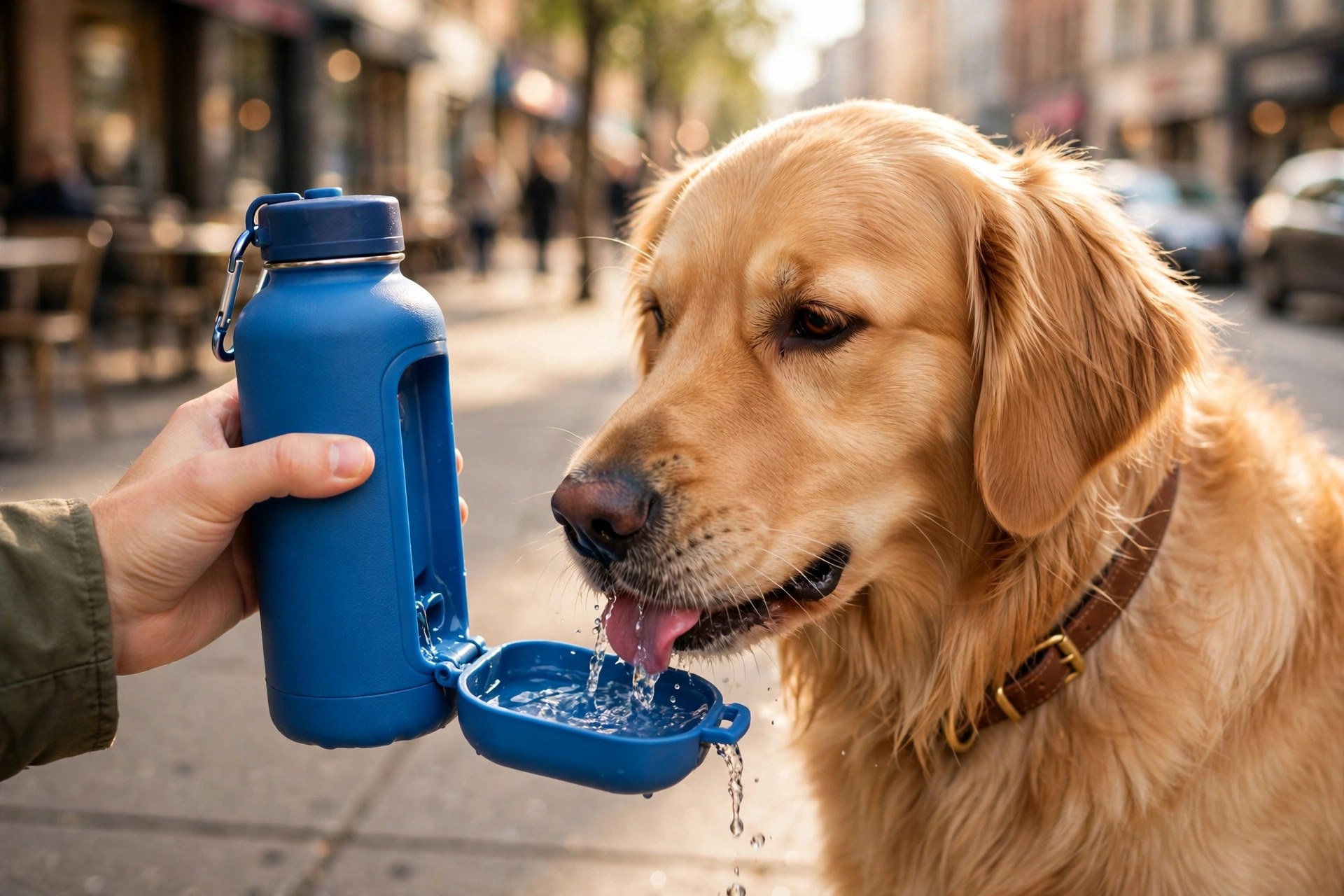
A summer city walk is a hydration math problem you solve with your feet: hot pavement radiating heat back up, a dog panting with the leash wrapped around one wrist and your phone in the other hand, and the nearest clean water fountain three blocks away — with a suspicious puddle much closer. A travel water bottle built for dogs solves this with a squeeze or a flip of a latch, filling a small trough your dog can actually lap from. The right one disappears into your walk bag and works with one thumb. The wrong one leaks, dribbles, or demands two hands you do not have.
- Best for most city walks: Lesotc Pet Water Bottle (19 oz). Flip-down bowl, one-button water release, genuinely leakproof, usually $9–$13.
- Best for big dogs and long walks: MalsiPree Dog Water Bottle (750 ml / 25 oz). Wider bowl fits broad muzzles, holds a real drink, usually $13–$17.
- Best insulated: Tuff Pupper H2O4K9 K9 Water Bottle (25 oz). Stainless steel keeps water cool through a long afternoon walk, usually $28–$40.
- Best bowl-style: Asobu Dog Bowl Bottle. Detachable bowl doubles as a travel dish for water or food, usually $24–$30.
- Best budget: Dexas Popware for Pets Travel Cup. Simple bottle-and-bowl combo, dishwasher safe, usually $8–$12.
- If you only remember one rule: 19 oz covers most dogs for a 30–60 minute walk. Size up for dogs over 60 lbs or walks over an hour.
Five bottles worth your bag space
Every bottle below is a widely sold, well-reviewed model — the kind with tens of thousands of owner reviews, not a dropship curiosity. Prices move with sales, so treat the ranges as typical street prices, not promises.
| Bottle | Best for | Usually | City-walk note |
|---|---|---|---|
| Lesotc Pet Water Bottle (19 oz) | Most dogs, everyday walks | $9–$13 | True one-hand operation; the benchmark design everyone else copies |
| MalsiPree (750 ml) | Large breeds, long walks | $13–$17 | Bigger trough for wide muzzles; food-grade materials |
| Tuff Pupper H2O4K9 (25 oz) | Hot climates, chew-prone dogs | $28–$40 | Insulated stainless; heaviest of the bunch but nearly indestructible |
| Asobu Dog Bowl Bottle | Travel, day trips | $24–$30 | Bowl detaches for the park; insulated body keeps water cool |
| Dexas Popware Travel Cup | Tight budgets, backup bottle | $8–$12 | Simple and cheap; great second bottle for a walk bag |
Lesotc Pet Water Bottle (19 oz) — the everyday pick
This is the bottle that defined the category, and it remains the default recommendation for a reason. Press the release button and water fills the flip-down trough; release the button and the flow stops. Untouched water drains back into the bottle when you tilt it upright, so you are not pouring half your supply onto the sidewalk. The seal is genuinely leakproof — it can rattle around in a tote bag next to your phone without consequences — and at roughly 9 oz empty it does not weigh down a small crossbody walk bag. The 19 oz capacity is the sweet spot: enough for a medium dog on a 45-minute walk with water to spare. The 12 oz version exists for toy breeds, and a 34 oz version for giant breeds, but most city walkers should start with the 19.
MalsiPree Dog Water Bottle (750 ml) — the big-dog pick
MalsiPree’s design is similar in spirit to the Lesotc but scaled up in the ways that matter for bigger dogs: a deeper, wider trough that a boxer or lab can actually get its muzzle into, and 750 ml (about 25 oz) of capacity for walks that stretch past an hour or summer afternoons when a big dog drinks like a small horse. It is made from food-grade materials and the whole thing comes apart for cleaning, which matters more than it sounds — narrow-neck bottles grow biofilm fast. The tradeoff is size: it is noticeably bulkier, so it rides better in a tote or backpack than in a jacket pocket.
Tuff Pupper H2O4K9 K9 Water Bottle (25 oz) — the insulated pick
If your walks happen in real heat, room-temperature water from a plastic bottle starts tasting like a warm gym bag by the second stop. The H2O4K9 is a double-wall stainless bottle with a screw-on lid that converts into a drinking bowl, and it keeps water cool for hours — meaningfully cooler, not marketing cooler. Stainless also survives the two things that kill plastic bottles: a dog that chews the cap while you are distracted, and repeated dishwasher cycles. It is the heaviest option here (over a pound full), and the lid-bowl takes both hands to deploy, so it suits longer outings better than quick around-the-block trips.
Asobu Dog Bowl Bottle — the travel pick
Asobu’s bottle wears its bowl on the outside: a detachable bowl wraps the insulated body, so you unscrew it, pour, and your dog drinks from a proper bowl instead of a trough. That matters at the dog park or on a day trip, where a wide bowl lets a nervous dog drink comfortably instead of sipping from a narrow slot. The insulated body keeps water cool, and the bowl doubles as a food dish in a pinch — handy if you are out past dinner time. Downsides: it is the bulkiest of the group, and the external bowl can collect sidewalk grit if you clip it to the outside of a bag.
Dexas Popware for Pets Travel Cup — the budget pick
The Travel Cup is the simplest design here: a water bottle with an integrated cup you flip out and squeeze to fill. No valves, no buttons, nothing to jam. It will not win a feature comparison, but at under $12 it is the bottle you buy as a backup for the walk bag, the car, or the dog-walker’s tote. Everything is dishwasher safe and BPA-free. The honest caveat: the flip cup is shallower than the trough on the Lesotc, so enthusiastic drinkers splash more, and the seal is good but not quite as confidence-inspiring as the button-valve bottles.
What to skip
Two things consistently disappoint. Collapsible silicone bowls with a separate human water bottle sound clever until you are juggling three items with a leash in your hand — an integrated bottle-bowl you operate with one thumb wins every time on a real walk. And the novelty bottles with built-in waste-bag dispensers or treat compartments look efficient but make the bottle fat, hard to clean, and worse at its actual job. Buy a bottle that is excellent at being a bottle; put the bags in a proper walk-bag setup.
Capacity math: how much water a city walk actually needs
Guessing the size is how bottles end up either bone-dry halfway through a walk or so bulky they never leave the apartment. The math is simpler than it looks:
- The baseline. Dogs need roughly 1 oz of water per pound of body weight per day. A 40-lb dog needs about 40 oz across a full day, most of it at home.
- The walk premium. Exercise and heat roughly double the drinking rate for the walk’s duration. A 45-minute walk in 75°F weather costs a 40-lb dog about 6–10 oz — more if the route is mostly sun-baked concrete, which radiates heat back at belly height.
- The translation. 12 oz covers toy and small breeds on ordinary walks. 19 oz is the sweet spot for dogs from about 25 to 60 lbs on 30–60 minute walks. 25 oz or more is for dogs over 60 lbs, summer midday walks, or anything over an hour.
- The spillage tax. Dogs are not efficient drinkers. Expect 10–20% of what you pour to end up on the sidewalk, more for jowl-heavy breeds. Buy one size up from your exact math.
Rule of thumb: fill the bottle full every single walk, even short ones. A full bottle leaks less than a half-empty one sloshing around, the weight difference is negligible, and the day you skip is the day the walk runs long because your dog found a smell worth investigating for twenty minutes.
The features that actually matter on a city walk
Product pages compete on capacity and colors. On a real sidewalk, these five things decide whether the bottle gets used or abandoned:
- One-handed operation. Your other hand holds the leash, full stop. Button-release valves (press to fill, release to stop) and squeeze-to-fill troughs both work; twist-cap bowls that need two hands do not. Test this mentally before you buy: can you picture doing it while your dog lunges at a pigeon?
- A seal you trust in a bag. The bottle will live sideways in a tote with your phone, treats, and poop bags. Button-valve bottles with a locking latch are the safest bet. If a product’s reviews keep mentioning “leaks in my bag,” believe them — that failure mode never gets better with age.
- Trough size versus muzzle. A narrow trough is fine for a dachshund and a cruel joke for a mastiff. Broad-muzzled breeds need a wide, deep bowl or they will push the bottle around and drink nothing. This is the spec product pages hide; check owner photos, not the marketing renders.
- Cleaning reality. Narrow necks and multi-part valves grow a slimy biofilm within days of daily use. Favor bottles that fully disassemble and are dishwasher safe, and plan on a weekly deep clean. Stainless steel is the most forgiving material here — plastic holds onto odors once they set in.
- Weight and clip. A full 25 oz bottle weighs about 2 lbs — fine in a tote, annoying clipped to a belt loop. A carabiner or strap loop is genuinely useful for clipping to a backpack, but a heavy bottle swinging from your waist will irritate you within a week. Keep it light if it rides on your body.
Material deserves one more word: look for BPA-free, food-grade plastics (Tritan is the current standard) or stainless steel. Cheap unbranded bottles from marketplace sellers sometimes skip this, and a bottle your dog drinks from daily is not where you want to gamble on plastic quality.
The 30-second water-stop routine
Offering water mid-walk should be a pit stop, not a production. Here is the sequence once it becomes muscle memory:
- Pick your spots. Offer water at natural pauses — a shady bench, a quiet corner, the halfway point — rather than stopping mid-block where your dog is still in “go” mode. Most dogs drink better when they have stopped moving mentally, not just physically.
- Brace the leash. Step on the leash or loop it around your wrist so both … no, so your one free hand has the bottle and the dog has exactly enough slack to reach the trough. Dogs that get a full six feet of leash will wander off mid-sip.
- Fill, offer, wait. Fill the trough about two-thirds — a full trough sloshes when the dog’s nose hits it. Give the dog a full 20–30 seconds. Most dogs take two or three separate laps at the water with pauses between.
- Pour back the rest. Tilt the bottle upright so untouched water drains back in (on valve bottles) or pour it onto the tree pit, not the sidewalk where the next dog will find it. Do not pour it back if the water is visibly dirty.
- Lock and stow. Engage the lock latch before the bottle goes back in the bag. This is the step everyone skips, and it is the entire difference between a dry tote and a wet phone.
On hot days (above about 85°F), offer water every 15–20 minutes and watch for the real overheating signs: excessive drooling, bright red gums, or a dog that wants to lie down in the shade and not get up. Water helps, but shade and a shorter route help more — no bottle fixes a walk that should not be happening. If your evenings follow a regular pattern, fold the water stop into your calm evening routine so the dog learns that water, then home, then settle.
Four mistakes that waste water (and money)
2. Squeezing before the bowl is ready. On flip-trough bottles, make sure the trough is fully open before you press the button. Squeezing early shoots water over the closed lid and straight down your hand — everyone does this exactly once.
3. Leaving water in the bottle for days. A bottle refilled daily without ever being emptied and dried grows a biofilm that smells like a pond and can upset a sensitive stomach. Empty it after every walk, leave the cap off to air-dry overnight, and run it through the dishwasher weekly.
4. Letting the dog drink from street puddles instead. Puddle water in a city collects oil, de-icing residue, fertilizer runoff, and whatever the last hundred dogs left behind. A bottle you control is not fussiness — it is the difference between a normal walk and a vet visit for giardia.
FAQ
How much water should I bring for a 30-minute walk?
For a dog under 40 lbs, 12–19 oz is plenty — most of it will come home with you. For dogs over 40 lbs, bring 19–25 oz, especially in warm weather. The honest answer is that almost everyone overestimates what a short walk needs and underestimates a long hot one: 19 oz is the safe default, and it weighs almost nothing.
Can my dog just drink from public fountains or dog-park bowls?
Sometimes, but communal bowls are a known vector for kennel cough, giardia, and canine papilloma virus, and public fountains in many cities run intermittently or taste of chlorine. Your own bottle is the only water source you fully control, and it is always there when the fountain is broken — which, in our experience, is often.
How often should I clean the bottle?
Rinse and air-dry after every walk, and run every part through the dishwasher (or a hot soapy soak) once a week. If the trough or valve ever feels slimy, you have waited too long — that slime is a bacterial biofilm. Bottles that fully disassemble make this a two-minute job instead of a chore you avoid.
Do I need an insulated stainless bottle?
Not for ordinary walks. Insulation matters if you walk in real heat (85°F and up), leave the bottle in a hot car between outings, or want one bottle to last for years of dishwasher cycles. For a 30-minute evening walk in mild weather, a good plastic bottle keeps water perfectly fine and weighs half as much.