Best Morning Routine for Apartment Dog Owners
In an apartment, the morning walk starts before the front door: hallway, elevator, lobby, and only then the street. A routine that ignores those in-between minutes falls apart by Wednesday. What follows is a realistic first hour — first-out timing, a 20-minute walk formula that covers relief, exercise, and sniffing, feeding order that sets up a calm workday, and fixes for the 5 a.m. wake-up, the elevator standoff, and the weekend lie-in.
- Potty comes before everything — before coffee, before email. A dog who has waited eight hours should not wait nine while you shower.
- The reliable formula for most adult dogs: out within 15 minutes of waking, a 20–30 minute walk with sniff time, then breakfast.
- Feed after the walk, not before: motivated dogs walk better slightly hungry, and post-walk feeding settles into a nap.
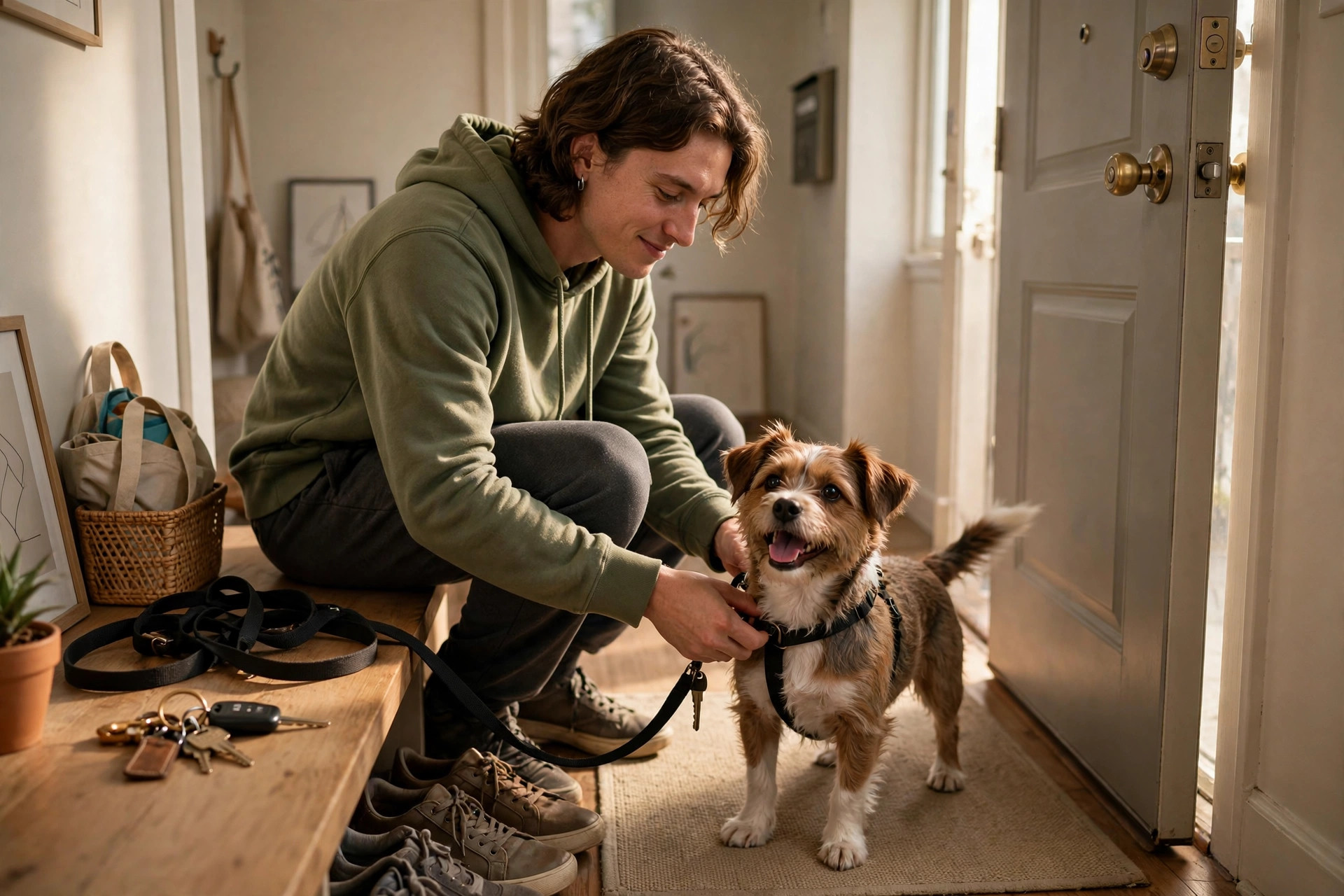
- Stage the night before: harness, leash, poop bags, and keys live by the door. Two saved minutes at 6:40 a.m. are worth ten.
- Weekend lie-ins work only if the dog gets a last late evening out — shift the whole schedule, never just the morning.
The first fifteen minutes decide the whole morning
Every apartment dog morning starts with the same constraint: between your dog's bladder and the street there is a hallway, possibly an elevator, and at least one locked door. In a house, a sleepy owner opens a door; in a high-rise, the first potty opportunity may be six minutes away even at a brisk pace. That gap is why the first rule of the routine is absolute: the dog goes out before anything else happens. No shower, no phone scroll, no just-checking-email. Dogs who are asked to hold it through a human morning routine learn to either have accidents by the door or rehearse frantic barking in the hallway — both are lease problems, not dog problems.
Build the sequence so it runs on autopilot. Alarm, clothes that are already laid out, harness on, out. The harness matters: a well-fitted front-clip harness like the Ruffwear Front Range (usually $40–$50) goes on in seconds, gives you steering on a crowded sidewalk, and does not press on the throat during the morning's first enthusiastic lunge at a pigeon. Keep it clipped to the leash by the door with bags already tied to the handle. The goal is a door-to-street time under three minutes inside your own home, so the elevator — the part you cannot control — gets the schedule's whole buffer.
The 20-minute walk formula: business, movement, sniffing
A good pre-work walk has three acts. Act one is business: head to the dog's preferred relief spot and give it a genuine minute. Rushing this produces the classic second accident twenty minutes later back upstairs. Act two is movement: ten to fifteen minutes of steady walking, which empties the rest of the bladder, wakes up joints stiff from eight hours of sleep, and burns the edge off morning energy. Act three is sniffing: five minutes where the dog chooses the lampposts. Sniffing is not wasted time — it is the mental half of the walk, and dogs who get it settle noticeably better during the workday.
Scale the formula to the dog, not the ideal. Senior dogs and small dogs with short legs may do the whole routine in 15 minutes; adolescents of high-energy breeds may need 40 plus a game of tug back home. Puppies under five months invert the formula entirely: potty, five minutes of gentle exploration, potty again, home for breakfast and a nap. What does not change at any age is the order — relief, exercise, decompression — and the finish: a calm entry, paws wiped, water offered, then breakfast.
Weather compresses but never cancels. In hard rain, shorten act two and add two minutes of indoor sniff work — a snuffle mat (usually $15–$30) or treats scattered in a muffin tin with tennis balls on top. In summer heat, move the walk earlier rather than shorter; pavement that is fine at 7 a.m. can be paw-burning by 9. Our guide to exercising your dog in hot weather has the five-second paw test.
Breakfast after the walk, and the 30-minute settle
Feeding after the walk solves three problems at once. A slightly hungry dog focuses better on you outdoors; a fed dog who then naps digests quietly instead of asking to go out again mid-morning; and for deep-chested breeds, avoiding vigorous exercise right after a meal is a sensible precaution against bloat. Serve breakfast as soon as you are back, in the dog's normal spot, then start your own morning. Most dogs follow breakfast with a drink, a contented sigh, and a nap that conveniently covers your shower and commute prep.
Use breakfast as training capital. Reserve a third of the ration for a food toy — a stuffed West Paw Toppl or a lick mat (both usually $8–$30) — given when you actually leave for work. The dog then experiences your departure as the moment the good frozen thing arrives, which is the foundation of calm alone time. For dogs who inhale food, a slow-feeder bowl like the Outward Hound Fun Feeder (usually $12–$20) stretches two minutes of gulping into eight of working, and those six quiet minutes often cover your entire exit routine.
Keep the whole pattern weekday-consistent for at least the first month with a new dog. Dogs are excellent statisticians: after twenty repetitions they know that shoes mean walk, walk means breakfast, and breakfast means nap, and they stop offering anxious improvisations at 6 a.m. Consistency is also what makes the weekend exception possible — a dog with a rock-solid weekday pattern can enjoy a later Saturday start without anxiety, as long as Friday night's last out shifts later by the same amount.
- 6:30 a.m. version (office day): up, out by 6:40, home 7:10, breakfast, your shower, leave 8:00 with a frozen food toy.
- Work-from-home version: same walk, then breakfast, then ignore the dog for the first work hour so home days and office days feel identical to the dog.
- Two-dog version: walk together if they match pace; if one is elderly, do a shared 15 minutes, drop the senior home, and finish the young dog's exercise solo.
Hallway, elevator, and lobby: the apartment-specific minutes
The morning walk includes three shared-space tests. Teach a default behavior for each. In the hallway: short leash, dog on your building-side, and a practiced sit at your door while you lock it — ten seconds that prevent the charge-around-the-corner greeting. In the elevator: dog in the back corner, sitting or standing between you and the wall, with a treat delivered for ignoring the opening doors. This is the position our elevator etiquette guide recommends for reactive dogs, and it works just as well as prevention for friendly ones. In the lobby: no greetings on a flexi-lead at 7 a.m. — half your neighbors are late, and a cheerful dog across their path is still an obstacle.
Timing is also etiquette. Building sound carries at 6 a.m. in a way it does not at noon, so keep hallway voices low, catch tags with a rubber tag silencer (usually $5–$8 for a pack), and if your dog is a known hallway commentator, take the stairs for the first flight or walk during the building's natural lull. A white-noise machine by your door (usually $30–$55) masks the lobby sounds that trigger pre-walk whining, so the morning stays quiet for the neighbors still asleep.
When the morning routine breaks: four fixes
If your dog wakes you at 5 a.m. daily, the last evening out is too early or dinner is. Shift the final walk to within an hour of your bedtime and move dinner 30 minutes later before you accept a 5 a.m. alarm as your life. If accidents happen between door and elevator, the dog is telling you the margin is zero: add a balcony grass patch or an indoor potty station as the emergency first stop (our high-rise potty guide compares the options), then continue outside for the real walk.
If the walk itself is chaos — pulling, lunging at runners, refusing to move — the morning is the wrong classroom. Feed a small part of breakfast as training treats and rehearse loose-leash skills on the quietest block at the quietest hour, then let the morning walk be maintenance, not training. The leash-training guide's stop-and-reset drill fits into act two without adding time.
Finally, protect the routine from your own schedule drift. Dogs read patterns, not clocks; a routine that slides ninety minutes across the week feels random to them. Anchor the walk to an event — right after your alarm — rather than a time, and keep the sequence identical even when the hour moves. Two weeks of an unbroken pattern will do more for your mornings than any piece of gear you can buy.
FAQ
How soon after waking should my dog go out?
Within 10–15 minutes for most adult dogs, and immediately for puppies, seniors, and any dog who had a short evening. The hallway and elevator add minutes a house dog never faces, so start moving at once.
Should I feed my dog before or after the morning walk?
After, for most dogs. A slightly hungry dog walks with better focus, breakfast then settles into a nap, and avoiding hard exercise on a full stomach is safer for large, deep-chested breeds.
How long should the morning walk be before work?
Twenty to thirty minutes covers most adult dogs: relief, ten-plus minutes of movement, and five minutes of sniffing. High-energy adolescents may need 40; seniors often need less distance but the same unhurried sniff time.
Can I skip the morning walk if we do a big evening walk?
No — the morning outing is first a bladder break after eight hours, and only second an exercise session. Evening loading helps energy, but it cannot replace the morning relief trip.
My dog refuses to walk in the morning. What is going on?
Check pain first (stiff joints are worst in the morning), then fear — garbage trucks and school-run noise peak early. Shorten to a relief trip plus indoor play for a week and rebuild distance gradually; if it persists, see your vet.